Insecure Direct Object References IDOR: How to Stop Data Leaks
Insecure direct object references expose data because servers trust client inputs without verifying ownership, turning public IDs into private keys.

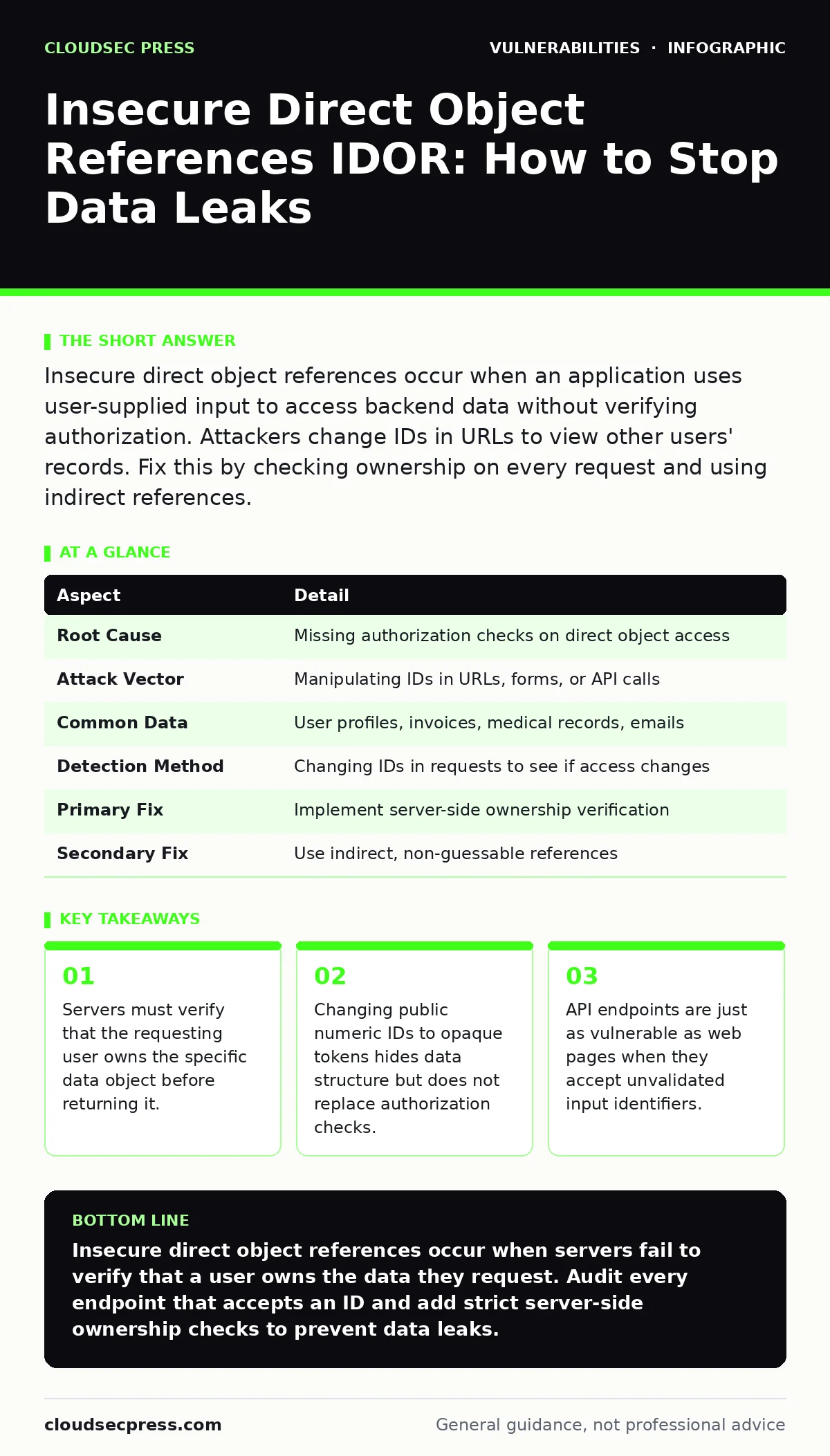
Insecure direct object references occur when an application uses user-supplied input to access backend data without verifying authorization. Attackers change IDs in URLs to view other users' records. Fix this by checking ownership on every request and using indirect references.
Why Your Database Trusts Strangers
Imagine a hotel where the front desk gives you room key number 101. You decide to try key 102. The lock opens because the hotel relies on the key number alone, not on who you are. Insecure direct object references work exactly like this broken lock. The system assumes that if you can see a link or ID, you have permission to use it. This assumption fails when users manipulate those identifiers to access data that belongs to someone else.
The vulnerability exists because applications often separate identification from authorization. Identification asks who you are. Authorization asks what you are allowed to do. Insecure direct object references happen when the application performs identification but skips authorization for specific objects. The server sees a valid request for a resource but does not check if the requester owns that resource. This gap allows anyone with a guessable ID to traverse your entire dataset.
| Aspect | Detail |
|---|---|
| Root Cause | Missing authorization checks on direct object access |
| Attack Vector | Manipulating IDs in URLs, forms, or API calls |
| Common Data | User profiles, invoices, medical records, emails |
| Detection Method | Changing IDs in requests to see if access changes |
| Primary Fix | Implement server-side ownership verification |
| Secondary Fix | Use indirect, non-guessable references |
How Insecure Direct Object References IDOR Works
You interact with an application by clicking links or submitting forms. These actions send parameters to the server, such as user_id=55. The server receives this parameter and queries the database for the record with ID 55. If the server does not check if your session belongs to user 55, it returns the data. An attacker changes user_id=55 to user_id=56. The server returns user 56's data. This is not a hack of the database itself. It is a logic error in how the application handles requests.
This mechanism affects any application that uses direct identifiers. Numeric sequences are the easiest to guess. Sequential IDs like 1, 2, 3 invite enumeration. Attackers write simple scripts to loop through thousands of IDs. They harvest data until the script hits an error or an empty record. Even non-numeric IDs can be vulnerable if they follow a predictable pattern. The attack requires no special tools. It only requires a web browser or a basic command-line utility.
Who Gets Hit by This Logic Error
This vulnerability affects every organization that builds web or mobile applications. It is not limited to large enterprises. Small startups often build features quickly and forget to add authorization checks. The risk is highest in applications with multiple user roles. Admin panels, customer support portals, and financial dashboards are prime targets. These systems often have complex permission structures that developers oversimplify.
Internal tools are often more vulnerable than public-facing websites. Developers assume internal networks are safe. They skip rigorous security reviews for internal apps. Attackers who compromise a single employee account can use insecure direct object references to exfiltrate the entire company's data. This is why IT asset inventory matters. You cannot protect what you do not know exists. If you do not track your internal applications, you cannot patch their logic errors.
What People Usually Get Wrong
Many developers believe that hiding IDs solves the problem. They replace numeric IDs with long, random strings called UUIDs. They think this stops attackers because the IDs are hard to guess. This is a false sense of security. If an attacker finds one valid UUID through error messages or logs, they can still manipulate it. The vulnerability remains because the server still lacks an ownership check. Obscurity is not a security control.
Another common mistake is relying solely on client-side checks. JavaScript can hide buttons or links for users who should not see them. Attackers bypass this by sending raw HTTP requests. They do not use the browser interface. They send data directly to the server. The server must enforce rules, not the browser. Client-side controls are for user experience, not security. Server-side authorization is the only defense that actually stops the data leak.
How to Fix the Logic Gap
Start by mapping every endpoint that accepts an object identifier. List every API call and page load that uses an ID. For each one, ask if the data belongs to the user. If the answer is yes, add a check. The code must verify that the user_id in the request matches the user_id in the authenticated session. If they do not match, return an error. Do not reveal why the error occurred. A generic "access denied" message is safer than "user 55 does not own invoice 56".
Use indirect object references when possible. Instead of sending the real database ID, store a mapping table. The application uses a random token to look up the real ID. This adds a layer of indirection. It makes bulk harvesting harder. It does not replace the need for authorization checks. You must still verify ownership. This approach is part of broader configuration hardening. It reduces the attack surface by removing predictable patterns from your application's interface.
See also: Formjacking: How Small Businesses Lose Customer Data · Data Controllers vs Processors: Clarifying Roles and Liability
Beyond Basic Fixes: Advanced Defenses
Rate limiting helps mitigate the damage of an insecure direct object reference. If an attacker tries to guess thousands of IDs, rate limiting slows them down. You can limit the number of requests per minute from a single IP address. This does not stop a determined attacker with many IPs. It stops automated scripts that rely on speed. Combine this with logging. Monitor for unusual patterns of ID access. Alert on sequences of requests that look like enumeration.
Regular code reviews should include security experts. Developers often miss logic errors because they think like users, not attackers. A fresh pair of eyes can spot missing checks. Automated testing tools can help, but they often miss business logic flaws. Manual testing is still required. Test with different user roles. Try accessing data as a guest, as a regular user, and as an admin. Verify that permissions hold up in every case.
When Other Vulnerabilities Overlap
Insecure direct object references often appear alongside other issues. If your application has broken authentication, attackers can steal valid sessions. They then use those sessions to probe for IDORs. This combination is dangerous. It gives attackers a legitimate foothold. You must secure authentication first. Then you can rely on session tokens for authorization checks.
APIs are particularly prone to this issue. They often expose raw data without the protective layers of a web interface. Ensure your API gateway enforces strict access controls. This relates to vulnerabilities in VPN gateways and application delivery controllers. If your gateway does not validate requests properly, it passes malicious traffic to your application. The application then fails because it trusts the gateway's implicit trust.
Keeping Your Defenses Updated
Software changes over time. New features introduce new endpoints. Each new endpoint needs authorization checks. Include security testing in your deployment pipeline. Do not treat security as a one-time task. It is a continuous process. As you update your software bill of materials (SBOM), you gain visibility into your dependencies. Some libraries may have known IDOR issues. Patching these libraries helps, but you must still review your own code.
Legacy systems are often the hardest to fix. They may use outdated frameworks that do not support modern security practices. If the code is too risky to maintain, consider replacing it. This is why tracking end-of-life software is critical. Unsupported software receives no security patches. It remains vulnerable to known attacks like insecure direct object references indefinitely. Migrate to supported platforms that offer built-in security features.
Summary of Action Steps
You must verify ownership on every request that accesses sensitive data. Do not trust input from the client. Use server-side checks to ensure the user owns the object. Replace sequential IDs with random tokens to reduce guessability. Monitor your logs for enumeration patterns. Test your application with different user roles regularly. These steps create a layered defense. No single measure is enough. You need a combination of code fixes, operational monitoring, and architectural changes to stop insecure direct object references effectively.
Key takeaways
- Servers must verify that the requesting user owns the specific data object before returning it.
- Changing public numeric IDs to opaque tokens hides data structure but does not replace authorization checks.
- API endpoints are just as vulnerable as web pages when they accept unvalidated input identifiers.
Insecure direct object references occur when servers fail to verify that a user owns the data they request. Audit every endpoint that accepts an ID and add strict server-side ownership checks to prevent data leaks.
Frequently asked questions
Does using HTTPS fix insecure direct object references?
No, HTTPS encrypts data in transit but does not verify if the user has permission to access the specific data object. You still need authorization checks.
Can an automated scanner find this vulnerability?
Automated scanners often miss logic errors like IDOR. They look for known code patterns but cannot understand business logic. Manual testing is usually required.
Is this the same as broken access control?
Insecure direct object references are a specific type of broken access control. They focus on unauthorized access to data objects via manipulated identifiers.
How do I know if my API is vulnerable?
Test your API by changing object IDs in requests. If you can access data that does not belong to your authenticated user, your API is vulnerable to IDOR.
How this guide was produced: written by the CloudSec Press editorial team with AI assistance, checked against the public references listed below, and reviewed when the facts change. See our editorial policy or report an error.