Difference Between Rate Limiting and Circuit Breaker: When to Use Each
Rate limiting controls incoming request volume to prevent overload, while circuit breakers stop outgoing calls to failing services to prevent cascading failures.

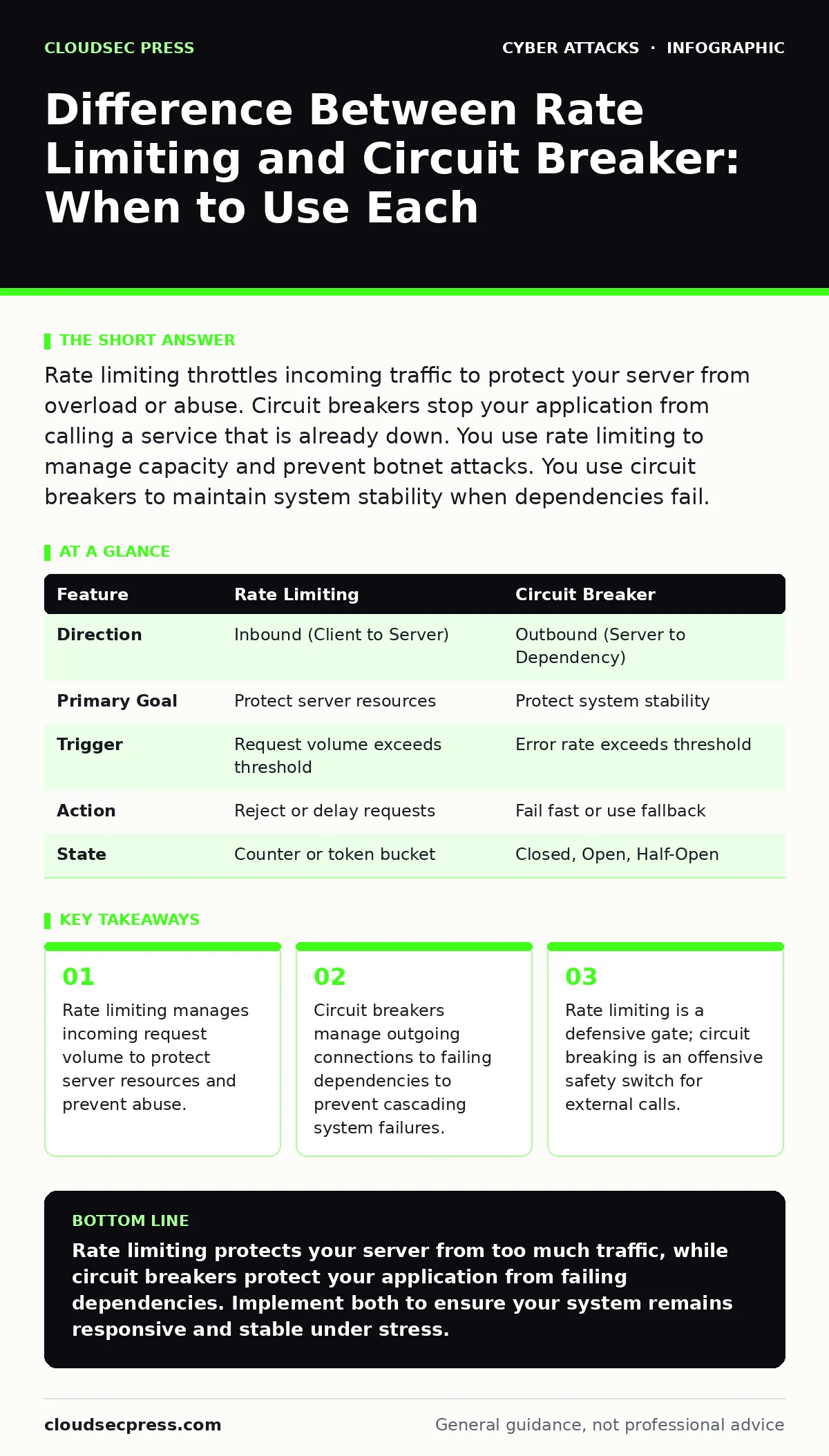
Rate limiting throttles incoming traffic to protect your server from overload or abuse. Circuit breakers stop your application from calling a service that is already down. You use rate limiting to manage capacity and prevent botnet attacks. You use circuit breakers to maintain system stability when dependencies fail.
What is the difference between rate limiting and circuit breaker?
Rate limiting controls the speed of incoming requests to your application, while a circuit breaker controls the reliability of outgoing calls to other services. Rate limiting acts as a traffic cop at your door, ensuring no single user or bot overwhelms your system. Circuit breaking acts as an electrical fuse, cutting power to a failing component so the rest of the house stays lit. You deploy rate limiting to manage capacity. You deploy circuit breakers to handle dependency failures.
How does rate limiting protect your application?
Rate limiting protects your application by enforcing a maximum number of requests a client can make within a specific time window. This mechanism prevents resource exhaustion during high traffic or targeted assaults. Imagine a server receiving thousands of requests per second from a single IP address. Without limits, the server spends all its memory processing these requests, leaving none for legitimate users. Rate limiting rejects excess requests before they consume resources. This is vital for mitigating Slowloris attacks, where attackers hold connections open to starve the server.
How does a circuit breaker prevent system failure?
A circuit breaker prevents system failure by stopping your application from repeatedly calling a service that is already unresponsive. When a dependency fails, your application should not waste time waiting for a timeout. Instead, the circuit breaker trips, immediately failing the request and returning a cached response or an error. This frees up threads and memory for other tasks. If you ignore failing dependencies, your entire application stack can collapse under the weight of waiting connections. Circuit breaking preserves the health of the healthy parts of your system.
When should you use rate limiting instead of a circuit breaker?
You should use rate limiting when you control the destination of the traffic and want to manage its volume. Rate limiting is the correct tool when the threat comes from the client side, such as excessive API calls, brute force login attempts, or data scraping. It is also the right choice when you need to enforce fair usage policies among your users. Circuit breakers do not solve volume problems. They only solve reliability problems. If your server is slow because it is processing too many valid requests, rate limiting is the solution, not circuit breaking.
When should you use a circuit breaker instead of rate limiting?
You should use a circuit breaker when you are calling external services that you do not control. These services might be third-party payment gateways, weather APIs, or internal microservices that are currently down. If you call a failing service repeatedly, you create a cascade of failures that can bring down your own application. Rate limiting does not help here because the requests are legitimate and necessary. You need a mechanism that detects failure and stops the bleeding. Circuit breaking provides this detection and isolation.
| Feature | Rate Limiting | Circuit Breaker |
|---|---|---|
| Direction | Inbound (Client to Server) | Outbound (Server to Dependency) |
| Primary Goal | Protect server resources | Protect system stability |
| Trigger | Request volume exceeds threshold | Error rate exceeds threshold |
| Action | Reject or delay requests | Fail fast or use fallback |
| State | Counter or token bucket | Closed, Open, Half-Open |
See also: HTML Smuggling Myths Debunked: What Attackers Actually Hide
What happens if you combine both mechanisms?
Combining both mechanisms creates a resilient architecture that handles both abuse and failure. Rate limiting ensures that no single client can exhaust your server's capacity, even if all dependencies are healthy. Circuit breaking ensures that if a dependency fails, your server does not waste resources waiting for responses that will never come. Imagine a scenario where a botnet attacks your login endpoint while your password verification service is also slow. Rate limiting stops the bot traffic. Circuit breaking stops your app from hanging on the slow password service.
How do you configure the thresholds correctly?
Configuring thresholds requires understanding your normal operating patterns. For rate limiting, set limits slightly above your peak legitimate traffic to avoid blocking real users. Use sliding windows to smooth out bursts of activity. For circuit breakers, set the failure threshold based on acceptable error rates. The half-open state allows a small number of test requests to check if the service has recovered. If these test requests succeed, the circuit closes. If they fail, the circuit remains open.
What are the common mistakes in implementation?
A common mistake is treating rate limiting as a substitute for authentication. Rate limiting slows down attackers, but it does not stop them. You still need strong authentication and monitoring. Another mistake is applying circuit breakers to synchronous calls that must complete. If a user action requires a database write, you cannot simply fail fast. You must queue the request or retry later. Circuit breakers are best for read operations or non-critical background tasks.
How does this relate to other security controls?
Rate limiting and circuit breaking work alongside other security controls to provide defense in depth. For example, rate limiting helps mitigate the impact of session hijacking by limiting how many sessions an attacker can attempt to create or abuse. Circuit breaking ensures that if your DNS provider fails, your application does not crash, reducing the risk of DNS hijacking exploitation during outages. These mechanisms do not replace encryption or access controls. They complement them by managing the flow and reliability of network traffic.
Key takeaways
- Rate limiting manages incoming request volume to protect server resources and prevent abuse.
- Circuit breakers manage outgoing connections to failing dependencies to prevent cascading system failures.
- Rate limiting is a defensive gate; circuit breaking is an offensive safety switch for external calls.
Rate limiting protects your server from too much traffic, while circuit breakers protect your application from failing dependencies. Implement both to ensure your system remains responsive and stable under stress.
Frequently asked questions
Can rate limiting stop a DDoS attack?
Rate limiting can mitigate low-volume DDoS attacks by throttling excessive requests from single sources. It cannot stop high-volume volumetric attacks that exceed your network bandwidth capacity.
Does a circuit breaker cache responses?
A circuit breaker can be configured to return cached or default responses when the circuit is open. This provides a degraded but functional experience to users while the dependency recovers.
How do I detect if rate limiting is too strict?
Monitor your error logs for legitimate users receiving 429 Too Many Requests errors. If real users are frequently blocked, your thresholds are too low. Adjust the limits to accommodate normal user behavior patterns.
Can circuit breakers cause data inconsistency?
Yes, if used incorrectly on write operations. Circuit breakers fail fast, which means data writes may be dropped. Only use circuit breakers on read operations or idempotent writes where retries are safe.
How this guide was produced: written by the CloudSec Press editorial team with AI assistance, checked against the public references listed below, and reviewed when the facts change. See our editorial policy or report an error.