Secrets Management: How to Secure API Keys and Credentials
Storing credentials in code repositories creates a permanent attack surface that persists even after you rotate the keys, because historical commits remain accessible.

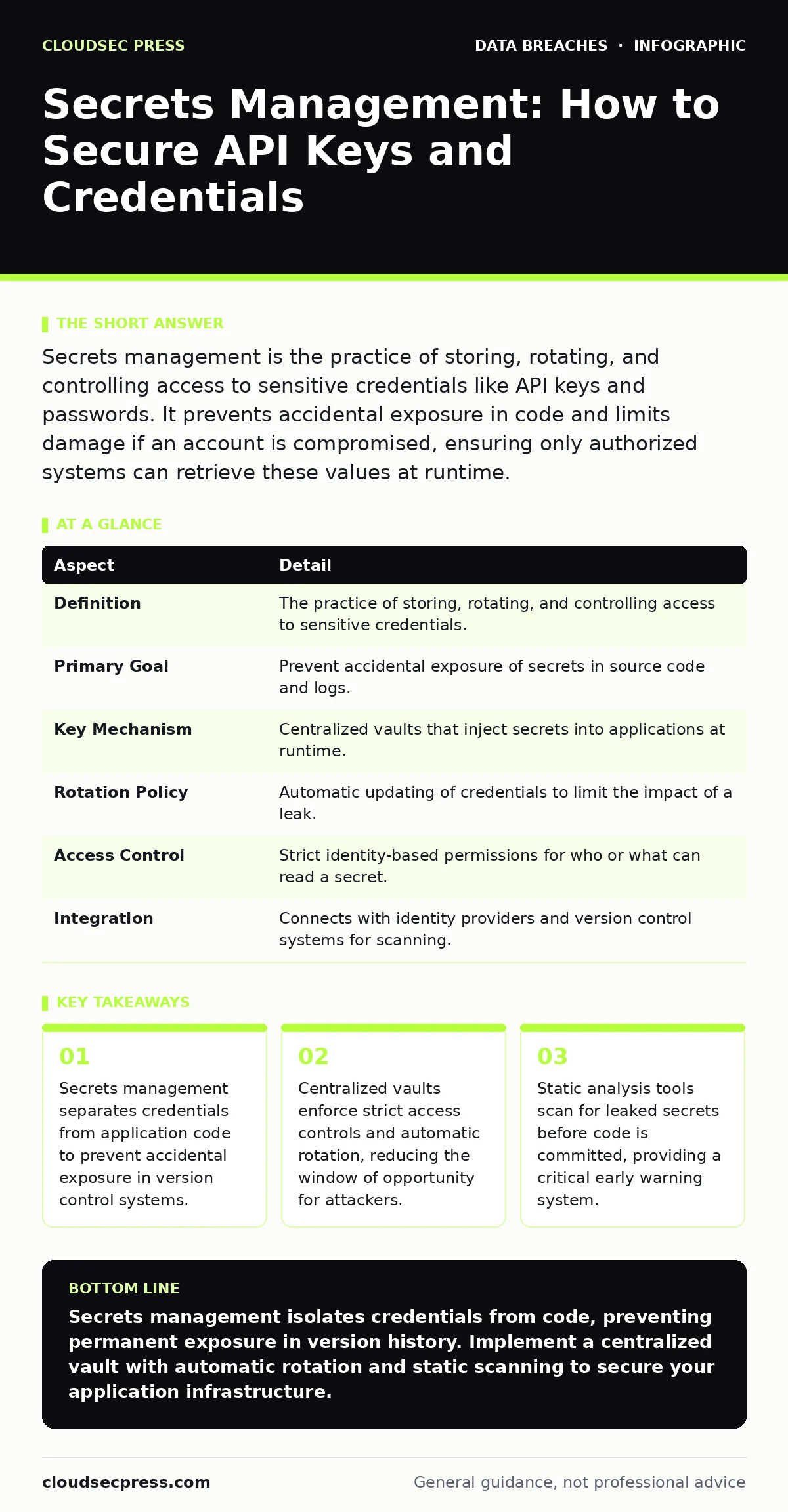
Secrets management is the practice of storing, rotating, and controlling access to sensitive credentials like API keys and passwords. It prevents accidental exposure in code and limits damage if an account is compromised, ensuring only authorized systems can retrieve these values at runtime.
The Digital Safe Deposit Box
Imagine you run a bakery. You keep the recipe for your signature cake in a locked safe, not written on a napkin left on the counter. Anyone who finds the napkin can copy the recipe. The safe requires a key, and you change that key regularly. Secrets management works the same way for your software. It keeps sensitive data—like database passwords, API keys, and encryption certificates—separate from the public-facing parts of your application.
In software development, "secrets" are any credentials required for an application to function. These include private keys, tokens, and passwords. If these values end up in your source code, they become part of the public record once you share that code. Secrets management provides a secure container for these values. It ensures that only the specific services that need them can retrieve them, and only for a short time.
| Aspect | Detail |
|---|---|
| Definition | The practice of storing, rotating, and controlling access to sensitive credentials. |
| Primary Goal | Prevent accidental exposure of secrets in source code and logs. |
| Key Mechanism | Centralized vaults that inject secrets into applications at runtime. |
| Rotation Policy | Automatic updating of credentials to limit the impact of a leak. |
| Access Control | Strict identity-based permissions for who or what can read a secret. |
| Integration | Connects with identity providers and version control systems for scanning. |
Why Hardcoding Fails
Developers often hardcode credentials directly into their scripts for convenience. This works during local testing. It fails catastrophically when the code is pushed to a shared repository. Version control systems like Git keep a history of every change. Even if you delete the password in the next commit, the previous commit still contains it. Anyone with read access to the repository can retrieve that old version.
This creates a persistent vulnerability. Attackers do not need to hack your current system. They only need to find a copy of your code online. A single leaked source code repository can expose every database and service your application connects to. This is often the first step in a larger data breach. The attacker uses the exposed credentials to move laterally through your infrastructure.
The Core Components
A functional secrets management system relies on three main components. First is the vault. This is a secure storage service that encrypts secrets at rest. It handles the complexity of encryption keys and storage security. You do not manage the encryption algorithms; the vault does.
Second is the access control layer. This defines who can see which secrets. It uses identity-based policies. An application or a human user must prove who they are before the vault releases a secret. This prevents unauthorized access even if the vault itself is targeted.
Third is the injection mechanism. Applications need a way to get the secret from the vault. This usually happens via an API call or an environment variable. The application requests the secret at startup. The vault delivers it, often with a short expiration time. The application then uses the secret to connect to other services.
Automation and Rotation
Static credentials are risky because they last forever. If a static password is stolen, it remains valid until you manually change it. Secrets management enables automatic rotation. The system generates a new credential and updates the application without human intervention. This happens in the background.
Rotation reduces the "blast radius" of a leak. If an attacker steals a credential that expires in five minutes, they have only five minutes to use it. Most attacks take longer than that to execute. Automatic rotation ensures that credentials are always fresh. It also simplifies compliance audits. You can prove that you do not rely on long-lived, static passwords.
This automation requires careful planning. The application must be able to handle credential changes without crashing. It must re-authenticate seamlessly. If your application cannot handle rotation, you cannot benefit from this security feature. You must test your applications to ensure they tolerate these changes.
Integration with Broader Defences
Secrets management does not work in isolation. It fits into a larger security framework. It complements the CIA triad by ensuring confidentiality of credentials. It supports SOC 2 compliance by providing audit logs of who accessed which secret. These logs are critical for demonstrating control over sensitive data.
It also mitigates risks associated with password leaks. If a developer reuses a password across personal and professional accounts, secrets management limits the damage. The professional credential is isolated and rotated automatically. It does not rely on the developer’s memory or habits.
Furthermore, it helps prevent leaked source code from becoming a critical incident. Even if code is exposed, the secrets inside it are invalid or expired. This adds a layer of defense in depth. You assume the code will leak. You design the system to remain secure despite that leak.
See also: IaaS, PaaS and SaaS security: small business defense strategies · Shadow IT Prevention Checklist for Cloud Environments
Common Misconceptions
Many teams believe that environment variables are sufficient for secrets management. Environment variables are not encrypted by default. They can be viewed by anyone with access to the server. They are often included in error logs or debugging outputs. This makes them a poor substitute for a dedicated vault.
Another misconception is that secrets management only applies to large enterprises. Small teams are often more vulnerable. They lack the processes to audit code for secrets. They rely on shared credentials. Implementing secrets management early prevents technical debt. It is easier to build security into a new application than to retrofit it into a legacy system.
What People Get Wrong
The biggest mistake is treating secrets management as a storage problem. It is an access problem. Storing a password in a vault is useless if anyone can read the vault. You must enforce strict least-privilege access. Only the specific service that needs the secret should be able to retrieve it.
Another error is ignoring static analysis. You must scan your code for secrets before they are committed. This catches human error. If a developer accidentally types a key into a comment, the scanner blocks the commit. This prevents the secret from ever entering the version control history.
Finally, teams often forget to monitor access logs. The vault records every time a secret is retrieved. You should alert on unusual patterns. If a service that rarely accesses a database suddenly requests its credentials, something is wrong. Monitoring turns the vault from a passive store into an active detection tool.
Key takeaways
- Secrets management separates credentials from application code to prevent accidental exposure in version control systems.
- Centralized vaults enforce strict access controls and automatic rotation, reducing the window of opportunity for attackers.
- Static analysis tools scan for leaked secrets before code is committed, providing a critical early warning system.
- Integrating secrets management with identity providers ensures that applications authenticate using short-lived tokens rather than long-lived static keys.
Secrets management isolates credentials from code, preventing permanent exposure in version history. Implement a centralized vault with automatic rotation and static scanning to secure your application infrastructure.
Frequently asked questions
Can I use secrets management for personal passwords?
No, secrets management is designed for machine-to-machine credentials. Use a dedicated password manager for human identities.
Does secrets management protect against insider threats?
It limits the damage by enforcing least-privilege access and logging all retrievals, but it does not stop a malicious insider with authorized access.
How do I migrate existing hardcoded secrets?
Identify all hardcoded values, replace them with references to the vault, and update your application configuration to fetch secrets at runtime.
Is secrets management expensive?
The cost varies, but the cost of a data breach due to leaked credentials is significantly higher. Many cloud providers offer basic vaults at low or no cost.
How this guide was produced: written by the CloudSec Press editorial team with AI assistance, checked against the public references listed below, and reviewed when the facts change. See our editorial policy or report an error.