Leaked Source Code Risks: How Small Teams Prevent Exposure
Source code leaks expose internal logic and hidden credentials, turning a software asset into a direct pathway for attackers to bypass standard defenses.

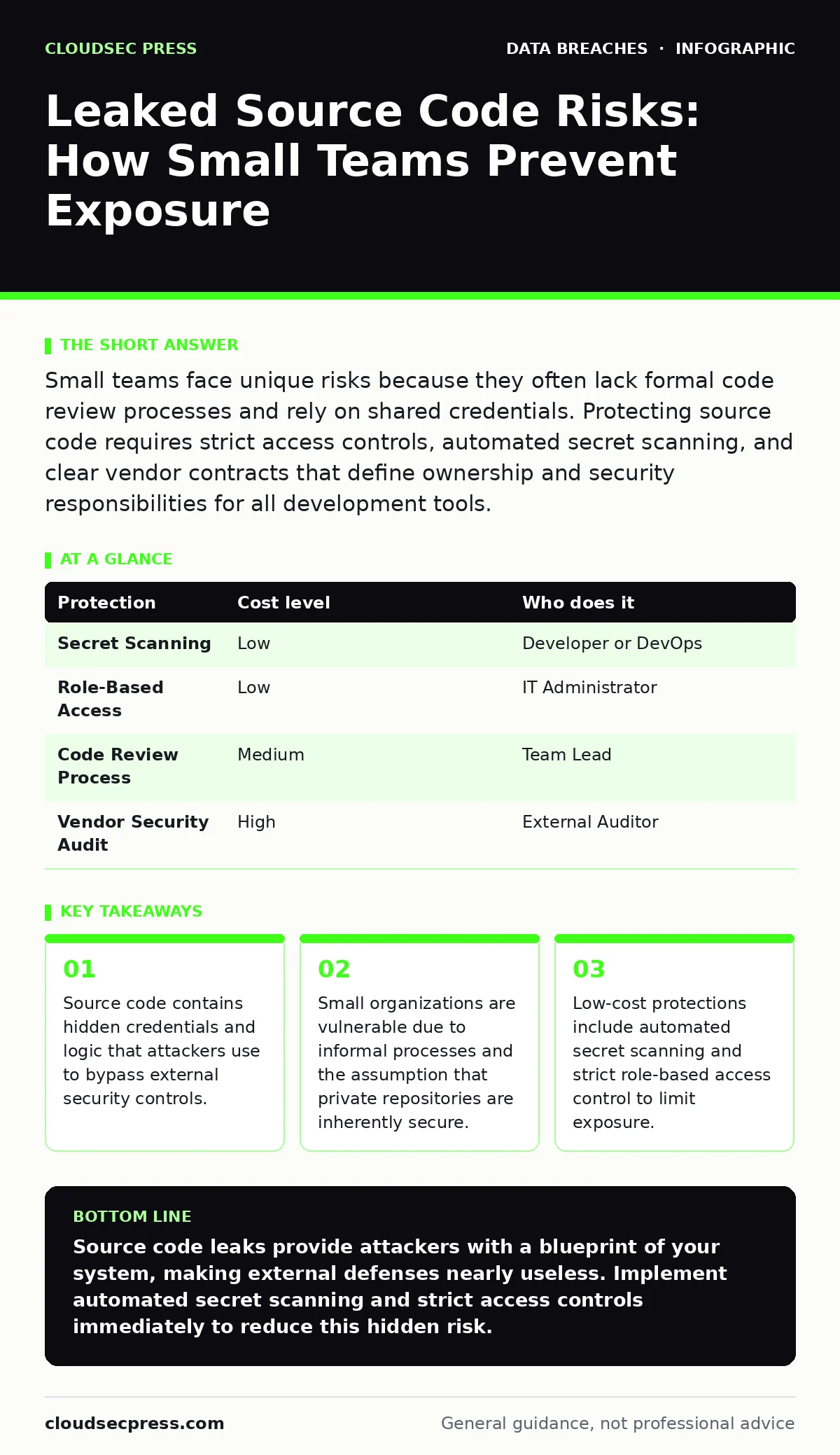
Small teams face unique risks because they often lack formal code review processes and rely on shared credentials. Protecting source code requires strict access controls, automated secret scanning, and clear vendor contracts that define ownership and security responsibilities for all development tools.
The Hidden Value in Your Code
Source code is not just instructions for a computer. It is a map of your business logic. It reveals how you validate inputs, how you handle errors, and where you store sensitive data. Attackers do not need to guess how your system works. They can read it.
When code is leaked, the attacker gains insight into your architecture. They can identify weaknesses that are not visible from the outside. This knowledge allows them to craft precise attacks. They know exactly which parameters to manipulate. They know which endpoints are vulnerable.
This risk exists regardless of the programming language. Python scripts, JavaScript applications, and C++ libraries all contain valuable information. The structure of your code often reveals more than your public website does. It shows the shortcuts you took and the assumptions you made.
Why Small Teams Are Exposed
Small organizations often operate with speed as a priority. Formal security processes are viewed as bottlenecks. This creates an environment where human error is likely. A developer may push code to a shared repository without reviewing it. They may reuse a password from a previous project. They may assume that a private repository is immune to breaches.
The scale of the team amplifies the risk. In a large corporation, roles are specialized. Security engineers review code. In a small team, developers wear many hats. They write code, deploy it, and manage infrastructure. There is no second pair of eyes to catch a mistake.
Furthermore, small teams often use third-party tools and libraries without fully understanding their supply chain. A compromised library can introduce backdoors. The team may not realize the source until damage is done. This connects to the broader issue of data breaches, where the initial entry point is often a trusted component.
The Cost of a Leak
The immediate cost of a leak is often underestimated. It is not just about fixing the code. It is about the time spent investigating the breach. It is about the reputational damage. Customers lose trust when they learn their data was accessible through poor code hygiene.
Legal implications can also arise. If your code contains personal data or intellectual property, you may be liable for damages. Insurance premiums may increase. The cost of hiring external experts to audit your systems can be prohibitive for a small business.
Long-term, the leak can affect your competitive advantage. If your code contains unique algorithms or business logic, competitors can replicate your features. You lose the edge that made your product unique. This is a silent loss that is hard to quantify but easy to feel.
Low-Cost Protections
You do not need a large budget to protect your source code. Many effective measures are built into modern development tools. The key is to enable them and enforce their use.
| Protection | Cost level | Who does it |
|---|---|---|
| Secret Scanning | Low | Developer or DevOps |
| Role-Based Access | Low | IT Administrator |
| Code Review Process | Medium | Team Lead |
| Vendor Security Audit | High | External Auditor |
Secret scanning tools scan your repository for hardcoded passwords, API keys, and tokens. These tools are often free or included in standard plans. They prevent credentials from being committed to the codebase. This is a critical step in secrets management. It ensures that sensitive data is stored in secure vaults, not in plain text files.
Role-based access control limits who can view and modify the code. Not every employee needs access to the entire codebase. Limit access to those who need it. This reduces the attack surface. If an account is compromised, the damage is contained.
Code review processes add a layer of human oversight. Even a quick peer review can catch mistakes. It forces developers to think about security before pushing code. This is a cultural change, not a technical one. It requires leadership to prioritize it.
What to Ask Your IT Provider
If you outsource development or IT support, you must verify their security practices. Do not assume they follow best practices. Ask specific questions.
- How do you store and manage credentials for development environments?
- Do you use automated tools to scan for secrets in code?
- What is your process for reviewing code before it goes to production?
- How do you handle access rights for former employees or contractors?
- Can you provide documentation of your security policies?
These questions reveal their maturity. Vague answers are a red flag. Look for concrete processes and tools. Ask for examples of how they have handled a security incident in the past. This shows their readiness.
See also: DLL Hijacking: How to Stop Code Execution Attacks · Formjacking: How Small Businesses Lose Customer Data
The Human Factor
Technology alone cannot solve this problem. Human error is the primary cause of leaks. Developers are busy. They want to ship features. Security can feel like an obstacle.
You must create a culture where security is part of the workflow. Make it easy to do the right thing. Integrate security tools into the development pipeline. Do not make developers leave their workflow to check for secrets.
Train your team on the risks. Explain why leaking code is dangerous. Use hypothetical scenarios to illustrate the impact. This builds awareness. It makes security a shared responsibility, not just an IT issue. This approach also helps prevent insider data theft, as employees understand the value of the data they handle.
Beyond the Code
Protecting source code is part of a broader security strategy. It is not enough to secure the repository. You must also secure the infrastructure where the code runs. This includes servers, databases, and network connections.
Use encryption in transit to protect data moving between systems. This ensures that even if traffic is intercepted, it cannot be read. Combine this with strong authentication methods. This adds layers of defense.
Regularly update your dependencies. Outdated libraries often have known vulnerabilities. Attackers exploit these easily. Keep your software stack current. This reduces the number of entry points available to attackers.
Building Resilience
You cannot prevent every leak. Systems fail. People make mistakes. The goal is to reduce the likelihood and impact.
Implement monitoring for unusual activity. Detect when code is accessed or downloaded unexpectedly. Set up alerts for large data transfers. This allows you to respond quickly.
Have a plan for when a leak occurs. Know who to contact. Know how to rotate credentials. Know how to communicate with customers. Preparation reduces panic. It allows you to act decisively.
This resilience is part of the CIA triad. Confidentiality, integrity, and availability are the pillars of information security. Protecting source code supports all three. It keeps your data secret, your systems intact, and your business running.
Key takeaways
- Source code contains hidden credentials and logic that attackers use to bypass external security controls.
- Small organizations are vulnerable due to informal processes and the assumption that private repositories are inherently secure.
- Low-cost protections include automated secret scanning and strict role-based access control to limit exposure.
Source code leaks provide attackers with a blueprint of your system, making external defenses nearly useless. Implement automated secret scanning and strict access controls immediately to reduce this hidden risk.
Frequently asked questions
Is my code safe if I keep it in a private repository?
Private repositories reduce risk but do not eliminate it. Account compromises or insider threats can still expose your code. Treat all code as potentially public.
How do I find hardcoded secrets in my code?
Use automated secret scanning tools integrated into your development pipeline. These tools detect patterns resembling passwords or API keys and alert you before they are committed.
What should I do if I find a secret in my code?
Remove the secret immediately and rotate the credential. Assume it has been exposed. Update your code to use a secure vault for storing secrets.
Do I need a security team to protect source code?
No. Small teams can protect code using automated tools and strict access controls. Focus on process and automation rather than hiring specialized staff.
How this guide was produced: written by the CloudSec Press editorial team with AI assistance, checked against the public references listed below, and reviewed when the facts change. See our editorial policy or report an error.