CSAF Security Advisories Explained: Machine-Readable Vulnerability Data
CSAF advisories allow automated systems to ingest and act on vulnerability data without human interpretation or manual triage delays.

CSAF is a standardized format for security advisories that machines can read. It replaces ambiguous text reports with structured data. This enables automatic patching and risk assessment. You gain speed and accuracy by letting software parse the details of vulnerabilities directly.
The Digital Maintenance Log
Imagine a large apartment complex with hundreds of units. Each unit has different appliances, locks, and wiring. When a manufacturer discovers a flaw in a specific model of smoke detector, they cannot call every resident. They publish a bulletin. In the past, this bulletin was a vague letter saying "check your devices." Now, the bulletin is a precise digital log. It lists the exact model number, the serial range, and the fix. This is the core idea behind CSAF. It turns vague warnings into precise, actionable data for automated systems.
What CSAF Actually Does
CSAF, or Common Security Advisory Framework, is a specification for how vendors publish security updates. It defines a structure using JSON or XML. This structure contains facts about a vulnerability. It lists the affected product, the version numbers, the severity, and the fix. Unlike traditional text-based bulletins, this format allows software tools to read the data instantly. You can imagine this as the difference between a handwritten note and a barcode scanner. The scanner knows exactly what item it is looking at.
Key Terms Defined
Understanding CSAF requires knowing the specific roles of each data element. These terms appear in every advisory and dictate how your systems respond.
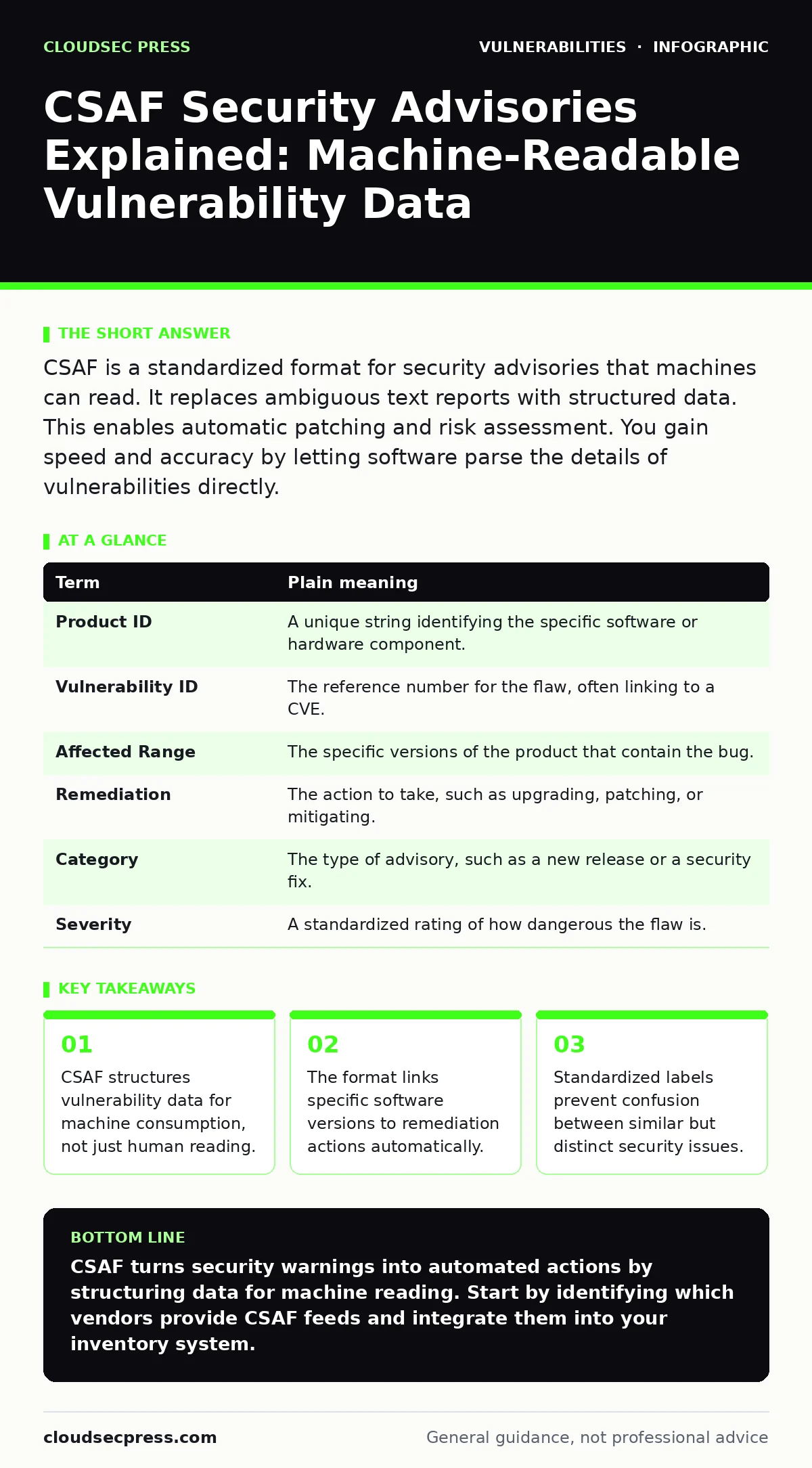
| Term | Plain meaning |
|---|---|
| Product ID | A unique string identifying the specific software or hardware component. |
| Vulnerability ID | The reference number for the flaw, often linking to a CVE. |
| Affected Range | The specific versions of the product that contain the bug. |
| Remediation | The action to take, such as upgrading, patching, or mitigating. |
| Category | The type of advisory, such as a new release or a security fix. |
| Severity | A standardized rating of how dangerous the flaw is. |
Common Points of Confusion
Many readers confuse CSAF with the vulnerability itself. CSAF is the wrapper, not the bug. It is the container that holds the information. Another common mistake is assuming CSAF replaces other formats. It coexists with them. You might still see text-based security bulletins for human readers. CSAF is the machine-readable twin. It ensures that when a human reads the bulletin, a robot reads the same facts simultaneously. This duality prevents errors in translation.
Why Structure Matters
Unstructured text is ambiguous. A sentence like "update your server" is unclear. Which server? Which version? CSAF removes this guesswork. It uses strict labels. A tool can parse the Affected Range and check your inventory. If your system matches the range, the tool triggers the Remediation step. This automation is vital for large environments. You cannot manually check thousands of devices. CSAF allows you to scale your security operations without hiring more staff. It turns a flood of information into a stream of actions.
See also: OpenSSH Vulnerability Response: Immediate Containment and Recovery Steps · Security Bulletins Explained: Meaning, Purpose, and Daily Use
Integration with Other Standards
CSAF does not work in isolation. It often references a software bill of materials (SBOM). An SBOM lists every component in your software. CSAF tells you which of those components are broken. Together, they give you a complete picture. You might also use vulnerability scanning tools to find exposed weaknesses. CSAF provides the truth data for those scanners. Without accurate advisories, scanners produce false positives. CSAF reduces noise by providing precise version matching.
The Hidden Cost of Ambiguity
Consider the risk of misinterpreting a text advisory. A technician might patch the wrong version. This can break functionality. CSAF prevents this by defining exact boundaries. It specifies which versions are safe and which are not. This precision saves time and prevents outages. In complex networks, a single mispatched server can cascade into larger failures. By using structured data, you eliminate the human error factor in initial triage. The machine makes the decision based on facts, not interpretation.
Try This Now
- Check your feed sources: Verify if your vendors publish CSAF-compliant advisories. Look for JSON or XML links in their security pages.
- Map your products: Create a list of your critical software using their exact product IDs. This makes matching easier.
- Test automation: Use a small script to parse a sample CSAF document. Ensure it extracts the version ranges correctly.
Beyond Basic Patching
CSAF supports more than just simple patches. It can describe mitigations. Sometimes a fix is not available. The advisory might suggest a configuration change. CSAF captures this nuance. It can also link to vulnerability chaining scenarios. One flaw might enable another. CSAF helps you see these connections. It provides the context needed for deeper analysis. This depth is what separates basic updates from true security management.
The Future of Advisories
The industry is moving toward full automation. CSAF is a key part of this shift. As systems become more complex, manual review becomes impossible. You need machines to talk to machines. CSAF provides the language for this conversation. It standardizes the exchange of security information. This standardization reduces friction between vendors and users. You get faster, more accurate updates. The result is a more resilient infrastructure that reacts to threats in real time.
Key takeaways
- CSAF structures vulnerability data for machine consumption, not just human reading.
- The format links specific software versions to remediation actions automatically.
- Standardized labels prevent confusion between similar but distinct security issues.
CSAF turns security warnings into automated actions by structuring data for machine reading. Start by identifying which vendors provide CSAF feeds and integrate them into your inventory system.
Frequently asked questions
Does CSAF replace CVEs?
No, CSAF references CVEs. It provides the context and remediation details for the vulnerabilities identified by those IDs.
Can I use CSAF with legacy systems?
Yes, but you may need a parser to convert the JSON or XML into a format your older tools can understand.
Is CSAF only for large enterprises?
No, any organization with automated patching or inventory systems can benefit from the precision of CSAF data.
How does CSAF handle false positives?
By defining exact version ranges, CSAF reduces false positives that occur with vague text-based advisories.
How this guide was produced: written by the CloudSec Press editorial team with AI assistance, checked against the public references listed below, and reviewed when the facts change. See our editorial policy or report an error.