Vulnerability Remediation SLAs: Set Timelines That Actually Work
Fixed-length remediation deadlines ignore exploit complexity and risk, causing teams to patch low-risk flaws while critical chains remain open.

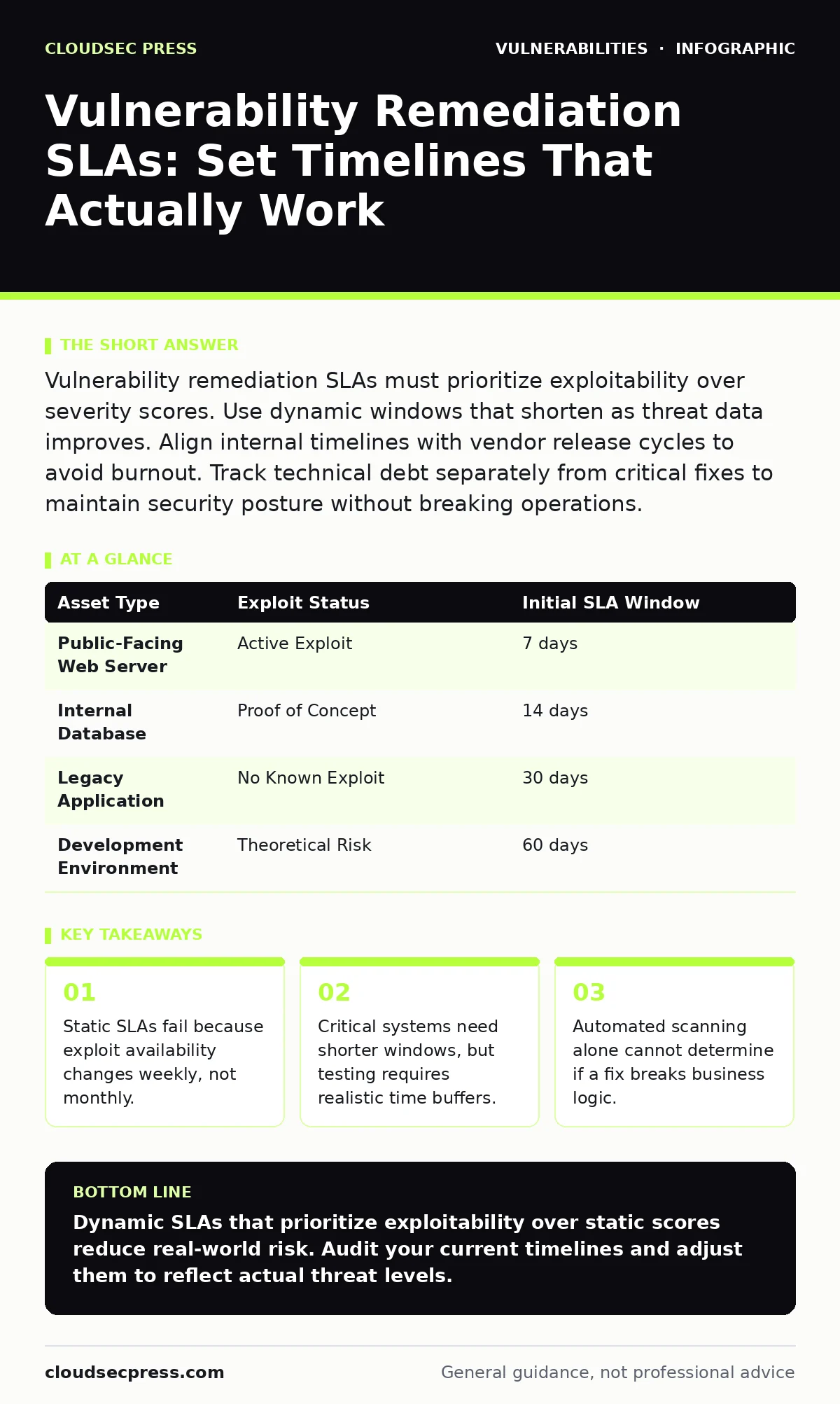
Vulnerability remediation SLAs must prioritize exploitability over severity scores. Use dynamic windows that shorten as threat data improves. Align internal timelines with vendor release cycles to avoid burnout. Track technical debt separately from critical fixes to maintain security posture without breaking operations.
What is a vulnerability remediation SLA?
A vulnerability remediation SLA is a defined timeframe for fixing a security flaw after discovery. Most organizations default to rigid deadlines based on Common Vulnerability Scoring System ratings. This approach assumes all high-score flaws are equally dangerous. Reality differs because exploit code availability and environmental context vary wildly. A static window ignores whether an attacker can actually reach the affected component. You must treat the SLA as a risk management tool, not a compliance checkbox. The goal is to reduce exposure before an adversary exploits the weakness.
Why do static time limits fail in practice?
Static limits fail because they treat all vulnerabilities as equal threats. A high-score flaw in an internal, air-gapped system poses less risk than a medium-score flaw on a public-facing web server. Attackers exploit easy targets first, regardless of the theoretical maximum damage. When you force teams to fix everything within 30 days, they prioritize speed over stability. This leads to rushed patches that introduce new bugs or break functionality. Dynamic SLAs adjust the deadline based on exploit maturity and asset criticality. This ensures resources focus on the most likely attack vectors.
How do you calculate a realistic deadline?
Calculate deadlines by weighing exploitability against asset value. Start with the base severity score, then adjust for environmental factors. If exploit code exists publicly, shrink the window significantly. If the asset is internet-facing, prioritize it over internal tools. Consider the effort required to test the fix. Complex systems need more validation time to ensure stability. A 14-day window might work for a simple server, but a 60-day window may be necessary for a complex application. Balance speed against the risk of introducing instability.
| Asset Type | Exploit Status | Initial SLA Window |
|---|---|---|
| Public-Facing Web Server | Active Exploit | 7 days |
| Internal Database | Proof of Concept | 14 days |
| Legacy Application | No Known Exploit | 30 days |
| Development Environment | Theoretical Risk | 60 days |
What breaks when you enforce strict SLAs?
Strict SLAs break development velocity and system stability. Developers spend hours patching low-risk issues instead of building features or fixing critical logic flaws. Operations teams deploy patches without adequate testing to meet the deadline. This creates a cycle of break-fix-repair that erodes trust in security initiatives. Employees begin to view security as an obstacle rather than a partner. The hidden cost is technical debt accumulation. Unpatched critical flaws linger because teams are busy ticking boxes for minor issues. You sacrifice long-term security for short-term metric compliance.
How do you handle end-of-life software?
End-of-life software lacks vendor support for security patches. You cannot apply an SLA to a product that no longer receives updates. The only viable strategies are isolation, replacement, or virtual patching. Isolation restricts network access to prevent exploitation. Virtual patching applies rules at the firewall or application layer to block known attack patterns. This is not a permanent solution but buys time for migration. See our guide on end-of-life software for detailed mitigation strategies. Treating unsupported software as "normal" exposes your infrastructure to unfixable risks.
See also: OpenSSH Vulnerability Response: Immediate Containment and Recovery Steps · Security Bulletins Explained: Meaning, Purpose, and Daily Use
Do automated scanners replace human judgment?
Automated scanners identify flaws but cannot assess context. They report severity scores without knowing if the vulnerable code is actually executed. A scanner might flag a critical flaw in a deprecated function that no one calls. Human analysts must triage these findings. They determine if the vulnerability is reachable and exploitable. This step prevents wasted effort on false positives or irrelevant issues. Automation speeds up detection; humans prioritize action. Relying solely on tools leads to alert fatigue and missed critical threats.
How do you manage firmware and hardware flaws?
Firmware and hardware flaws require physical access or specialized update processes. You cannot patch a router or server BIOS with a simple software click. These updates often require maintenance windows and downtime. SLAs for firmware must account for procurement and testing delays. A 30-day window is often unrealistic for hardware replacements. Coordinate with vendors early to secure replacement units. See our guide on firmware update management for best practices. For network devices, virtual patching via intrusion prevention systems can provide temporary protection until the hardware is updated.
What is the risk of vulnerability chaining?
Vulnerability chaining occurs when attackers combine multiple low-severity flaws to achieve a high-impact breach. A single minor flaw might not allow remote code execution. However, combined with a second flaw, it can bypass authentication and elevate privileges. Static SLAs often ignore these relationships. You must analyze vulnerabilities in the context of your entire attack surface. See our guide on attack surface management to map these connections. Prioritize fixing the first link in the chain, even if it has a low individual score. This prevents the combination that leads to compromise.
How do you track SLA compliance effectively?
Track compliance by measuring time-to-remediation, not just closure rates. Record when the vulnerability was discovered and when the fix was verified. Exclude time spent waiting for vendor patches from your internal SLA. Report on exceptions and the reasons for extended windows. This data reveals bottlenecks in your process. Are developers slow to patch, or is testing too rigorous? Use this insight to optimize the workflow. Transparency builds trust with stakeholders. Show how dynamic SLAs reduce actual risk, not just count closed tickets.
Key takeaways
- Static SLAs fail because exploit availability changes weekly, not monthly.
- Critical systems need shorter windows, but testing requires realistic time buffers.
- Automated scanning alone cannot determine if a fix breaks business logic.
Dynamic SLAs that prioritize exploitability over static scores reduce real-world risk. Audit your current timelines and adjust them to reflect actual threat levels.
Frequently asked questions
What is the standard SLA for critical vulnerabilities?
There is no universal standard. Critical vulnerabilities with active exploits typically require a 7-day window. Those without known exploits may allow 14 to 30 days, depending on asset criticality.
Can I extend an SLA for a complex system?
Yes, if the complexity requires extensive testing to prevent outages. Document the reason for the extension and apply temporary compensating controls to mitigate risk during the extended period.
How do I handle third-party software vulnerabilities?
You cannot fix third-party code directly. Your SLA should track the time to isolate, virtual patch, or upgrade the third-party component. Coordinate with vendors for updates but control your own mitigation timeline.
Should development teams be responsible for SLAs?
Development teams should own the remediation process. Security teams define the risk and the required window. This shared responsibility ensures that fixes are both secure and functional.
How this guide was produced: written by the CloudSec Press editorial team with AI assistance, checked against the public references listed below, and reviewed when the facts change. See our editorial policy or report an error.