Vulnerability Chaining: How Small Flaws Become Major Breaches
Attackers rarely exploit one flaw; they string together minor issues in different systems to bypass security controls that appear secure individually.

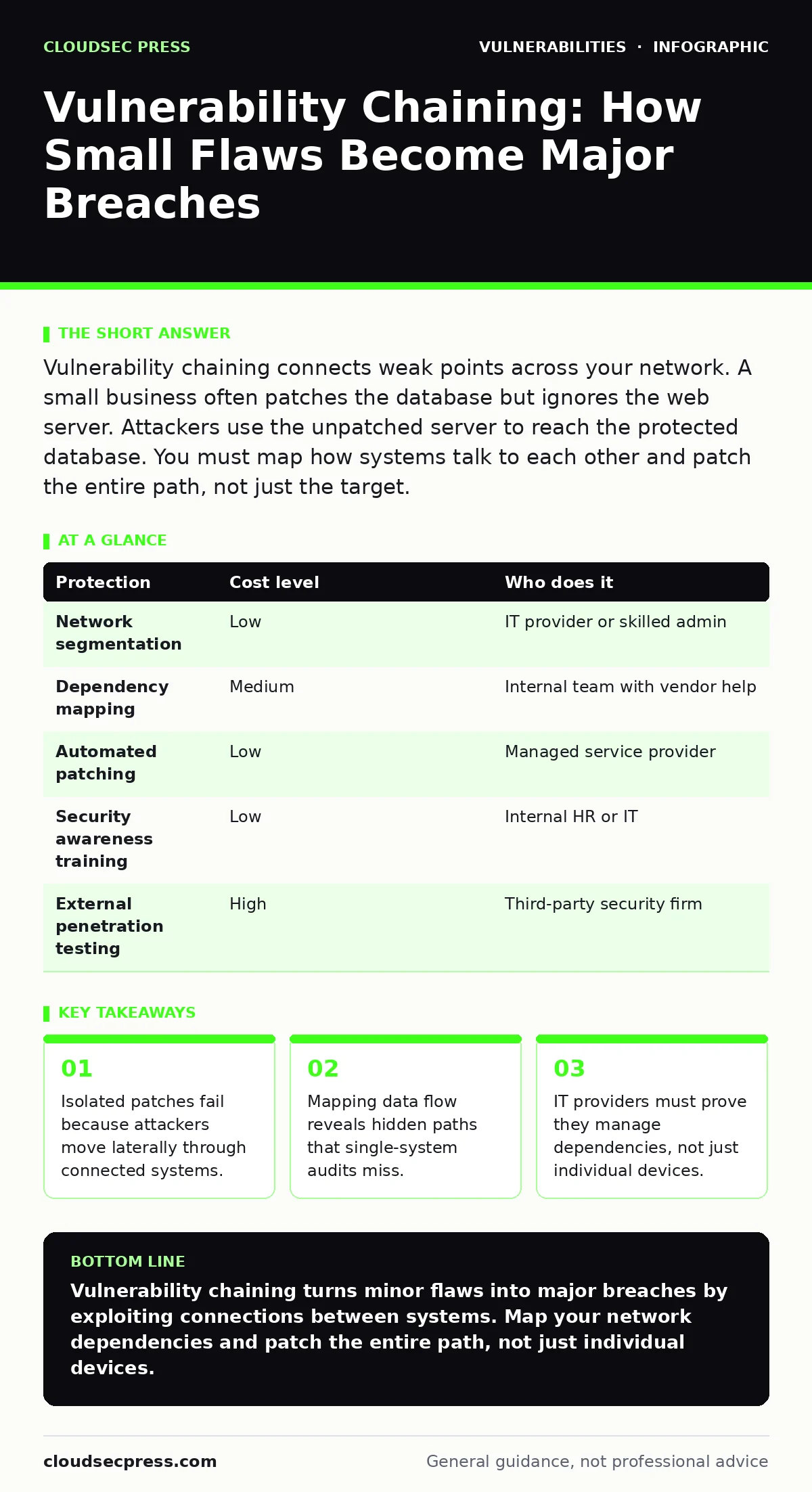
Vulnerability chaining connects weak points across your network. A small business often patches the database but ignores the web server. Attackers use the unpatched server to reach the protected database. You must map how systems talk to each other and patch the entire path, not just the target.
How Chains Form in Small Networks
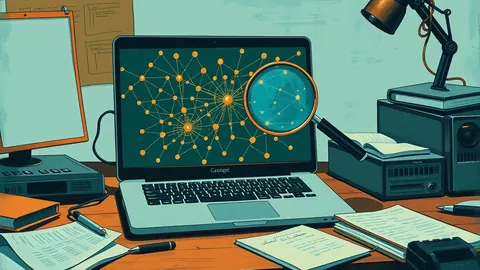
Vulnerability chaining occurs when an attacker combines multiple weaknesses to achieve a goal. A single flaw might only allow reading a file. A second flaw might allow uploading a file. Together, they allow remote code execution. Small businesses often treat each device as an island. They patch the server. They patch the router. They forget the cable connecting them.
The danger lies in the interaction between systems. You might secure the front door with a heavy lock. You leave the back window open for ventilation. An attacker does not pick the lock. They walk through the window and open the door from the inside. Your security model assumes threats come from outside. It rarely accounts for movement between internal systems.
This dynamic changes the risk profile of minor issues. A flaw in a printer firmware seems harmless. It cannot access your customer database directly. If the printer shares a network segment with the database server, the printer becomes a stepping stone. The attacker jumps from the printer to the server. The chain is complete.
Why Scale Does Not Guarantee Safety
Large enterprises have more resources but also more complexity. Small businesses have fewer resources and often less visibility. You might think fewer systems mean fewer risks. This is incorrect. Fewer systems mean fewer barriers. If one system fails, the attacker has fewer hurdles to jump.
In a large organization, strict network segmentation limits lateral movement. An attacker stuck in the marketing VLAN cannot easily reach the finance VLAN. Small networks often lack this segmentation. All devices share the same subnet. A vulnerability in the receptionist’s computer can pivot to the CEO’s laptop. The attack surface is smaller, but the blast radius is total.
You must treat your network as a single organism. You cannot protect the heart while ignoring the lungs. If the lungs fail, the heart stops. Security controls must account for the entire lifecycle of data. Data enters through email. It sits on a server. It leaves through an API. Each handoff is a potential link in the chain.
Mapping the Hidden Paths
You cannot patch what you cannot see. Most small businesses know their servers. They do not know how those servers communicate. Attackers exploit these blind spots. They look for trust relationships that were never audited. They find legacy protocols that allow unrestricted access.
Start by documenting every connection. List every device that talks to every other device. Note the protocol used. Note the data transferred. This creates a map of dependencies. If Device A trusts Device B, and Device B is compromised, Device A is at risk. This is the basis of attack surface management. You must understand the shape of your exposure.
Look for privileged accounts. These accounts have high access levels. They are often shared across systems. If one system is breached, the attacker gains the keys to the castle. Limit the scope of these accounts. Use least privilege principles. Give each system only the access it needs to function. Nothing more.
The Cost of Invisible Dependencies
Software rarely runs in a vacuum. It relies on libraries, frameworks, and plugins. These components introduce hidden risks. A flaw in a common library can affect every application that uses it. You might patch your application. You forget the library it imports. The chain remains intact.
This is where a software bill of materials (SBOM) becomes useful. An SBOM lists every component in your software stack. It reveals dependencies you did not know existed. Without an SBOM, you are guessing about your exposure. You are patching the visible symptoms while the underlying cause remains.
Consider third-party integrations. Your CRM talks to your email platform. Your email platform talks to your cloud storage. Each integration adds a link. Each link has its own security posture. If the email platform is compromised, the attacker can traverse the integration to reach your CRM. You must assess the security of your partners, not just your own code.
Practical Steps for Small Teams
You do not need a large security team to break chains. You need discipline and process. Start by reducing the number of links. Turn off unused services. Disable unnecessary ports. Every open port is a potential entry point. Every running service is a potential target.
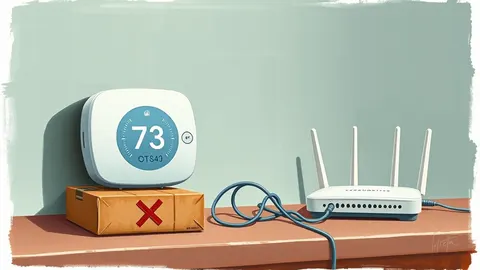
Implement network segmentation. Even a small network can be divided. Separate guest Wi-Fi from corporate devices. Separate IoT devices from critical servers. This limits lateral movement. If an attacker compromises a smart thermostat, they cannot reach the financial server. The chain is broken at the network layer.
Prioritize patching based on connectivity, not just severity. A low-severity flaw in a highly connected system is more dangerous than a high-severity flaw in an isolated system. Use remediation tracking to ensure patches are applied across all dependent systems. Do not assume a patch on one device protects the others.
| Protection | Cost level | Who does it |
|---|---|---|
| Network segmentation | Low | IT provider or skilled admin |
| Dependency mapping | Medium | Internal team with vendor help |
| Automated patching | Low | Managed service provider |
| Security awareness training | Low | Internal HR or IT |
| External penetration testing | High | Third-party security firm |
See also: Remediation Tracking Best Practices for Cloud Security · Router Firmware Vulnerabilities: 10 Critical Questions Answered
What to Ask Your IT Provider
Your IT provider is your first line of defense. They must understand chaining, not just individual fixes. Ask them how they view your network. Do they see isolated devices or a connected ecosystem? Their answer reveals their maturity.
Ask for their incident response plan. Specifically, ask how they handle lateral movement. If one server is breached, what steps do they take to isolate it? Do they have tools to detect unusual traffic between internal systems? If they cannot answer this, they are not ready for modern threats.
Ask about their patching strategy. Do they patch the OS only? Do they patch applications and libraries? Do they verify that patches do not break dependencies? A good provider tests patches in a staging environment. They understand that a patch can introduce new vulnerabilities or break functionality.
- How do you map our internal network dependencies?
- What is your process for detecting lateral movement?
- How do you handle patching for third-party integrations?
- Do you provide a software bill of materials for managed services?
- How often do you test our incident response procedures?
Breaking the Chain Before It Starts
Prevention is cheaper than recovery. You cannot stop all attacks. You can make them difficult enough that attackers move on. The goal is to increase the effort required to chain vulnerabilities. Each added step reduces the likelihood of success.
Focus on visibility. You cannot protect what you do not monitor. Use logging and monitoring tools to track activity across your network. Look for anomalies. A printer talking to a database server is unusual. Flag it. Investigate it. Break the chain at the detection phase.
Remember that security is a continuous process. New flaws emerge daily. New dependencies are added constantly. Your defense must evolve. Review your architecture regularly. Update your maps. Patch your systems. Train your staff. The chain is only as strong as its weakest link. Strengthen every link.
The Human Element in Chaining
Technology is not the only link in the chain. Humans are often the weakest point. Phishing emails target people, not servers. A clicked link can bypass technical controls. You must train your staff to recognize social engineering.
Training must be specific. Do not just say "be careful." Show them examples of chained attacks. Explain how a simple password reset can lead to full account takeover. Make them understand the consequences of their actions. Awareness reduces the risk of the first link being established.
Encourage a culture of reporting. If an employee sees something strange, they should report it. Do not punish mistakes. Reward vigilance. A small team that communicates well is harder to compromise than a large team that stays silent. The human firewall is real. Train it regularly.
Key takeaways
- Isolated patches fail because attackers move laterally through connected systems.
- Mapping data flow reveals hidden paths that single-system audits miss.
- IT providers must prove they manage dependencies, not just individual devices.
Vulnerability chaining turns minor flaws into major breaches by exploiting connections between systems. Map your network dependencies and patch the entire path, not just individual devices.
Frequently asked questions
How do I know if my network is segmented?
Check if devices on one part of the network can communicate directly with devices on another. If a guest laptop can see your server, you lack segmentation.
Is vulnerability chaining common in small businesses?
Yes, because small networks often lack strict separation between devices. Attackers exploit these open paths to move laterally and access critical data.
Do I need an SBOM for every application?
You need an SBOM for applications that process sensitive data or connect to your core infrastructure. It helps you identify hidden dependencies and risks.
Can antivirus software stop vulnerability chaining?
Antivirus stops known malware. It does not stop logic flaws or configuration errors. Chaining often uses legitimate commands, which antivirus may not flag.
How this guide was produced: written by the CloudSec Press editorial team with AI assistance, checked against the public references listed below, and reviewed when the facts change. See our editorial policy or report an error.