Lateral Movement Explained: Step-by-Step Attack Progression
Attackers rarely breach a network from the outside; they usually enter through a single weak point and move inward by stealing credentials and trusting default configurations.

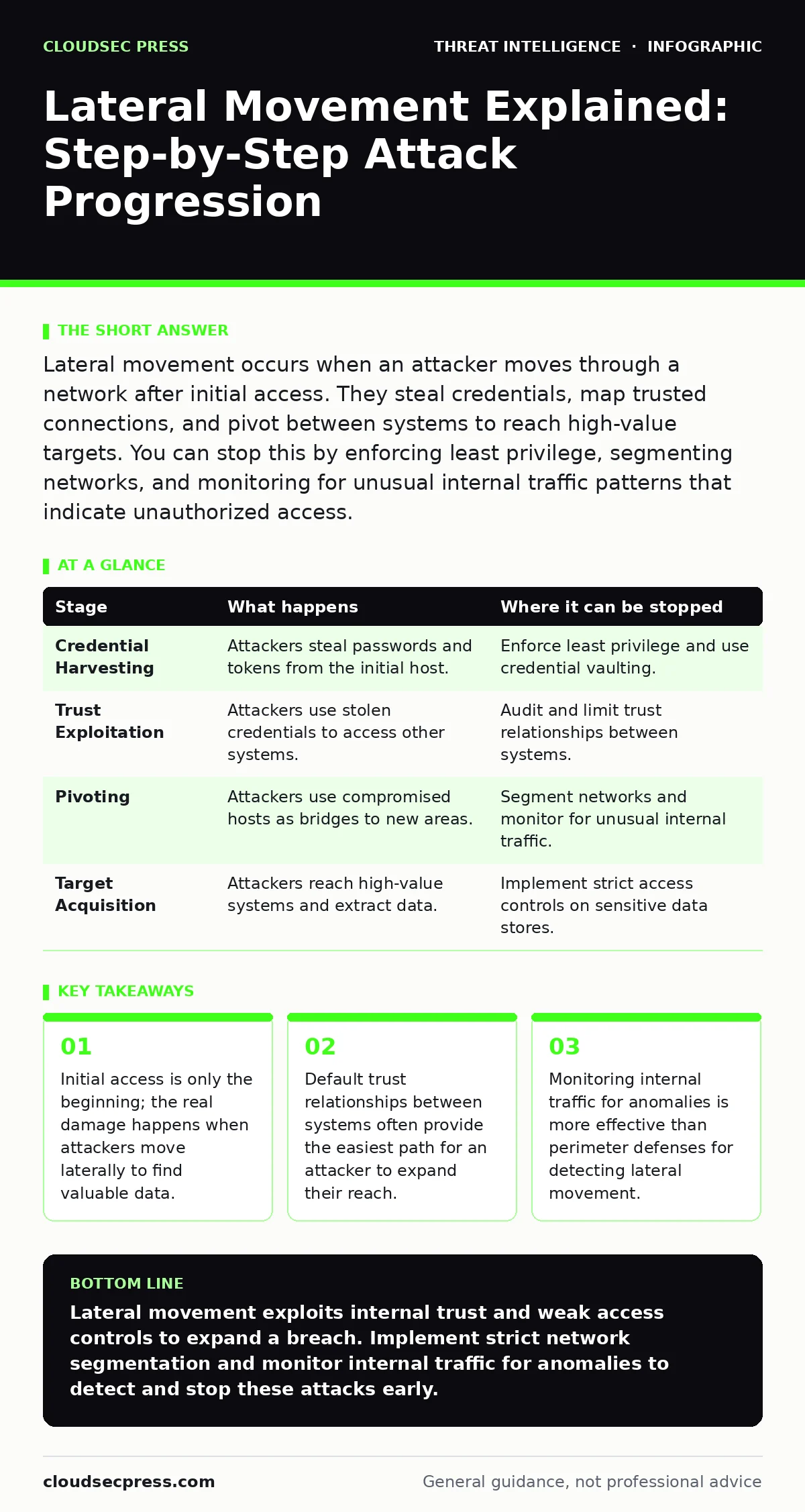
Lateral movement occurs when an attacker moves through a network after initial access. They steal credentials, map trusted connections, and pivot between systems to reach high-value targets. You can stop this by enforcing least privilege, segmenting networks, and monitoring for unusual internal traffic patterns that indicate unauthorized access.
The Mechanics of Internal Expansion
Lateral movement is the phase of a cyberattack where an adversary navigates through a network after gaining initial entry. Unlike external attacks that focus on breaching firewalls, this stage relies on internal trust relationships and misconfigurations. Attackers seek to escalate privileges and access sensitive data by moving from one compromised system to another. This process exploits the fact that most networks are designed for efficient internal communication, which attackers repurpose for their own gain. The goal is not just to stay hidden, but to reach specific high-value assets like database servers or domain controllers.
Imagine a network as a large office building. The attacker has picked the lock on a side door. They are now inside, but they do not have keys to the executive suites. Lateral movement is the act of finding unlocked internal doors, copying keycards from desks, or convincing guards to open restricted areas. The building’s design, intended for employee convenience, becomes the attacker’s roadmap. Understanding this progression helps you identify where defenses fail and where monitoring is most critical.
Stage 1: Credential Harvesting and Discovery
The first step in lateral movement involves gathering the keys to the kingdom. Attackers use various techniques to collect credentials from the initial compromised host. They may dump memory to extract passwords, capture network traffic to intercept authentication tokens, or exploit weak storage practices where credentials are saved in plain text. This stage relies on the victim system having access to more information than necessary. If a standard user account can access administrative credentials, the attacker inherits those rights.
Discovery follows immediately. The attacker scans the local network to identify other active hosts, open ports, and shared resources. They map the network topology to understand how systems communicate. This mapping reveals potential paths to higher-value targets. The attacker looks for systems that trust the compromised host or share common authentication mechanisms. Without this intelligence, random guessing would alert defenders. Methodical discovery allows the attacker to choose the path of least resistance, avoiding heavily monitored systems while targeting those with weaker security postures.
Stage 2: Exploiting Trust Relationships
Networks rely on trust relationships to function efficiently. Domain controllers manage user accounts, file servers share data, and applications communicate via service accounts. Attackers exploit these established trusts to move laterally. They use the stolen credentials to authenticate to other systems as if they were legitimate users. This stage often involves abusing remote management protocols that are enabled by default. If a system allows remote command execution, the attacker can use it to run commands on other machines within the trusted zone.
The flaw here is often excessive privilege. Many systems operate with administrative rights unnecessarily, allowing an attacker who compromises a low-level service to control the entire machine. Attackers also exploit shared service accounts where multiple systems use the same credentials. Compromising one system grants access to all others using that account. This creates a domino effect where one breach leads to widespread access. Defenders must audit these trust relationships regularly to ensure they are minimal and strictly controlled.
Stage 3: Pivoting and Escalation
Pivoting is the technical act of using a compromised system as a bridge to reach other parts of the network. The attacker sets up a proxy or tunnel through the compromised host, masking their origin. This makes it appear as though traffic is coming from a trusted internal source. They then use this bridge to attack systems that are not directly reachable from their initial entry point. This stage often involves escalating privileges to gain administrative control over new systems.
Escalation relies on finding vulnerabilities in the new systems or misconfigurations that allow privilege growth. Attackers may exploit unpatched software, weak configurations, or default passwords. Once they gain higher privileges, they can access more sensitive data and move further into the network. This stage is critical because it transforms a limited breach into a full compromise. The attacker moves from a guest role to an administrator role, gaining the ability to install persistent tools and cover their tracks.
Stage 4: Target Acquisition and Data Staging
The final stage of lateral movement is reaching the specific target. Attackers know what they are looking for, whether it is intellectual property, customer data, or financial records. They move toward systems that store this information, often identified during the discovery phase. Once they reach the target system, they exfiltrate data or install ransomware. This stage relies on the attacker having successfully navigated the network without detection.
Data staging involves collecting the target information into a single location for easier extraction. Attackers may compress and encrypt the data to hide its contents from network monitoring tools. They then transfer the data to an external server under their control. This final step completes the attack chain. The success of this stage depends entirely on the previous stages. If the attacker cannot move laterally or escalate privileges, they cannot reach the high-value targets.
| Stage | What happens | Where it can be stopped |
|---|---|---|
| Credential Harvesting | Attackers steal passwords and tokens from the initial host. | Enforce least privilege and use credential vaulting. |
| Trust Exploitation | Attackers use stolen credentials to access other systems. | Audit and limit trust relationships between systems. |
| Pivoting | Attackers use compromised hosts as bridges to new areas. | Segment networks and monitor for unusual internal traffic. |
| Target Acquisition | Attackers reach high-value systems and extract data. | Implement strict access controls on sensitive data stores. |
See also: Botnet Attack Mistakes That Leave Your Network Exposed · DNS Filtering for Schools: How It Blocks Threats and Shapes Access
Monitoring for Internal Anomalies
Detecting lateral movement requires looking inside the network, not just at the perimeter. Traditional firewalls often miss internal traffic because it is trusted. You must monitor for unusual patterns such as a workstation connecting to a database server at odd hours. Behavioral analytics can help identify these anomalies by learning normal network behavior. Any deviation from the baseline should trigger an alert.
Focus on authentication logs. Multiple failed login attempts followed by a success can indicate credential testing. Look for lateral movement tools being used, such as remote management software or command-line tools. These tools are often legitimate but become suspicious when used in unusual contexts. Integrating threat intelligence with your monitoring tools can help identify known attack patterns. See our guide on tactical threat intelligence for more on using this data effectively.
Breaking the Chain of Movement
Stopping lateral movement requires a combination of technical controls and process changes. Network segmentation is one of the most effective defenses. By dividing the network into smaller zones, you limit the attacker’s ability to move freely. Each zone should have strict access controls, requiring explicit permission to cross boundaries. This reduces the blast radius of a compromise.
Privilege management is equally important. Ensure that users and services only have the minimum privileges necessary to perform their tasks. Regularly audit accounts to remove unnecessary access. Disable unused accounts and enforce strong authentication methods. Multi-factor authentication adds an extra layer of security, making it harder for attackers to use stolen credentials. See our guide on incident triage to understand how to respond when lateral movement is detected.
The Role of Threat Intelligence
Threat intelligence helps you anticipate how attackers might move through your network. By understanding common tactics, you can proactively strengthen your defenses. Indicators of compromise (IOCs) can help identify known attack tools and techniques. Enriching these indicators with context helps you prioritize alerts and respond faster. See our guide on IOC enrichment for details on enhancing your data.
Understanding threat actor profiling can also help. Different attackers have different goals and methods. Knowing who might target you helps you tailor your defenses. For example, some attackers focus on ransomware, while others seek espionage. Adjusting your monitoring to look for specific behaviors can improve detection. See our guide on threat actor naming conventions to standardize your internal reporting.
Long-Term Defense Strategies
Defending against lateral movement is an ongoing process. You must continuously monitor, audit, and improve your security posture. Regular penetration testing can reveal weaknesses in your network segmentation and access controls. These tests simulate real attacks, helping you identify gaps before attackers do.
Employee training is also vital. Users can inadvertently facilitate lateral movement by falling for phishing attacks or using weak passwords. Educate them on the risks and best practices. See our guide on open-source intelligence (OSINT) to understand how attackers gather information about your organization. Finally, stay updated on new threats and vulnerabilities. The attack landscape changes constantly, and your defenses must evolve with it. See our guide on DCSync attacks for a specific example of how attackers exploit directory services.
Key takeaways
- Initial access is only the beginning; the real damage happens when attackers move laterally to find valuable data.
- Default trust relationships between systems often provide the easiest path for an attacker to expand their reach.
- Monitoring internal traffic for anomalies is more effective than perimeter defenses for detecting lateral movement.
Lateral movement exploits internal trust and weak access controls to expand a breach. Implement strict network segmentation and monitor internal traffic for anomalies to detect and stop these attacks early.
Frequently asked questions
How is lateral movement different from initial access?
Initial access is the first breach of the network perimeter, while lateral movement is the subsequent navigation through internal systems to reach high-value targets.
Can firewalls stop lateral movement?
Traditional perimeter firewalls often fail to stop lateral movement because internal traffic is usually trusted. You need internal segmentation and monitoring to detect and block it.
What is the most common tool used for lateral movement?
Attackers often use legitimate remote management tools and protocols, such as SSH or RDP, to move laterally, making detection more challenging.
How often should I audit trust relationships?
You should audit trust relationships regularly, at least quarterly, to ensure they are still necessary and properly configured.
How this guide was produced: written by the CloudSec Press editorial team with AI assistance, checked against the public references listed below, and reviewed when the facts change. See our editorial policy or report an error.