Tactical Threat Intelligence Explained: Actionable Indicators for Defense
Tactical threat intelligence converts raw data into specific indicators that security tools can automatically block or alert on within minutes.
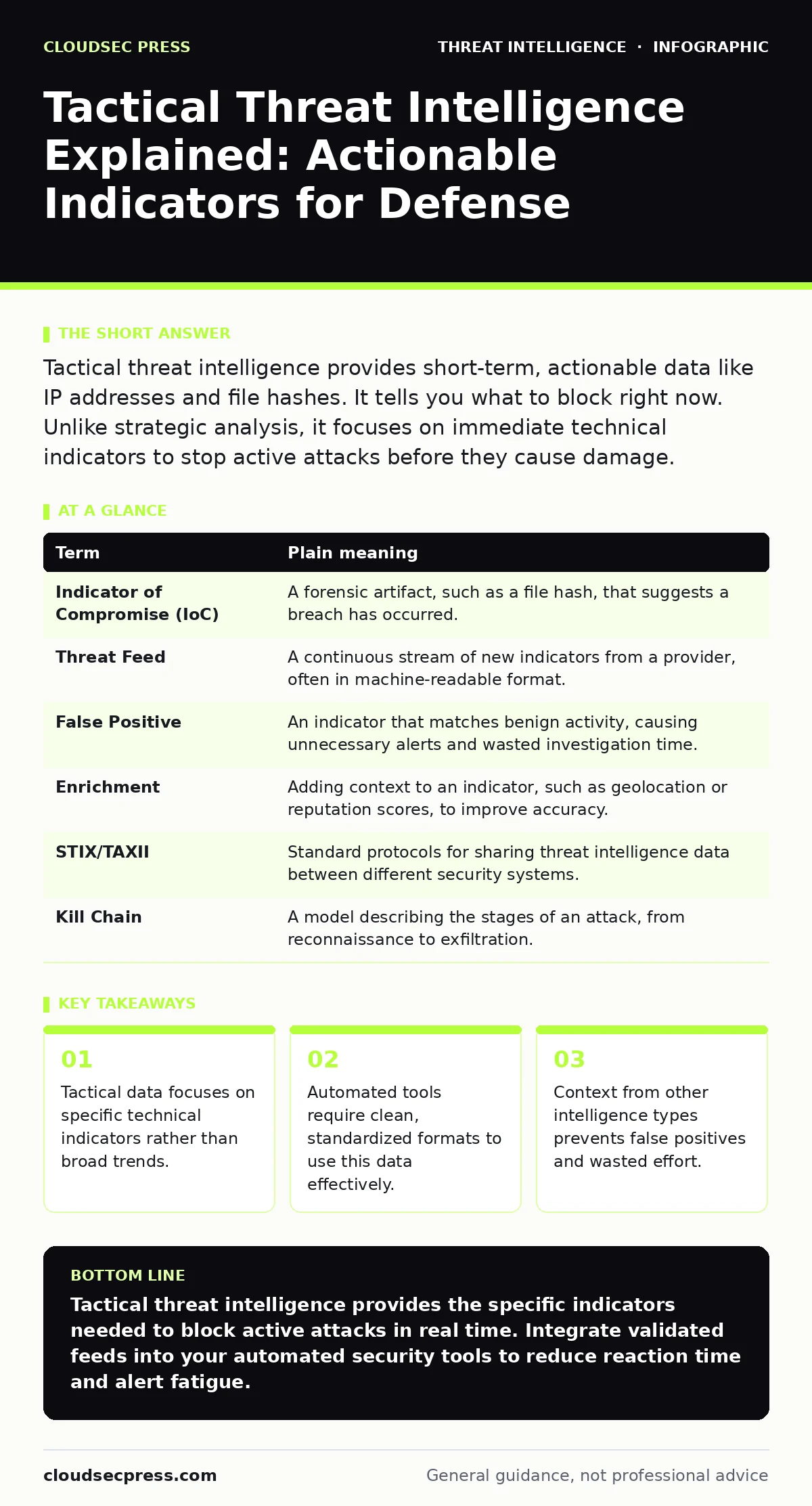
Tactical threat intelligence provides short-term, actionable data like IP addresses and file hashes. It tells you what to block right now. Unlike strategic analysis, it focuses on immediate technical indicators to stop active attacks before they cause damage.
What Is Tactical Threat Intelligence
Tactical threat intelligence consists of specific technical indicators that security teams use to detect and block active attacks. These indicators include IP addresses, domain names, file hashes, and URLs. You use this data to configure firewalls, intrusion detection systems, and endpoint protection tools. It answers the question of what specific artifacts an adversary uses in their current campaigns. This type of intelligence has a short shelf life. An attacker changes their command-and-control server IP address frequently. Once they change it, the old indicator becomes useless noise. You must update your feeds constantly to stay effective.
Imagine a neighborhood watch group. Strategic intelligence is the mayor’s report on rising crime trends in the city. Operational intelligence is the police briefing about a specific gang’s preferred methods. Tactical intelligence is the description of the suspect’s blue sedan with a cracked windshield. You look for that specific car right now. If you see it, you call the police. If you ignore it, you miss the immediate threat. This analogy holds throughout the guide. The blue sedan is your indicator of compromise.
Key Terms and Definitions
Understanding the vocabulary helps you separate useful data from noise. Many terms overlap, causing confusion for beginners. Use this table to clarify the distinctions.
| Term | Plain meaning |
|---|---|
| Indicator of Compromise (IoC) | A forensic artifact, such as a file hash, that suggests a breach has occurred. |
| Threat Feed | A continuous stream of new indicators from a provider, often in machine-readable format. |
| False Positive | An indicator that matches benign activity, causing unnecessary alerts and wasted investigation time. |
| Enrichment | Adding context to an indicator, such as geolocation or reputation scores, to improve accuracy. |
| STIX/TAXII | Standard protocols for sharing threat intelligence data between different security systems. |
| Kill Chain | A model describing the stages of an attack, from reconnaissance to exfiltration. |
Common Points of Confusion
Readers often mix up tactical, operational, and strategic intelligence. Strategic intelligence looks at long-term trends and adversary motivations. It helps executives plan budgets and policy. Operational intelligence describes adversary capabilities and tactics. It helps teams prepare defenses for likely methods. Tactical intelligence provides the specific indicators for immediate action. It helps tools block known bad actors. Confusing these layers leads to poor resource allocation. You might spend weeks analyzing an adversary’s ideology when you should be blocking a malicious IP address today.
Another common mistake is treating all indicators as equal. Not every IP address in a threat feed is equally dangerous. Some indicators have high confidence scores. Others are speculative. Without context, you risk blocking legitimate traffic. This is known as a false positive. A false positive disrupts business operations. It erodes trust in your security tools. You must validate indicators before deploying them widely.
The Role of Automation
Tactical intelligence works best when automated. Manual review of thousands of indicators is impossible at scale. You need tools to ingest, normalize, and deploy this data automatically. Security Information and Event Management (SIEM) systems often integrate threat feeds directly. They correlate indicators with internal logs in real time. Security Orchestration, Automation, and Response (SOAR) platforms can trigger automated responses. For example, if a firewall sees a known malicious IP, the SOAR platform can block it and create a ticket. This speed is critical. Attackers move quickly. Manual response is too slow.
However, automation has a hidden cost. Garbage in, garbage out. If your threat feed contains low-quality data, your tools will generate noise. You must curate your sources carefully. Open-source intelligence (OSINT) provides free data, but it requires heavy validation. Commercial feeds often offer better quality but at a higher cost. Balance cost against quality. Test new feeds in a sandbox before enabling them in production.
Integrating with Other Intelligence Types
Tactical intelligence does not exist in isolation. It gains power when combined with other types. Threat actor profiling provides context for why an attacker uses certain indicators. Knowing the adversary’s goals helps you prioritize which indicators to block first. If an attacker targets financial data, you prioritize indicators related to data exfiltration. Process injection techniques are often used to evade detection. Tactical indicators for these techniques help you catch advanced threats. DCSync attacks are a specific method for compromising Active Directory. Tactical indicators for these attacks can alert you to credential theft.
Cyber espionage campaigns often use long-term infrastructure. Tactical indicators for these campaigns change slowly. You can maintain these indicators for longer periods. Dark web monitoring can reveal stolen credentials or upcoming attack plans. This operational data can generate new tactical indicators. For example, if you see a new domain being registered for sale, it might be used for phishing. You can block that domain before the attack launches. This proactive approach reduces your reaction time.
See also: How the Dark Web Works: Architecture, Access, and Intelligence
Practical Steps for Implementation
You can start using tactical threat intelligence today. Follow these three steps to begin.
- Identify your critical assets. Determine what data and systems need protection. Focus your intelligence on threats that target these assets.
- Select a reliable threat feed. Look for providers that offer standardized formats like STIX. Ensure they provide context and confidence scores.
- Integrate with your security tools. Connect the feed to your SIEM or firewall. Test the integration in a non-production environment first. Monitor for false positives. Adjust filters as needed.
Managing the Lifecycle of Indicators
Indicators expire. An IP address used for command-and-control today might be reassigned to a legitimate user tomorrow. You must manage the lifecycle of your indicators. Set expiration dates for each indicator. Remove old indicators automatically. Review your feeds regularly. Prune sources that provide low-quality data. This maintenance keeps your defenses sharp. It prevents alert fatigue. Alert fatigue causes analysts to ignore real threats. By keeping your data clean, you ensure that every alert gets attention.
Key takeaways
- Tactical data focuses on specific technical indicators rather than broad trends.
- Automated tools require clean, standardized formats to use this data effectively.
- Context from other intelligence types prevents false positives and wasted effort.
Tactical threat intelligence provides the specific indicators needed to block active attacks in real time. Integrate validated feeds into your automated security tools to reduce reaction time and alert fatigue.
Frequently asked questions
How often should I update my tactical threat intelligence feeds?
Update feeds daily or in real time. Attackers change their infrastructure frequently. Stale data provides little protection.
Can I use free tactical threat intelligence feeds?
Yes, open-source feeds are available. However, they require more validation and may contain lower-quality data than commercial options.
What is the difference between an IoC and an IoA?
An Indicator of Compromise (IoC) is a specific artifact like a file hash. An Indicator of Attack (IoA) is a behavior or action, such as unusual network traffic.
Do I need a SOC analyst to use tactical intelligence?
Not necessarily. Automated tools can ingest and act on tactical data. However, human oversight is needed to manage false positives and tune rules.
How this guide was produced: written by the CloudSec Press editorial team with AI assistance, checked against the public references listed below, and reviewed when the facts change. See our editorial policy or report an error.