Pyramid of Pain: How Indicator Difficulty Shapes Your Defense
High-level indicators like hashes are useless if attackers change files, forcing you to hunt for infrastructure and tactics that cost them more to replace.

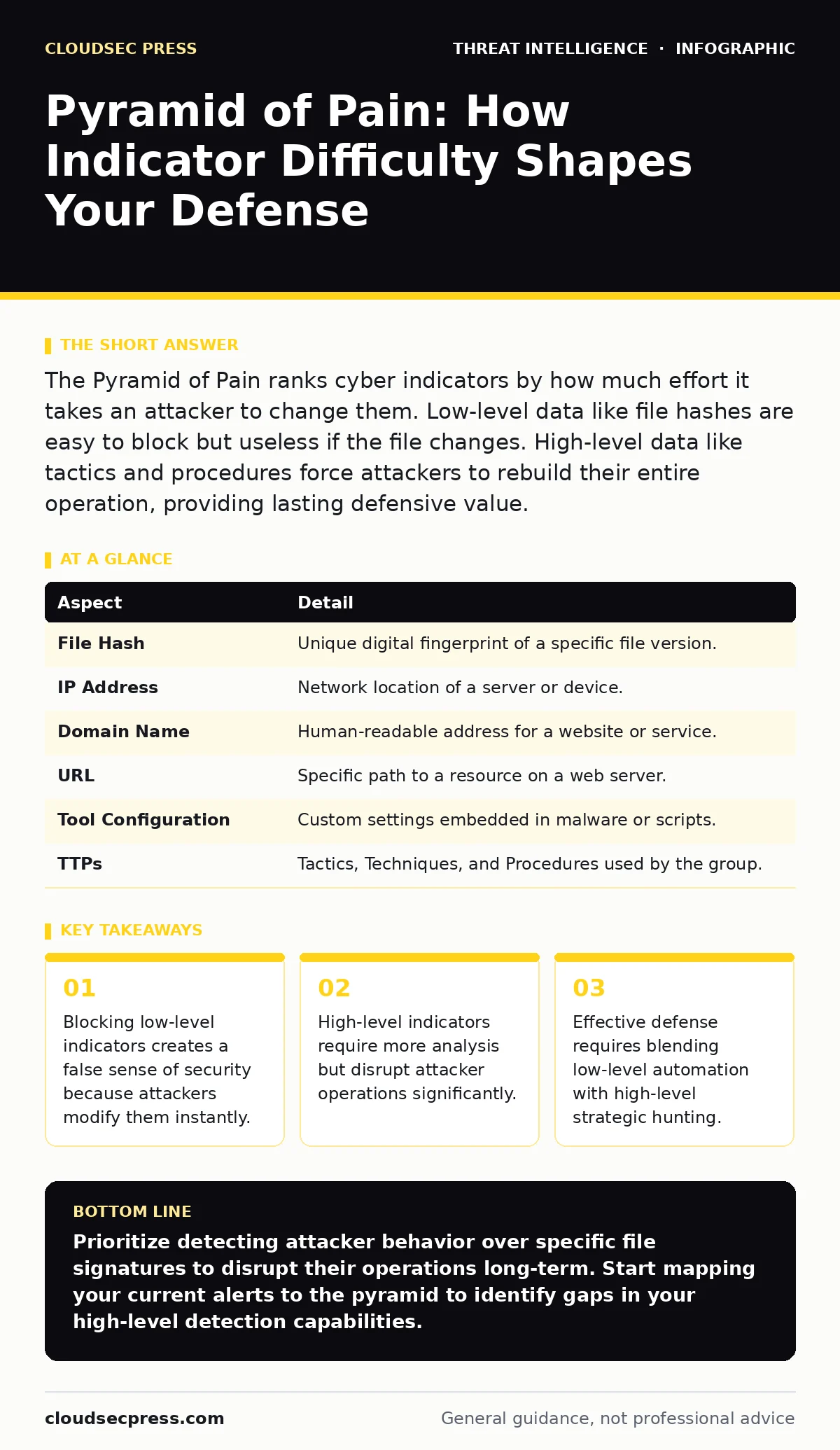
The Pyramid of Pain ranks cyber indicators by how much effort it takes an attacker to change them. Low-level data like file hashes are easy to block but useless if the file changes. High-level data like tactics and procedures force attackers to rebuild their entire operation, providing lasting defensive value.
The Cost of Changing Tools
Imagine a burglar who changes his fingerprint every time he touches a door handle. You could print his fingerprint and ban him, but he simply alters it again. The next day, he is back inside. This is the core problem with relying on low-level data in cybersecurity.
The Pyramid of Pain is a conceptual model that ranks indicators of compromise by the effort required for an attacker to change them. Indicators at the base are easy for attackers to alter, meaning your defenses provide only temporary relief. Indicators at the peak are difficult and costly for attackers to change, meaning your defenses disrupt their long-term operations.
Most teams focus on the base because that data is easy to collect. They block a malicious file hash, feel secure, and move on. The attacker, however, simply recompiles the code with a slight variation. The new file has a different hash. Your block rule fails. You must start over.
This cycle drains your resources. You are playing whack-a-mole. The pyramid helps you decide where to spend your limited analyst time. It argues that you should care more about the attacker’s methods than the specific tools they use today.
Anatomy of the Six Levels
The model consists of six distinct tiers. Each tier represents a different type of data you can collect from logs, network traffic, or malware analysis. Understanding the trade-off at each level is key to building effective operational threat intelligence.
| Aspect | Detail |
|---|---|
| File Hash | Unique digital fingerprint of a specific file version. |
| IP Address | Network location of a server or device. |
| Domain Name | Human-readable address for a website or service. |
| URL | Specific path to a resource on a web server. |
| Tool Configuration | Custom settings embedded in malware or scripts. |
| TTPs | Tactics, Techniques, and Procedures used by the group. |
At the bottom, File Hash is the easiest to detect. Your antivirus scans files and compares their hashes against a database of known bad files. If they match, it blocks the file. The downside is that the attacker only needs to change one byte of code to generate a new hash. Your detection becomes obsolete immediately.
Moving up, IP Address and Domain Name are slightly harder to change. Attackers rent servers or register domains. Changing these costs money and time. However, they often use stolen credentials or bullet-proof hosting, making these indicators noisy and prone to false positives.
The middle layers, URL and Tool Configuration, require more specific knowledge. A URL might point to a command-and-control server. A tool configuration might be a unique string embedded in a script. These are harder to automate but provide better context than a simple IP address.
The peak, TTPs, stands for Tactics, Techniques, and Procedures. This describes how the attacker thinks and operates. It includes the sequence of actions they take, the tools they prefer, and the goals they pursue. Changing TTPs requires the attacker to learn new skills, buy new infrastructure, and rewrite their entire playbook. This is painful for them.
Why the Base Is a Trap
Teams often mistake volume for value. They collect millions of file hashes and IP addresses. They feed this data into their SIEM (Security Information and Event Management) systems. The system alerts on every match. This creates alert fatigue.
The trap is that low-level indicators are ephemeral. They exist for a short time. By the time you analyze a hash, the attacker has moved on. You are reacting to history, not preventing future attacks. This reactive posture leaves you vulnerable to new variants.
Furthermore, low-level indicators lack context. A file hash tells you nothing about why the file is bad. It does not tell you who created it or what it tries to do. Without context, you cannot prioritize your response. You might block a critical business file because it was mislabeled as malicious.
This is where incident triage becomes difficult. Analysts spend hours investigating alerts that turn out to be noise. They chase ghosts. The pyramid warns you that chasing ghosts is a waste of time. You need to look higher up the stack.
The Value of the Peak
Focusing on TTPs changes your defensive posture. Instead of asking "What file is this?", you ask "What is the attacker trying to achieve?" This shift allows you to detect novel attacks. Even if the attacker uses a new tool, their behavior remains similar.
For example, if an attacker uses a specific method to escalate privileges, you can detect that behavior regardless of the tool used. You look for the sequence of events, not the specific binary. This is the basis of behavioral detection. It is harder to implement but far more effective.
This approach also aids in threat actor profiling. By understanding their TTPs, you can attribute attacks to specific groups. You can predict their next move based on their past behavior. This proactive stance allows you to harden your environment against likely future attacks.
The cost is higher. Analyzing TTPs requires skilled analysts. You need to correlate data from multiple sources. You need to understand the attacker’s mindset. But the payoff is a defense that adapts to change. You stop playing whack-a-mole.
Common Misconceptions
Many teams misunderstand the pyramid. They think it is a hierarchy of importance. They assume you should ignore the base. This is wrong. You need the base for automation. You need the peak for strategy. The pyramid is a balance, not a choice.
Another mistake is treating TTPs as static. Attackers adapt. They change their TTPs to avoid detection. You must continuously update your understanding of their behavior. This requires ongoing attacker persistence techniques analysis. You must know how they stay in your network to detect when they return.
Some teams believe that high-level indicators are too vague. They argue that you cannot block a tactic. This is true. You cannot block a concept. But you can detect the actions that implement the concept. You can monitor for the specific commands or network patterns that indicate the tactic is being used.
Finally, teams often fail to share high-level intelligence. They hoard their TTP analysis. This limits the value of their work. Sharing TTPs with partners and communities helps everyone defend better. It raises the cost for attackers across the board.
See also: Tactical Threat Intelligence Explained: Actionable Indicators for Defense
Implementing the Model in Practice
Start by mapping your current detections to the pyramid. Identify how many alerts come from the base. Identify how many come from the peak. You will likely find a heavy skew toward the base. This is your starting point.
Next, invest in tools that support behavioral detection. Look for platforms that can correlate events over time. These tools help you identify TTPs. They reduce the noise from low-level indicators. This is where SOAR (Security Orchestration, Automation, and Response) can help. Automate the response to low-level alerts. Free up your analysts to focus on high-level analysis.
Train your analysts to think in terms of TTPs. Teach them to look for the "why" behind the alert. Encourage them to document the attacker’s behavior. Build a library of TTPs specific to your industry. This knowledge base becomes your most valuable asset.
Finally, measure your success differently. Do not measure by the number of blocks. Measure by the time it takes to detect and respond to new tactics. Measure by the reduction in false positives. This aligns your metrics with the pyramid’s goals.
Beyond the Pyramid
The pyramid is a starting point, not the end. It helps you prioritize your efforts. But it does not tell you how to collect the data. You need robust logging, network monitoring, and endpoint detection. You need to ensure you have the visibility to see the attacker’s actions.
Integrate the pyramid with your broader security strategy. Use it to inform your risk assessments. Use it to guide your training programs. Use it to justify investments in advanced tools. The goal is to make the attacker’s life harder.
Remember that attackers are not static. They evolve. They find new ways to bypass your defenses. You must stay ahead of them. This requires continuous learning and adaptation. The pyramid provides the framework. You provide the effort.
Key takeaways
- Blocking low-level indicators creates a false sense of security because attackers modify them instantly.
- High-level indicators require more analysis but disrupt attacker operations significantly.
- Effective defense requires blending low-level automation with high-level strategic hunting.
Prioritize detecting attacker behavior over specific file signatures to disrupt their operations long-term. Start mapping your current alerts to the pyramid to identify gaps in your high-level detection capabilities.
Frequently asked questions
Should I stop blocking file hashes?
No, continue blocking hashes for automation, but do not rely on them as your primary defense. Use them to trigger deeper analysis of the underlying behavior.
How do I identify TTPs from logs?
Look for sequences of events that indicate a specific goal, such as privilege escalation or data exfiltration. Correlate these events across different systems to build a complete picture.
Is the Pyramid of Pain still relevant?
Yes, the fundamental trade-off between ease of detection and attacker cost remains valid. While tools evolve, the principle of focusing on behavior over static indicators holds true.
Can I use this for threat hunting?
Absolutely. The pyramid is a core concept in threat hunting. It helps you formulate hypotheses about attacker behavior and guides your search for evidence in your environment.
How this guide was produced: written by the CloudSec Press editorial team with AI assistance, checked against the public references listed below, and reviewed when the facts change. See our editorial policy or report an error.