Operational Threat Intelligence: 6 Common Misreadings Corrected
Operational threat intelligence is not a static list of bad actors but a dynamic context engine that reduces noise in your security tools.

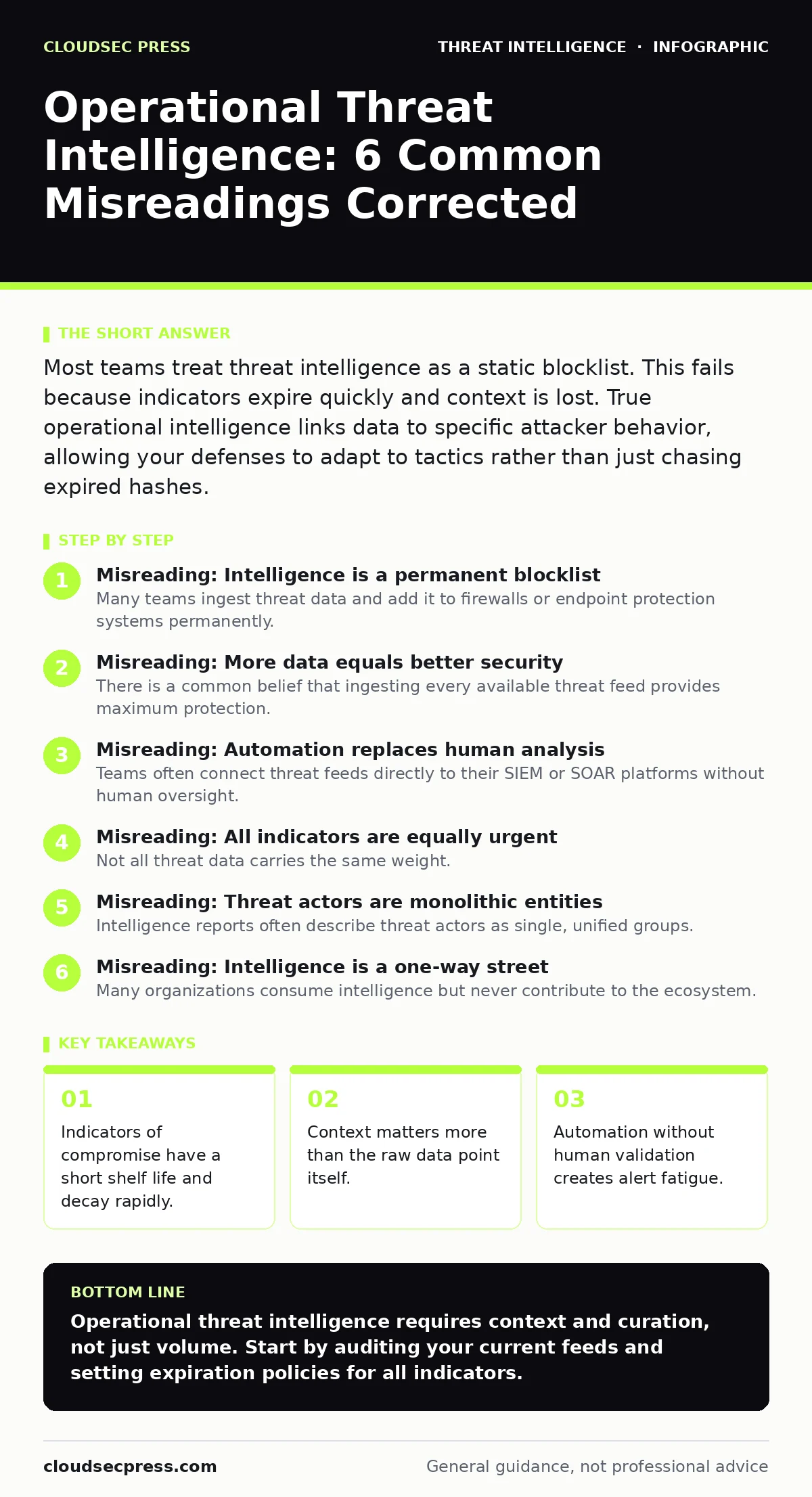
Most teams treat threat intelligence as a static blocklist. This fails because indicators expire quickly and context is lost. True operational intelligence links data to specific attacker behavior, allowing your defenses to adapt to tactics rather than just chasing expired hashes.
Misreading: Intelligence is a permanent blocklist
Many teams ingest threat data and add it to firewalls or endpoint protection systems permanently. This assumes that a malicious indicator will remain malicious forever. In reality, indicators of compromise, or IOCs, such as IP addresses and file hashes, change frequently. An IP address used by an attacker today may be reassigned to a legitimate business next month. Blocking it permanently causes false positives that disrupt user activity. The correct approach is to treat IOCs as temporary signals. You should set expiration dates on all ingested data. When an indicator expires, your system removes it automatically. This keeps your defenses accurate and reduces noise.
Correct reading: Treat every indicator as temporary. Set automatic expiration policies to remove stale data from your security controls.
Misreading: More data equals better security
There is a common belief that ingesting every available threat feed provides maximum protection. This leads to data overload, where your security team cannot process the volume of alerts. Most open-source feeds contain low-quality or irrelevant data for your specific environment. For example, a feed focused on ransomware targeting healthcare provides little value to a retail company.
This noise drowns out genuine threats and wastes analyst time. You must prioritize quality over quantity. Select feeds that align with your industry and technology stack. Use IOC enrichment to add context to raw data before it reaches your analysts. This process adds details like reputation scores and associated malware families. It helps you decide if an indicator warrants action.
Correct reading: Curate your sources based on relevance. Enrich data to add context before alerting your team.
Misreading: Automation replaces human analysis
Teams often connect threat feeds directly to their SIEM or SOAR platforms without human oversight. The expectation is that the system will automatically block all threats. This ignores the complexity of attacker behavior. Some indicators are ambiguous or have dual-use purposes. For instance, a domain might be used for both legitimate marketing and phishing campaigns.
Automatic blocking can break legitimate business processes. Human analysts must validate high-impact actions. They review the context and decide if the risk justifies the disruption. Automation should handle low-risk, high-volume tasks like logging or tagging. It should not make final decisions on blocking critical infrastructure.
Correct reading: Use automation for triage and logging. Reserve blocking actions for validated, high-confidence threats.
Misreading: All indicators are equally urgent
Not all threat data carries the same weight. A generic IP address has low specificity and high noise. A unique file hash or a specific command-and-control domain has high specificity. Treating all indicators with the same priority leads to alert fatigue. Analysts become desensitized to warnings when most are low-value. You must classify intelligence by confidence and severity.
High-confidence indicators related to active campaigns require immediate attention. Low-confidence indicators may be monitored but not blocked. This prioritization ensures your team focuses on real threats. It also helps in resource allocation during incidents. Understanding attacker persistence techniques helps you identify high-value targets that require immediate response.
Correct reading: Prioritize indicators by specificity and confidence. Focus resources on high-value, actionable intelligence.
Misreading: Threat actors are monolithic entities
Intelligence reports often describe threat actors as single, unified groups. This simplifies the narrative but obscures the reality. Attackers often share tools, infrastructure, and tactics. A tool used by one group may be adopted by many others. Focusing on the name of the group can lead to blind spots. You might ignore an attack because it does not match the named group’s usual profile.
Instead, focus on tactics, techniques, and procedures, or TTPs. These behaviors are more stable than the names or tools used. For example, DCSync attacks are a technique, not a specific group. Monitoring for the technique protects you regardless of who uses it. Understanding threat actor naming conventions helps you navigate reports, but TTPs drive your defense.
Correct reading: Monitor behaviors and techniques, not just group names. TTPs are more reliable indicators of risk than labels.
See also: How Threat Actor Profiling Works: Mechanics, Limits and Missteps · Lateral Movement Explained: Step-by-Step Attack Progression
Misreading: Intelligence is a one-way street
Many organizations consume intelligence but never contribute to the ecosystem. This limits their access to high-quality, private data. Sharing your own observations helps the community and improves your own data. However, sharing must be done carefully. You must scrub sensitive information about your own infrastructure. Revealing your internal IP ranges or asset details helps attackers target you.
Use standardized formats like STIX or TAXII for sharing. These standards ensure compatibility and reduce errors. Participating in information sharing and analysis teams, or ISACs, allows secure collaboration. It provides access to industry-specific threats that open feeds miss. This reciprocal relationship strengthens your overall posture.
Correct reading: Share sanitized data to improve community intelligence. Use standard formats to ensure safe and effective collaboration.
Key takeaways
- Indicators of compromise have a short shelf life and decay rapidly.
- Context matters more than the raw data point itself.
- Automation without human validation creates alert fatigue.
- Intelligence must map to your specific assets and risks.
Operational threat intelligence requires context and curation, not just volume. Start by auditing your current feeds and setting expiration policies for all indicators.
Frequently asked questions
How long should I keep an indicator of compromise?
Most indicators expire within days or weeks. Set default expiration periods based on the type of indicator and your risk tolerance.
Can I trust open-source threat feeds?
Open-source feeds are useful but often contain noise. Always enrich and validate data before using it in critical security controls.
What is the difference between strategic and operational intelligence?
Strategic intelligence informs long-term planning and risk management. Operational intelligence drives immediate defensive actions and tool configurations.
How do I measure the value of my threat intelligence?
Track metrics like detection time, false positive rates, and the number of blocked threats. Compare these metrics before and after implementing new feeds.
How this guide was produced: written by the CloudSec Press editorial team with AI assistance, checked against the public references listed below, and reviewed when the facts change. See our editorial policy or report an error.