How Threat Actor Profiling Works: Mechanics, Limits and Missteps
Profiling maps digital artifacts to behavior patterns, revealing that many attacks reuse code so much that unique identity is often an illusion.

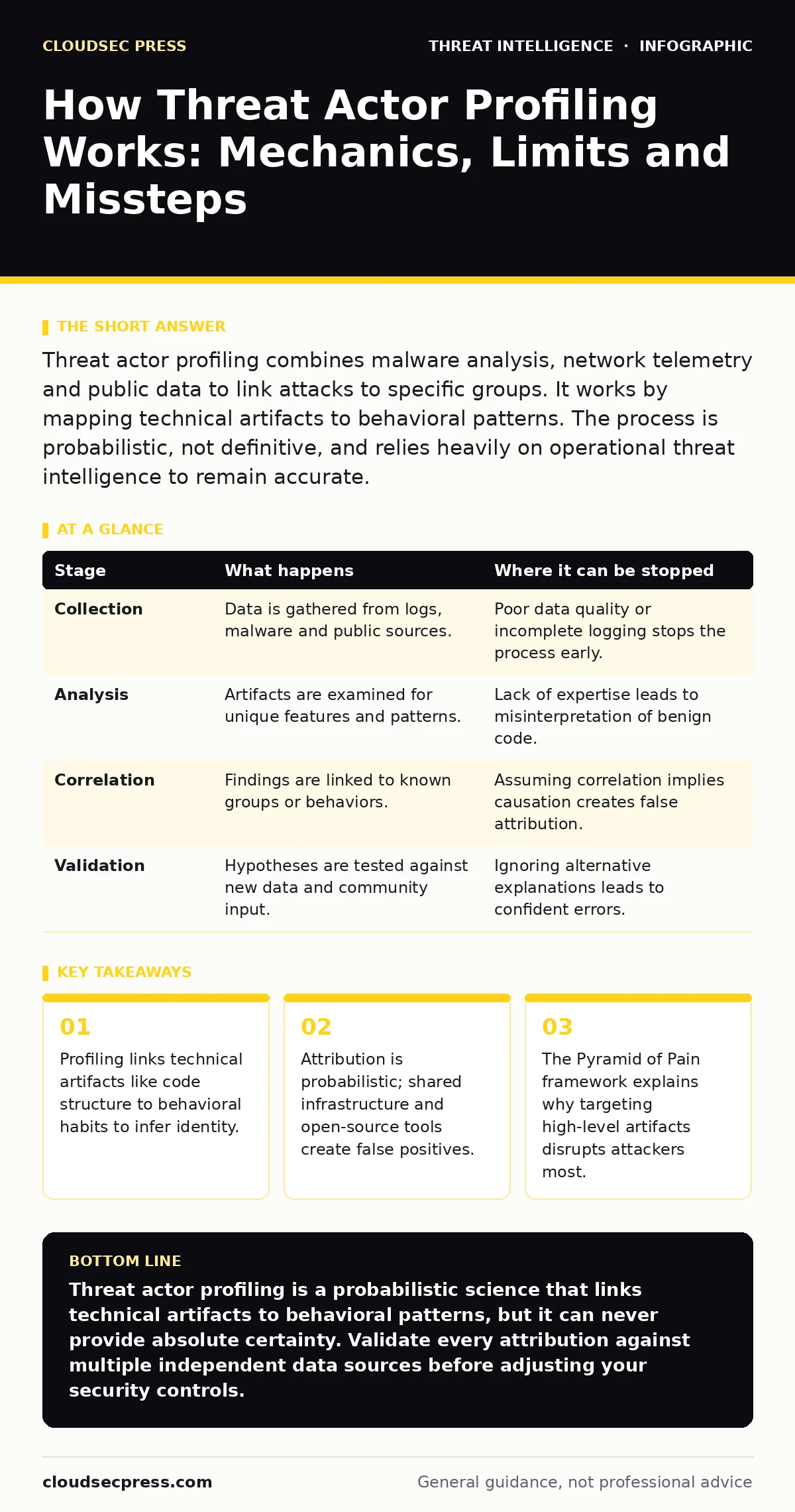
Threat actor profiling combines malware analysis, network telemetry and public data to link attacks to specific groups. It works by mapping technical artifacts to behavioral patterns. The process is probabilistic, not definitive, and relies heavily on operational threat intelligence to remain accurate.
The Anatomy of Digital Identity
Threat actor profiling is the process of attributing cyberattacks to specific groups or individuals. It is not magic. It is detective work performed on a massive scale, combining technical analysis with behavioral psychology. You are not looking for a name on a virus. You are looking for a pattern of habits that repeats across multiple incidents.
Imagine a burglar who always enters through the back door and leaves a specific type of tool behind. Even if they wear a mask, their method of entry and their choice of tools create a signature. In cybersecurity, these signatures are digital. They exist in code, in network traffic and in the timing of actions.
Profiling fails when analysts treat correlation as causation. Just because two attacks used the same software does not mean the same person launched them. Open-source tools are available to everyone. The goal is to find the unique modifications, the idiosyncrasies that a human developer leaves behind when they build or adapt a tool.
### Stage 1: Collection and Ingestion
The process begins with data collection. Security teams gather artifacts from their own environment and from external sources. This includes malware samples, network logs, email headers and web server records. You also pull in data from public forums and the dark web, where attackers sometimes boast about their work or sell stolen data.
This stage is noisy. You are ingesting terabytes of data that contain very few relevant signals. The challenge is not finding data; it is finding the right data. You must filter out automated bot traffic and known benign processes.
If you do not have a structured way to ingest this data, you drown in noise. A SIEM (Security Information and Event Management) system helps here by normalizing logs into a common format. Without this normalization, you cannot compare data from different sources.
| Stage | What happens | Where it can be stopped |
|---|---|---|
| Collection | Data is gathered from logs, malware and public sources. | Poor data quality or incomplete logging stops the process early. |
| Analysis | Artifacts are examined for unique features and patterns. | Lack of expertise leads to misinterpretation of benign code. |
| Correlation | Findings are linked to known groups or behaviors. | Assuming correlation implies causation creates false attribution. |
| Validation | Hypotheses are tested against new data and community input. | Ignoring alternative explanations leads to confident errors. |
### Stage 2: Technical Analysis
Once you have the data, you analyze the technical artifacts. You look at the malware code, but you also look at how it behaves. Does it use a specific encryption algorithm? Does it communicate with a command-and-control server using a unique protocol?
You examine the infrastructure. This includes the IP addresses, domain names and email accounts used in the attack. Attackers often reuse infrastructure to save time or money. If you see the same IP address behind three different attacks, that is a strong link.
However, attackers are aware of this. They use rented servers and compromised machines to hide their true location. This is called proxying. It makes infrastructure analysis difficult. You must look for deeper technical clues, such as compiler flags or specific coding errors, that are harder to change than an IP address.
### Stage 3: Behavioral Mapping
Technical artifacts give you the "what." Behavioral mapping gives you the "how." You analyze the tactics, techniques and procedures (TTPs) used in the attack. This includes how the attacker gained initial access, how they moved laterally and how they exfiltrated data.
You map these behaviors against known frameworks. This helps you understand the attacker’s goals and capabilities. A group that focuses on ransomware will have different behaviors than a group focused on intellectual property theft.
This stage requires context. You must understand the industry norms and the specific environment targeted. A tactic that looks aggressive in one context might be standard procedure in another. You are building a psychological profile based on technical actions.
### Stage 4: Correlation and Attribution
Now you link your findings to known threat actors. You compare your technical and behavioral data against existing profiles. If your findings match a known group’s TTPs, infrastructure and code style, you have a potential attribution.
This is where the concept of the Pyramid of Pain becomes relevant. The Pyramid of Pain describes how difficult it is for an attacker to change different parts of their operation. Changing an IP address is easy (low pain). Changing their malware code and development habits is hard (high pain).
You focus on the high-pain elements. If you can link an attack to a specific code signature or a unique TTP, the attribution is stronger. If you only have infrastructure links, the attribution is weak. The attacker may have simply rented the same server you previously identified.
See also: Pyramid of Pain: How Indicator Difficulty Shapes Your Defense
### Stage 5: Validation and Refinement
Attribution is never final. It is a hypothesis that must be tested. You validate your findings by looking for new data. If the same group launches another attack, do the patterns hold?
You also share your findings with the broader community. Other security teams may have seen the same artifacts. If multiple independent analysts reach the same conclusion, the attribution is more credible.
This stage prevents echo chambers. If you only look at your own data, you might miss alternative explanations. Peer review is essential in threat intelligence. It ensures that your profiling is based on evidence, not bias.
The Limits of Profiling
Threat actor profiling has inherent limits. It is probabilistic, not deterministic. You can only assign a level of confidence based on the available evidence.
One major limit is the use of shared tools. Many attackers use open-source malware or commercial tools. If you see a common tool, you cannot assume it is a specific group. You must look for unique modifications.
Another limit is deception. Attackers may deliberately mimic other groups to shift blame. This is called false flagging. They might use code from another group or target a country to create political distraction. You must always consider the motive for deception.
Integrating Profiling into Defense
Profiling is useless if it does not change your defense. You must translate intelligence into action. This often involves updating your detection rules to look for the specific TTPs identified in the profile.
You can also use profiling to prioritize risks. If a known group targets your industry, you can strengthen your defenses against their specific methods. This is where operational threat intelligence shines. It turns raw data into actionable guidance.
Integration requires automation. Manual analysis is too slow for real-time defense. You need systems that can automatically ingest threat intelligence and update your security controls.
Profiling also helps you understand attacker persistence techniques. By knowing how a group maintains access, you can search for those specific indicators in your network. This shifts your focus from signature-based detection to behavior-based detection.
The Human Element
Behind every profile is a human or a group of humans. Understanding their psychology can help you predict their next move. Do they prefer brute force or social engineering? Do they operate quietly or make noise?
This human element is often overlooked. Analysts focus on code and networks. But the decisions made by the attacker drive the technical choices. Understanding their incentives, resources and constraints provides a deeper insight.
However, you must avoid stereotyping. Not all attackers from a specific region behave the same way. You must base your profile on evidence, not assumptions. Bias can lead to incorrect attribution and wasted resources.
Remember that profiling is a continuous process. Attackers evolve. Their tools change. Their tactics shift. Your profiles must be updated regularly to reflect these changes. Stale intelligence is worse than no intelligence.
Key takeaways
- Profiling links technical artifacts like code structure to behavioral habits to infer identity.
- Attribution is probabilistic; shared infrastructure and open-source tools create false positives.
- The Pyramid of Pain framework explains why targeting high-level artifacts disrupts attackers most.
Threat actor profiling is a probabilistic science that links technical artifacts to behavioral patterns, but it can never provide absolute certainty. Validate every attribution against multiple independent data sources before adjusting your security controls.
Frequently asked questions
How accurate is threat actor attribution?
Attribution is rarely perfect. It is based on probability and evidence. Strong attribution relies on unique code signatures and behavioral patterns, not just infrastructure.
Can attackers fake their identity?
Yes. Attackers can mimic other groups by using their tools or targeting similar victims. This is called false flagging and requires careful analysis to detect.
What is the difference between IOC and TTP?
IOCs (Indicators of Compromise) are specific artifacts like file hashes. TTPs (Tactics, Techniques and Procedures) describe the attacker’s behavior. TTPs are harder for attackers to change.
How do I start profiling in my organization?
Start by collecting high-quality logs and establishing a baseline of normal behavior. Then, analyze any suspicious incidents for unique patterns and compare them to public threat intelligence.
How this guide was produced: written by the CloudSec Press editorial team with AI assistance, checked against the public references listed below, and reviewed when the facts change. See our editorial policy or report an error.