How the Dark Web Works: Architecture, Access, and Intelligence
The dark web relies on layered encryption and distributed routing to hide server locations, making traditional IP-based blocking ineffective for threat hunters.

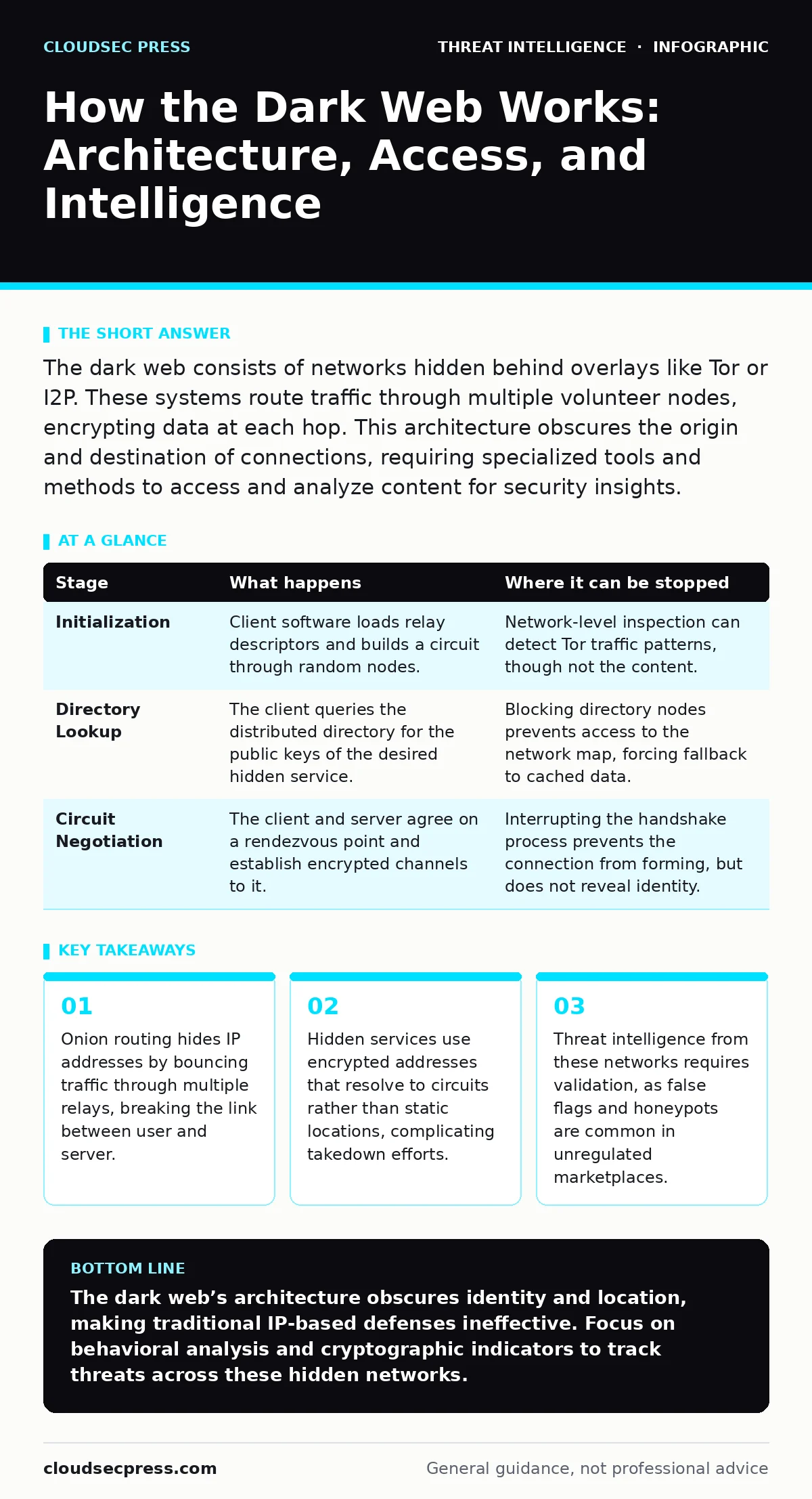
The dark web consists of networks hidden behind overlays like Tor or I2P. These systems route traffic through multiple volunteer nodes, encrypting data at each hop. This architecture obscures the origin and destination of connections, requiring specialized tools and methods to access and analyze content for security insights.
The Architecture of Obscurity
The dark web is not a single entity but a collection of networks designed to prevent identification. It sits atop the deep web, which contains all non-indexed data like private databases. The distinction matters because the deep web is mundane, while the dark web prioritizes anonymity through specific protocols.
These networks use overlay technologies to mask the physical location of servers and clients. The most common protocol is Tor, or The Onion Router. It works by wrapping data in multiple layers of encryption, similar to an onion. Each layer is peeled away by a different node in the network. This process ensures that no single node knows both the source and the destination of the traffic.
Suppose you send a message through this system. Your data travels through an entry node, several middle relays, and finally an exit node. The entry node knows who you are but not what you are accessing. The exit node knows what you are accessing but not who you are. This separation is the core mechanism of privacy. It also creates a significant challenge for defenders who rely on IP addresses to block malicious activity.
Accessing the Hidden Layer
You cannot reach these networks with a standard web browser. The default configuration of most browsers connects directly to servers using visible IP addresses. To interact with the dark web, you must use software that understands the overlay protocols. This software establishes the necessary encrypted tunnels before any data is exchanged.
The process involves connecting to a directory of known relays. The client software then negotiates a circuit through these relays. This circuit is temporary and changes periodically. If a connection drops, the software must rebuild the path. This dynamic nature means that a server’s address does not point to a fixed location. Instead, it points to a set of cryptographic keys that allow the network to route traffic to the current location of the service.
This mechanism prevents simple IP blocking. Even if you identify the IP address of a relay hosting a malicious site, that relay may be hosting dozens of other legitimate services. Blocking it disrupts innocent users. This trade-off between privacy and control is inherent to the design. Defenders must look beyond IP addresses to find indicators of compromise.
Understanding Hidden Services
Hidden services, often called onion sites, are servers that exist entirely within the overlay network. They do not have a public IP address. Instead, they advertise their location through the network’s distributed directory system. The address you see, a long string of random characters, is actually a hash of the server’s public key.
When you visit such a site, your client and the server establish a rendezvous point. This is a neutral node in the network where the two circuits meet. The data passes through this point without either side knowing the other’s identity. This adds an extra layer of security for both the user and the host.
For threat hunters, this means that domain names and IP addresses are useless. You cannot look up who owns an onion address in a traditional whois database. The ownership is tied to the private key used to generate the address. If that key is lost, the service disappears. This permanence of identity, despite changing physical locations, is a key feature for tracking persistent threats.
Stage 1: Network Establishment
| Stage | What happens | Where it can be stopped |
|---|---|---|
| Initialization | Client software loads relay descriptors and builds a circuit through random nodes. | Network-level inspection can detect Tor traffic patterns, though not the content. |
| Directory Lookup | The client queries the distributed directory for the public keys of the desired hidden service. | Blocking directory nodes prevents access to the network map, forcing fallback to cached data. |
| Circuit Negotiation | The client and server agree on a rendezvous point and establish encrypted channels to it. | Interrupting the handshake process prevents the connection from forming, but does not reveal identity. |
Stage 2: Data Exchange and Anonymity
| Stage | What happens | Where it can be stopped |
|---|---|---|
| Traffic Routing | Data is encrypted in layers and passed through the circuit. Each node decrypts one layer. | Content inspection is impossible without breaking end-to-end encryption at the endpoints. |
| Rendezvous | The client and server connect via the neutral rendezvous point, masking their true locations. | Correlation attacks can sometimes link traffic patterns if the attacker controls both entry and exit nodes. |
| Session Termination | Circuits are torn down, and keys are discarded. No log of the connection remains on the relays. | Persistent logging by compromised nodes can reveal metadata, though not the content itself. |
Applying Threat Intelligence
Reading the dark web for security insights requires a different approach than monitoring the clear web. You are looking for data that has not been indexed by search engines. This includes stolen credentials, exploit code, and discussions about new vulnerabilities. However, the unregulated nature of these spaces means that information is often incomplete or misleading.
You must validate any finding. A claim of a breach on a forum may be a hoax to drive traffic or sell fake data. Cross-referencing with other sources is necessary. If you see a leak of credentials, check if those credentials appear in other known breaches. This process aligns with the principles of IOC enrichment, where you add context to raw data to determine its relevance and severity.
Threat actor profiling becomes difficult here. Users often adopt pseudonyms that change frequently. They may use multiple identities to confuse trackers. This makes it hard to attribute actions to a specific group. Understanding attacker persistence techniques can help, as some groups leave subtle signatures in their code or communication styles that remain consistent across aliases.
A Worked Illustration
Imagine you discover a new file type being discussed on a hidden forum. The users claim it is a new variant of ransomware. You download the sample in a isolated sandbox environment. The file does not match any known signatures in your database.
You analyze the file’s behavior. It attempts to connect to a specific onion address. This address is not in your blocklist. You check the hash of the file against public databases. It is unique. You then look for metadata in the file. The compiler timestamps and string literals might reveal clues about the development environment.
Suppose the strings reference a specific coding framework that is rarely used. This is a distinctive marker. You search for other files using the same framework. You find a few other samples. They all connect to different onion addresses, but the infrastructure shares a common digital certificate. This link allows you to group these samples together, even if the actors change their names. This is a practical application of the Pyramid of Pain, where you target infrastructure and capabilities rather than just file hashes.
See also: Pyramid of Pain: How Indicator Difficulty Shapes Your Defense
The Limits of Visibility
You cannot see everything on the dark web. Many services are invite-only or require cryptocurrency payments to access. This creates a blind spot. The most dangerous actors often operate in private channels that are not accessible to the general public. Your intelligence will always be partial.
Furthermore, the cost of access is high. Not just in terms of money, but in terms of operational security. Connecting to these networks exposes your own infrastructure to potential deanonymization attacks. If your monitoring system is compromised, the attacker can see what you are looking at. This is why many organizations use dedicated, isolated systems for this work.
The trade-off is clear. The dark web provides early warning signals for new threats. But it also poses risks to the observer. You must balance the value of the intelligence against the risk of exposure. Using a SIEM can help aggregate and correlate the data you do collect, making it easier to spot trends without manual analysis of every post.
Maintaining Operational Security
Your own security is paramount. If an attacker knows you are monitoring them, they can feed you false information. This is known as disinformation. It can waste your time and lead to incorrect conclusions. To protect yourself, you must minimize the digital footprint of your monitoring activities.
Use separate accounts and identities for different tasks. Do not link your monitoring activities to your real identity. Rotate your access credentials regularly. This prevents a single compromise from revealing your entire operation. Additionally, be aware of honeytokens. These are fake credentials or data files placed by attackers to detect who is accessing their systems. If you touch a honeytoken, you may reveal your presence.
The goal is to gather intelligence without being detected. This requires discipline and careful planning. You should have a clear methodology for what you collect and how you store it. Regularly review your processes for gaps. The dark web is a dynamic environment. Your methods must evolve to keep pace with the changes in technology and user behavior.
Key takeaways
- Onion routing hides IP addresses by bouncing traffic through multiple relays, breaking the link between user and server.
- Hidden services use encrypted addresses that resolve to circuits rather than static locations, complicating takedown efforts.
- Threat intelligence from these networks requires validation, as false flags and honeypots are common in unregulated marketplaces.
The dark web’s architecture obscures identity and location, making traditional IP-based defenses ineffective. Focus on behavioral analysis and cryptographic indicators to track threats across these hidden networks.
Frequently asked questions
Can I access the dark web with a standard browser?
No, you need specialized software like Tor or I2P that can establish the necessary encrypted circuits and resolve hidden service addresses.
Is all data on the dark web illegal?
No, while it hosts illicit markets, it also provides privacy for journalists, activists, and researchers in oppressive regimes.
How do I verify the authenticity of a breach claim?
Cross-reference the data with other sources, check for known testing patterns, and analyze the file metadata for consistency with the claimed source.
What is the biggest risk of monitoring the dark web?
The risk of compromising your own operational security, which can lead to deanonymization or exposure to targeted malware.
How this guide was produced: written by the CloudSec Press editorial team with AI assistance, checked against the public references listed below, and reviewed when the facts change. See our editorial policy or report an error.