SIEM Explained: Answers to Your Most Pressing Security Questions
A SIEM system transforms raw log noise into actionable security context, but its true value depends on how well you tune correlation rules and integrate external threat data.
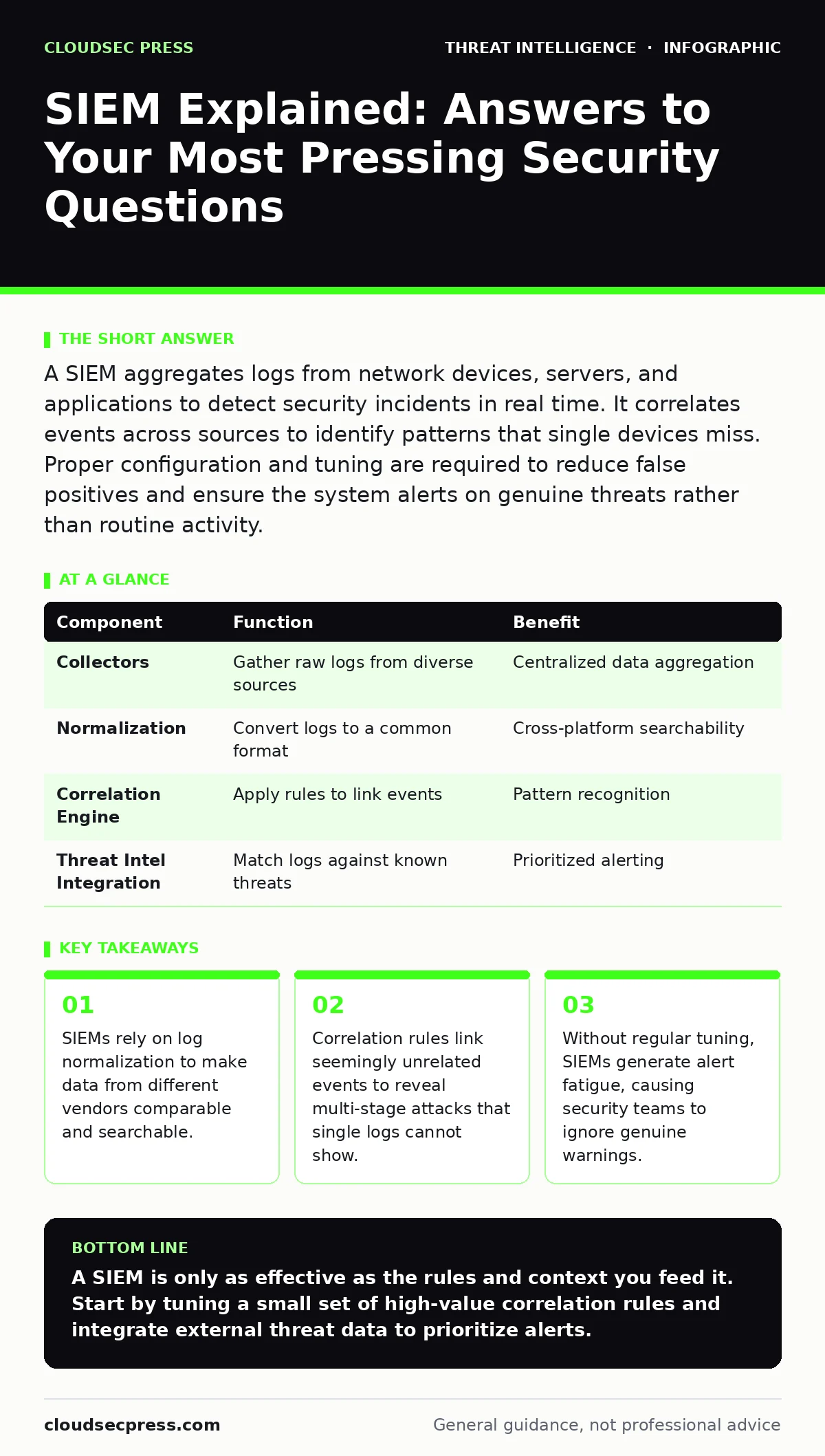
A SIEM aggregates logs from network devices, servers, and applications to detect security incidents in real time. It correlates events across sources to identify patterns that single devices miss. Proper configuration and tuning are required to reduce false positives and ensure the system alerts on genuine threats rather than routine activity.
What exactly is a SIEM and why do you need one?
A SIEM, or Security Information and Event Management system, collects, normalizes, and analyzes log data from across your IT infrastructure to detect security incidents. You need one because individual devices like firewalls or servers only see their own traffic, missing the broader context of an attack. A SIEM aggregates these isolated data points, allowing you to spot patterns that span multiple systems. It turns raw data into a unified view of your security posture.
How does a SIEM differ from simple log management?
Log management stores and archives data for compliance and troubleshooting, whereas a SIEM actively analyzes that data for security threats. A SIEM applies correlation rules to link events, such as a failed login followed by a successful one from a different location. It also integrates with threat intelligence feeds to flag known malicious indicators. Simple log management lacks this real-time analytical engine and contextual awareness.
What are the core components of a modern SIEM?
The core components include log collectors, a normalization engine, a correlation engine, and a visualization dashboard. Collectors gather raw data from endpoints, network devices, and cloud services. The normalization engine converts this disparate data into a common format, making it searchable. The correlation engine applies rules to identify suspicious sequences, while the dashboard presents alerts and metrics to analysts.
How do correlation rules actually work in practice?
Correlation rules define logical conditions that trigger an alert when specific events occur together. For example, a rule might flag an account that fails to log in five times and then succeeds from a new IP address. These rules map to known attack patterns, such as brute-force attempts or lateral movement. You must tune these rules to match your environment, as default settings often generate too many false positives.
Imagine a rule that alerts on any large file download. In a software development firm, this is normal; in a finance firm, it might indicate data exfiltration. Context determines whether the rule is useful or noisy.
Why is log normalization so critical for detection?
Log normalization translates vendor-specific log formats into a standard schema, allowing the SIEM to compare apples to apples. Without it, you cannot easily search for a specific IP address or user account across different systems. This standardization enables complex queries and correlation rules that span multiple data sources. It is the foundation that makes cross-platform analysis possible.
See also: Honeytokens Checklist: Deploy Silent Traps for Early Breach Detection · Malware Droppers and Loaders: Six Myths That Hide Real Risk
How does a SIEM integrate with threat intelligence?
A SIEM ingests external threat intelligence feeds to enrich internal log data with context. It matches local indicators, such as IP addresses or file hashes, against known malicious lists. This process, often called IOC enrichment, helps prioritize alerts by highlighting events linked to active threats. It transforms generic alerts into high-priority incidents with known adversary associations. For deeper context, see our guide on operational threat intelligence.
| Component | Function | Benefit |
|---|---|---|
| Collectors | Gather raw logs from diverse sources | Centralized data aggregation |
| Normalization | Convert logs to a common format | Cross-platform searchability |
| Correlation Engine | Apply rules to link events | Pattern recognition |
| Threat Intel Integration | Match logs against known threats | Prioritized alerting |
What is the biggest challenge in maintaining a SIEM?
The biggest challenge is managing alert fatigue caused by poor tuning and excessive noise. If a SIEM generates hundreds of false alarms daily, analysts become desensitized and may miss real incidents. Regular tuning of correlation rules and suppression of known benign activities is required to maintain signal-to-noise ratio. This ongoing maintenance is often underestimated in initial planning.
How does a SIEM support incident response workflows?
A SIEM provides the initial context needed for incident triage by aggregating relevant logs and timeline data. It helps analysts understand the scope and impact of an incident quickly. Many SIEMs integrate with SOAR platforms to automate repetitive response tasks, such as isolating a compromised host. This integration speeds up containment and reduces the burden on human analysts. For more on automation, read our guide on SOAR.
Can a SIEM detect advanced persistent threats (APTs)?
A SIEM can detect APTs if it is configured to look for low-and-slow behaviors and unusual lateral movement. APTs often avoid triggering high-volume alerts, so detection relies on subtle anomalies in user or system behavior. You must implement behavioral analytics and correlate events over longer time windows to catch these stealthy attacks. Standard signature-based detection is insufficient for sophisticated adversaries.
How do you measure the effectiveness of your SIEM?
Effectiveness is measured by the time to detect and respond to incidents, not just by the volume of logs processed. Track metrics like mean time to detect (MTTD) and mean time to respond (MTTR). Regularly test your detection rules with simulated attacks to ensure they trigger as expected. Review false positive rates and adjust rules to improve precision. For a framework on prioritizing detection efforts, see the Pyramid of Pain.
What role does user behavior analytics play in a SIEM?
User behavior analytics (UBA) establishes a baseline of normal activity for each user and device. It flags deviations from this baseline, such as accessing files at unusual hours or from unfamiliar locations. This helps identify compromised accounts or insider threats that do not match known attack signatures. UBA adds a layer of anomaly detection that complements traditional rule-based alerts.
Key takeaways
- SIEMs rely on log normalization to make data from different vendors comparable and searchable.
- Correlation rules link seemingly unrelated events to reveal multi-stage attacks that single logs cannot show.
- Without regular tuning, SIEMs generate alert fatigue, causing security teams to ignore genuine warnings.
A SIEM is only as effective as the rules and context you feed it. Start by tuning a small set of high-value correlation rules and integrate external threat data to prioritize alerts.
Frequently asked questions
Does a SIEM replace a firewall?
No, a SIEM analyzes logs generated by firewalls and other devices. It does not block traffic or enforce access controls itself. It provides visibility and alerting, while firewalls provide perimeter defense.
How much log data does a SIEM need?
The volume depends on your environment size and retention policies. More data increases search power but also cost and complexity. Focus on collecting high-value logs from critical assets first.
Can I use a SIEM for compliance reporting?
Yes, most SIEMs offer pre-built reports for standards like PCI-DSS or HIPAA. They archive logs and provide audit trails required for compliance. However, ensure your data retention policies meet specific regulatory requirements.
What is the difference between SIEM and XDR?
XDR, or Extended Detection and Response, integrates endpoint, network, and cloud data natively. SIEMs aggregate data from third-party sources. XDR often offers more automated response capabilities, while SIEMs provide broader visibility across heterogeneous environments.
How this guide was produced: written by the CloudSec Press editorial team with AI assistance, checked against the public references listed below, and reviewed when the facts change. See our editorial policy or report an error.