Honeytokens Checklist: Deploy Silent Traps for Early Breach Detection
Honeytokens trigger alerts when touched because legitimate systems never access them, providing a low-noise signal that often precedes traditional intrusion detection.

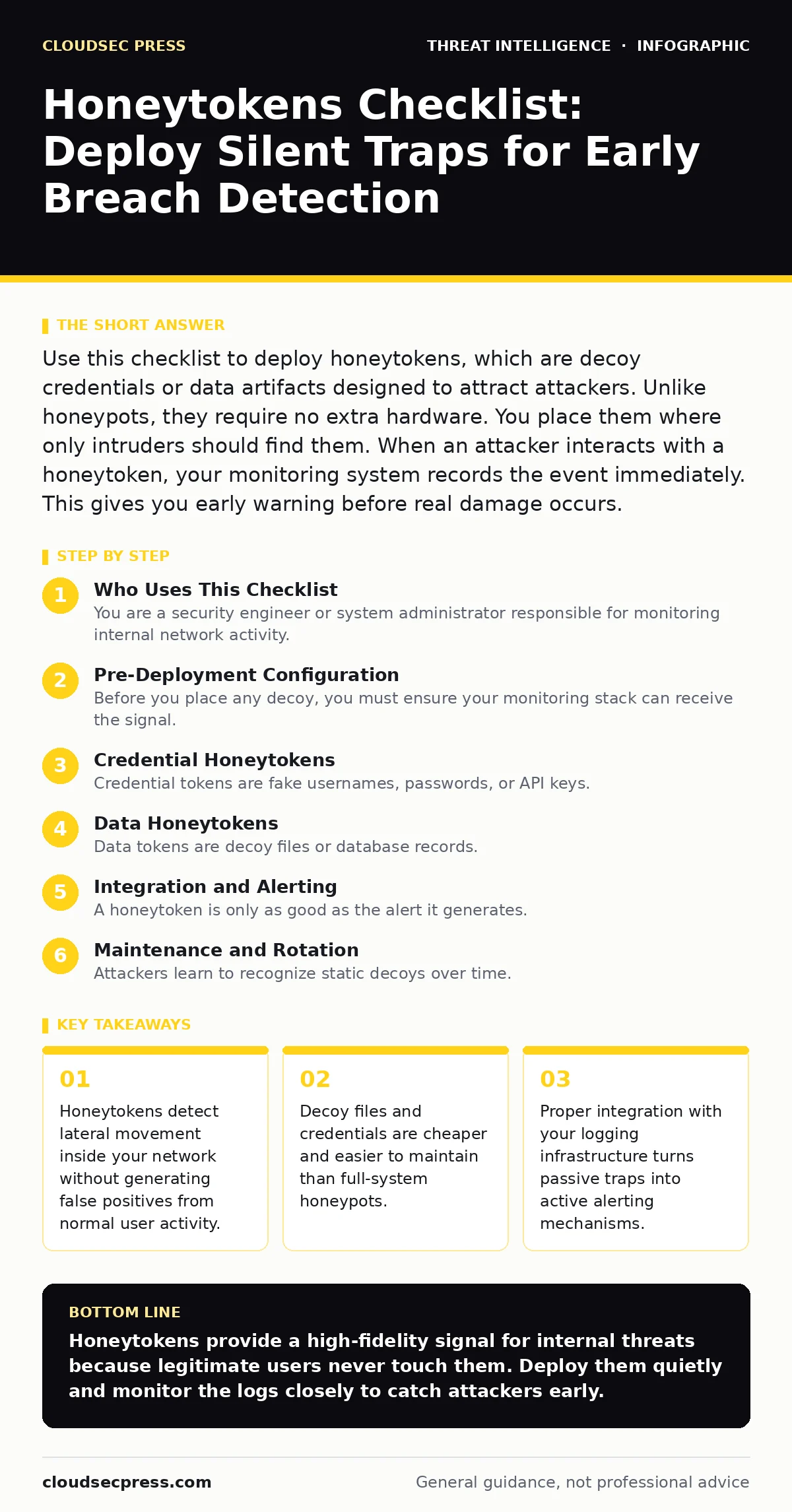
Use this checklist to deploy honeytokens, which are decoy credentials or data artifacts designed to attract attackers. Unlike honeypots, they require no extra hardware. You place them where only intruders should find them. When an attacker interacts with a honeytoken, your monitoring system records the event immediately. This gives you early warning before real damage occurs.
Who Uses This Checklist
You are a security engineer or system administrator responsible for monitoring internal network activity. You want to detect breaches early, but your current logs are noisy. Normal user behavior creates too many alerts to review manually. This checklist helps you deploy honeytokens, which are decoy data objects or credentials. They sit quietly until an attacker touches them. Because no legitimate process should ever access these items, any interaction is suspicious by definition.
Use this list before deploying tokens and during your initial monitoring phase. It ensures you capture useful data without creating new vulnerabilities.
Pre-Deployment Configuration
Before you place any decoy, you must ensure your monitoring stack can receive the signal. If your logging system ignores the token interaction, the trap is useless.
- Verify log forwarding is active: Ensure your endpoint agents send events to your central collector in real time.
- Define unique identifiers: Assign a distinct name or hash to each token so you can track it across systems.
- Map the data flow: Know exactly which service or database field the token will occupy.
- Test the alert trigger: Simulate an access event to confirm your SIEM generates a notification.
- Document the token location: Record where each token lives so you can verify its status later.
Credential Honeytokens
Credential tokens are fake usernames, passwords, or API keys. They look like valid login data but belong to no real user. Attackers often steal credential files to move laterally within a network. When they try to use a fake credential, your system logs the attempt. This reveals the attacker’s current position and their tools.
- Create dummy service accounts: Generate accounts that have no permissions and no real purpose.
- Embed tokens in config files: Place fake API keys in environment variables or configuration scripts.
- Use realistic but invalid passwords: Make the credentials look plausible so attackers do not discard them immediately.
- Monitor authentication logs: Watch for login attempts using these specific usernames or keys.
- Avoid using tokens in automation: Ensure no scheduled jobs or scripts ever use these credentials.
Data Honeytokens
Data tokens are decoy files or database records. They contain information that looks valuable, such as customer lists or financial summaries. An attacker searching for sensitive data may find and copy these files. The act of copying or opening them triggers an alert. This method helps you detect data exfiltration attempts early.
- Place decoy files in shared drives: Put fake documents in directories that attackers commonly scan.
- Insert records into test databases: Add fake entries that mirror the structure of real production data.
- Use unique watermarks: Embed invisible markers in PDFs or images to track where they appear later.
- Monitor file access events: Log every open, copy, or download action on these specific files.
- Avoid placing tokens in backups: Ensure your backup processes do not archive these decoys, which could confuse analysis.
Integration and Alerting
A honeytoken is only as good as the alert it generates. You must connect the trap to your incident response workflow. If the alert gets lost in noise, you miss the window to stop the attacker. This is where your monitoring strategy meets your response plan.
- Set high-priority rules: Configure your alerting system to flag token interactions as critical events.
- Link to incident triage: Ensure the alert includes context, such as the user account and machine involved.
- Automate initial containment: Consider blocking the source IP or disabling the compromised account automatically.
- Review false positive sources: Check if any maintenance scripts accidentally touch the tokens.
- Update token inventory: Remove old tokens and add new ones to keep the trap fresh.
See also: What Is Process Injection: How Malware Hides in Legitimate Memory · SIEM Explained: Answers to Your Most Pressing Security Questions
Maintenance and Rotation
Attackers learn to recognize static decoys over time. If a token remains unchanged, it may become known. You must rotate your honeytokens regularly. This changes the identifier or location, forcing the attacker to start their search again. It also tests your monitoring system’s resilience.
- Schedule regular rotation: Change token values or locations on a fixed calendar.
- Audit access logs: Review which tokens were touched and why.
- Remove stale tokens: Delete any decoys that are no longer monitored or relevant.
- Update documentation: Keep your inventory current so responders know what is a trap.
- Test detection logic: Verify that your new tokens still trigger the correct alerts.
Common Pitfalls to Avoid
Deploying honeytokens incorrectly can lead to wasted effort or security gaps. Some teams place tokens where legitimate users might accidentally touch them. This creates noise and hides real threats. Others forget to monitor the logs, leaving the traps silent.
- Avoid production databases: Do not place tokens in live systems where accidental access is likely.
- Do not use real data: Never put actual customer information in a decoy file.
- Check for script interactions: Ensure automated processes do not read or write to token locations.
- Monitor alert fatigue: If you get too many alerts, your rules are too broad.
- Plan for response: Have a clear procedure for what to do when an alert fires.
Key takeaways
- Honeytokens detect lateral movement inside your network without generating false positives from normal user activity.
- Decoy files and credentials are cheaper and easier to maintain than full-system honeypots.
- Proper integration with your logging infrastructure turns passive traps into active alerting mechanisms.
Honeytokens provide a high-fidelity signal for internal threats because legitimate users never touch them. Deploy them quietly and monitor the logs closely to catch attackers early.
Frequently asked questions
Are honeytokens the same as honeypots?
No. Honeypots are entire systems designed to look like real servers. Honeytokens are small data objects or credentials placed inside your existing systems.
Can an attacker detect honeytokens?
Sophisticated attackers may notice unusual files or credentials. Rotating tokens and using realistic names makes detection harder.
Do I need special software to use honeytokens?
No. You can create honeytokens with standard file systems and database entries. You only need logging and monitoring tools.
What if a legitimate user accidentally touches a token?
This creates a false positive. Review the alert to confirm it was not a scheduled job or maintenance task.
How this guide was produced: written by the CloudSec Press editorial team with AI assistance, checked against the public references listed below, and reviewed when the facts change. See our editorial policy or report an error.