Honeytokens: What They Are and How They Alert You to Breaches
See how honeytokens act as silent tripwires in your data, providing early warning of unauthorized access without slowing down legitimate operations.

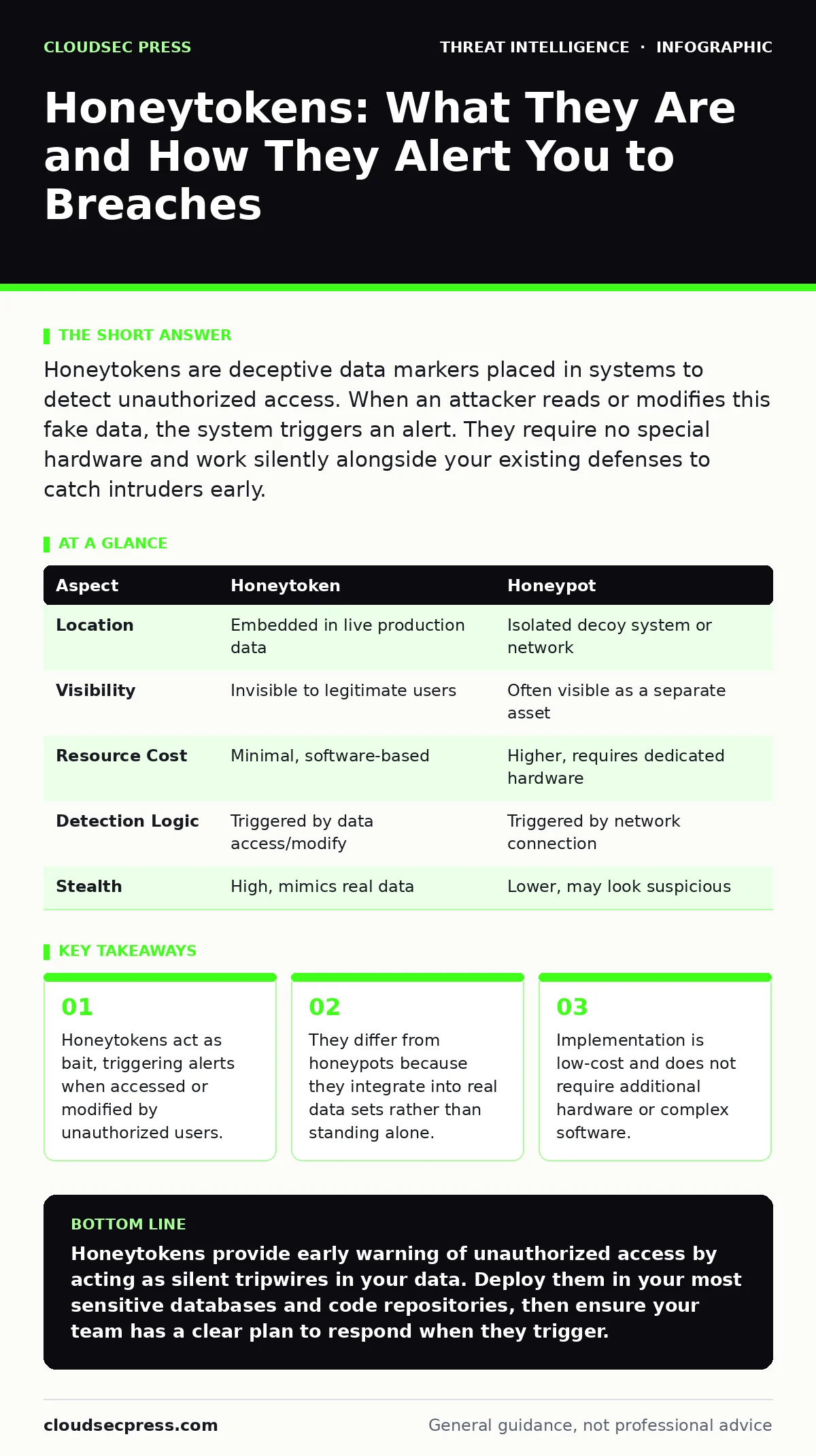
Honeytokens are deceptive data markers placed in systems to detect unauthorized access. When an attacker reads or modifies this fake data, the system triggers an alert. They require no special hardware and work silently alongside your existing defenses to catch intruders early.
The Silent Tripwire Concept
Imagine leaving a specific, fragile vase on a high shelf in an empty house. You do not expect anyone to touch it. If the vase breaks, you know immediately that someone entered and moved around, even if they did not steal anything valuable. Honeytokens work on this exact principle within your digital infrastructure. They are pieces of data or markers that serve no legitimate business purpose. Their only job is to be found, accessed, or modified by someone who should not be there.
When an authorized user interacts with your system, they access real data. They do not touch the honeytokens because they have no reason to. An attacker, however, often scans directories, downloads files, or queries databases to find valuable information. In doing so, they inevitably interact with the honeytoken. This interaction triggers a notification. You learn about the intrusion before the attacker has necessarily exfiltrated sensitive data or caused damage.
How Honeytokens Differ from Honeypots
Many security professionals confuse honeytokens with honeypots. A honeypot is an entire system or network segment designed to look attractive to attackers. It is a decoy server or application that sits apart from your production environment. Interacting with it is suspicious because legitimate users never go there. Honeytokens, by contrast, are embedded directly within your live production environment. They sit inside your real databases, file shares, and code repositories.
This distinction matters for detection. An attacker might avoid a honeypot if they recognize the system looks fake or isolated. They are more likely to trust a file sitting in a legitimate project directory. Honeytokens blend in. They look like real credentials, real database rows, or real configuration files. This camouflage makes them harder for sophisticated attackers to distinguish from actual targets. You gain visibility into the actual systems your employees use, not just the decoys on the perimeter.
| Aspect | Honeytoken | Honeypot |
|---|---|---|
| Location | Embedded in live production data | Isolated decoy system or network |
| Visibility | Invisible to legitimate users | Often visible as a separate asset |
| Resource Cost | Minimal, software-based | Higher, requires dedicated hardware |
| Detection Logic | Triggered by data access/modify | Triggered by network connection |
| Stealth | High, mimics real data | Lower, may look suspicious |
The Anatomy of a Token
A honeytoken is not a single technology. It is a category of deception mechanisms. The simplest form is a canary token. This is a unique identifier, often a URL or a file name, that is registered with a monitoring service. When the token is accessed, the service logs the event. More advanced tokens are embedded in data structures. These might be fake database records that contain impossible values, such as a customer ID that does not exist in the primary key index.
Another type is the credential honeytoken. This is a fake API key or password stored in a configuration file. Legitimate applications do not use it. If an attacker searches for credentials in your source code and finds this key, they may attempt to use it. The moment it is used against an external service or internal API, the system flags the activity. The token itself carries no value. Its value lies entirely in the alert it generates upon interaction.
Where They Fit in Your Defense
Honeytokens do not replace firewalls, intrusion detection systems, or access controls. They complement them. Traditional defenses look for known bad patterns or block traffic from known bad sources. They often struggle with insider threats or compromised legitimate accounts. If an employee’s credentials are stolen, the attacker looks like a valid user to a firewall. Honeytokens add a layer of behavioral detection. They assume breach and look for actions that no valid user would take.
This fits into the strategy of defense in depth. You have perimeter controls to keep most attackers out. You have endpoint protection to stop malware. Honeytokens provide a safety net for when those layers fail. They are particularly useful for detecting lateral movement. Once an attacker is inside, they move from system to system. Honeytokens placed in sensitive areas can catch this movement. They provide context that other tools might miss, such as which specific data sets are being targeted.
Common Implementation Mistakes
Placing honeytokens incorrectly can lead to false positives or missed detections. A common error is placing them where legitimate users might accidentally interact with them. If a developer runs a script that queries all database rows, they might trigger a honeytoken embedded in a record. This creates noise and reduces trust in the alerts. You must map your normal operational workflows carefully. Tokens should only be placed in areas where legitimate access is rare or impossible.
Another mistake is making the tokens too obvious. If a file is named "test_do_not_open.txt," a sophisticated attacker will ignore it. They will look for files with normal names and extensions. The token must look indistinguishable from real data. This requires careful crafting. The metadata, file format, and naming convention must match the surrounding legitimate data. If the token stands out, it becomes useless as a detection mechanism.
See also: What Is Process Injection: How Malware Hides in Legitimate Memory · SIEM Explained: Answers to Your Most Pressing Security Questions
The Hidden Costs and Trade-offs
While honeytokens are low cost, they are not free. The primary cost is operational overhead. You must manage the tokens. You need to ensure they remain in place as systems change. If a database schema updates, the honeytokens must be updated to match. If they are deleted or moved to a different location, the detection logic breaks. This requires integration with your change management processes. Neglecting this maintenance leads to blind spots.
There is also a psychological trade-off. Some teams worry that placing fake data in production is risky. They fear that an attacker might delete the token and leave, or that the token might interfere with application logic. In practice, well-designed tokens are passive. They do not execute code. They simply exist. The risk of interference is low if they are read-only markers. However, you must verify this with your development team. The token must not be referenced by any application logic that expects real data.
What People Usually Get Wrong
Many believe honeytokens can stop an attack. They cannot. They are detection tools, not prevention tools. They do not block the attacker. They only tell you that the attacker is there. You must have a response plan in place. If you detect a token interaction, what do you do? Do you revoke the compromised credentials? Do you isolate the affected system? The value of the honeytoken is only realized if you act on the alert quickly.
Another misconception is that honeytokens work everywhere. They are most effective in environments with structured data, such as databases, file shares, and source code repositories. They are less useful in unstructured environments or systems with high levels of legitimate noise. For example, placing tokens in a general email server might generate too many false positives from automated processes. You must choose your deployment targets wisely to ensure the signal is clear.
Key takeaways
- Honeytokens act as bait, triggering alerts when accessed or modified by unauthorized users.
- They differ from honeypots because they integrate into real data sets rather than standing alone.
- Implementation is low-cost and does not require additional hardware or complex software.
- Proper placement ensures they catch attackers without disrupting legitimate business operations.
Honeytokens provide early warning of unauthorized access by acting as silent tripwires in your data. Deploy them in your most sensitive databases and code repositories, then ensure your team has a clear plan to respond when they trigger.
Frequently asked questions
Do honeytokens slow down my application performance?
No, honeytokens are passive data markers. They do not execute code or require processing power to function. They simply sit in your data until accessed.
Can an attacker detect and remove honeytokens?
Sophisticated attackers may look for anomalies, but well-crafted tokens mimic real data. Removing them requires the attacker to understand your specific deployment strategy, which is rare.
How do I distinguish a legitimate user from an attacker?
Legitimate users follow established workflows and do not access restricted or fake data. Honeytokens are placed where legitimate users never go, so any access is suspicious.
Do I need special software to use honeytokens?
You can create simple tokens manually, but dedicated tools help manage them at scale. These tools handle registration, monitoring, and alerting automatically.
How this guide was produced: written by the CloudSec Press editorial team with AI assistance, checked against the public references listed below, and reviewed when the facts change. See our editorial policy or report an error.