Why Threat Actor Names Matter for Incident Response
Standardized naming conventions prevent duplicate alerts and help security teams prioritize responses by linking disparate attacks to a single source.

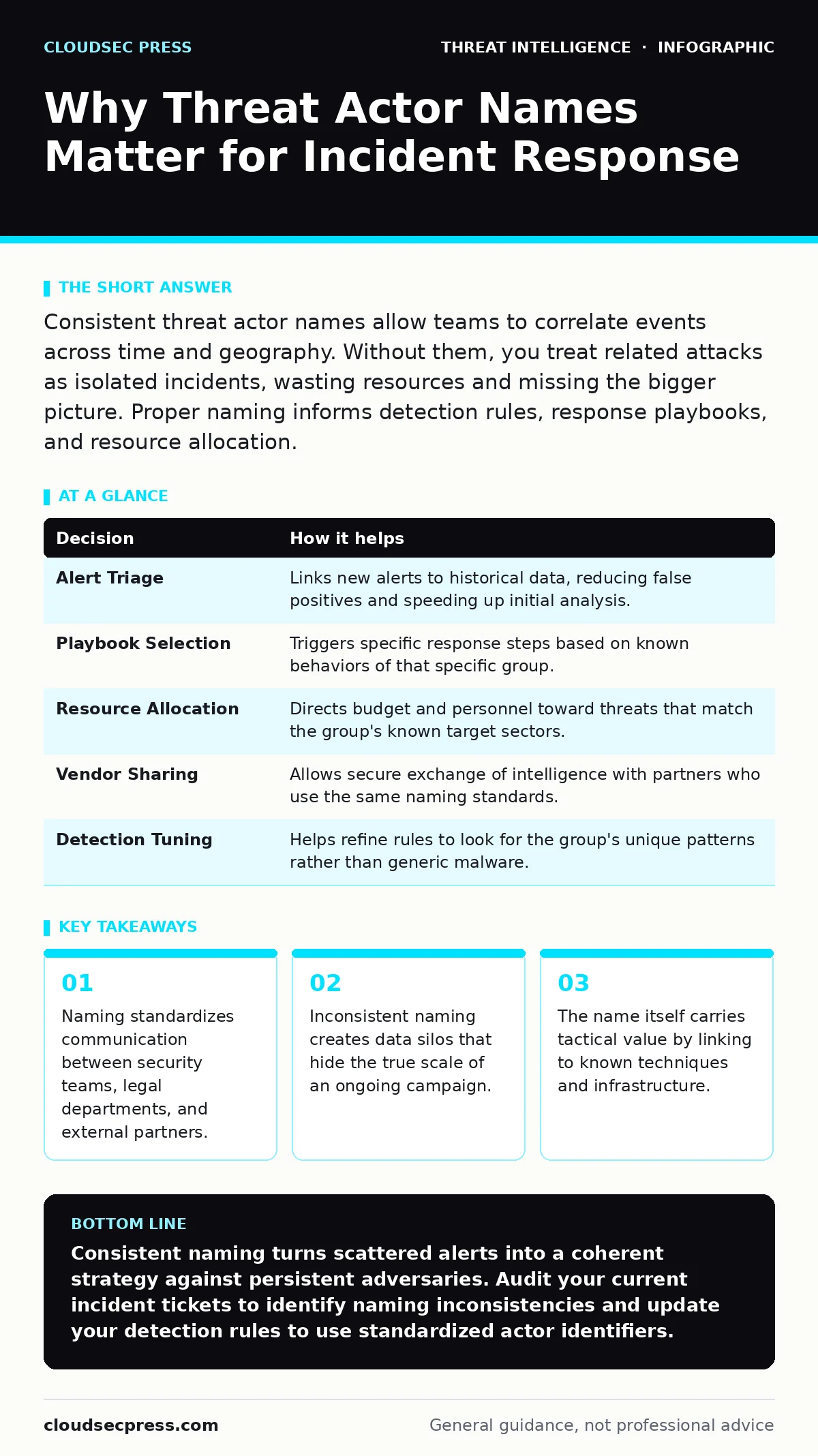
Consistent threat actor names allow teams to correlate events across time and geography. Without them, you treat related attacks as isolated incidents, wasting resources and missing the bigger picture. Proper naming informs detection rules, response playbooks, and resource allocation.
The Cost of Ambiguity
Imagine your security operations center detects a new phishing campaign. The email headers point to a server in Eastern Europe. The payload attempts to execute a remote procedure call on a domain controller. You flag this as a new threat. Two weeks later, another team flags a similar payload on a different network. Without a shared naming convention, these remain two separate tickets.
You treat them as isolated incidents. You deploy temporary blocks. You close the tickets. The attacker returns three months later with a slightly modified script. Your team starts from scratch. You miss the pattern because you never linked the first two events to a single source.
This fragmentation happens when teams rely on raw indicators rather than structured identities. Raw indicators like IP addresses or file hashes change easily. An attacker swaps the IP or recompiles the code, and your old rules fail. The actor behind the scenes remains constant, but your data does not reflect that continuity.
Why You Need a Naming Framework
Threat actor naming is not about giving villains catchy titles. It is about creating a stable identifier for a persistent group. This identifier allows you to aggregate data over time. It turns scattered noise into a coherent signal.
A good naming convention distinguishes between the tool and the user. Many groups reuse the same malware families. If you name your alerts after the malware, you confuse distinct groups using the same tools. You must name the group, not the binary. This distinction helps you track evolution. A group might switch from phishing to DCSync attacks to steal credentials. The tools change, but the group identity remains.
This stability supports the Pyramid of Pain. This model describes how difficult it is for an attacker to change different aspects of their operation. Indicators like IP addresses sit at the base; they are easy to change. Tactics, techniques, and procedures sit higher; they are harder to change. Naming the actor focuses your defense on the harder-to-change elements.
Decisions Informed by Consistent Naming
When you have a consistent name for a threat actor, you make better decisions faster. The name acts as a key that unlocks context. That context drives specific actions in your security stack.
| Decision | How it helps |
|---|---|
| Alert Triage | Links new alerts to historical data, reducing false positives and speeding up initial analysis. |
| Playbook Selection | Triggers specific response steps based on known behaviors of that specific group. |
| Resource Allocation | Directs budget and personnel toward threats that match the group's known target sectors. |
| Vendor Sharing | Allows secure exchange of intelligence with partners who use the same naming standards. |
| Detection Tuning | Helps refine rules to look for the group's unique patterns rather than generic malware. |
Without this structure, you guess. You apply generic blocks. You might block a legitimate service because it shares an IP with a bad actor. Or you might miss a breach because you filtered out an alert that looked like a previous, unrelated event.
How Teams Use the Data
Security teams use these names to enrich their data. When an alert fires, the system checks the attributes against known groups. If the attributes match "Crimson Spider," the system pulls all previous activity from that group. This process is called IOC enrichment. It adds depth to a shallow alert.
You use this enriched data to adjust your detection logic. If "Crimson Spider" favors PowerShell scripts, you increase monitoring on PowerShell execution. If they prefer lateral movement via remote desktop, you tighten access controls there. You are no longer reacting to a single file; you are defending against a known adversary’s playbook.
This approach also aids in threat actor profiling. Profiling goes beyond the name. It includes the group's preferred languages, target industries, and operational hours. If you know the group primarily targets financial institutions in Asia and operates during Asian business hours, you can adjust your monitoring priorities accordingly. You shift resources to when and where the risk is highest.
What Goes Wrong Without It
The most common failure is the drift of terminology. One analyst calls a group "APT-29". Another calls it "Cozy Bear". A third uses the malware name "SolarWinds". When these names float freely, collaboration breaks down.
Legal and compliance teams struggle to report incidents. Regulators require clear narratives. If your internal data uses three different names for the same breach, your report becomes contradictory. This inconsistency can delay regulatory responses and increase liability.
Operational security suffers too. Automation relies on consistency. If your playbook looks for "APT-29" but the alert contains "Cozy Bear," the automation fails. You revert to manual handling. Manual handling is slow and error-prone. In a fast-moving breach, seconds count. You cannot afford to spend minutes untangling naming confusion.
See also: Pyramid of Pain: How Indicator Difficulty Shapes Your Defense
The Hidden Cost of Bad Data
There is a hidden cost to poor naming: wasted analyst time. Analysts spend hours searching for connections that are already there, but hidden behind different labels. This is cognitive overhead. It drains focus from actual investigation.
This fatigue leads to burnout. When analysts cannot trust their data sources, they become skeptical. They start ignoring alerts that look familiar. This skepticism creates blind spots. An attacker exploits these blind spots by reusing old tactics with new names.
You also lose the ability to measure progress. If you cannot link events to a specific actor, you cannot track whether your defenses are working against that actor. You might think you have stopped a campaign, but you have only stopped one variant. The actor adapts and returns. Without the name, you never see the return until it is too late.
Building a Sustainable Practice
Start by adopting an existing standard. Do not invent your own taxonomy. Use frameworks that are widely accepted in the industry. This ensures your data speaks the same language as external feeds and partners.
Train your team on the difference between an indicator and an actor. Emphasize that the name represents the human group, not the code they wrote. Encourage the use of context in every report. Every alert should answer: Who did this, and what have they done before?
Integrate this practice into your incident response lifecycle. Make the actor name a required field in your ticketing system. Validate it against your threat intelligence database. This small step forces consistency. It turns naming from an afterthought into a foundational step.
Key takeaways
- Naming standardizes communication between security teams, legal departments, and external partners.
- Inconsistent naming creates data silos that hide the true scale of an ongoing campaign.
- The name itself carries tactical value by linking to known techniques and infrastructure.
Consistent naming turns scattered alerts into a coherent strategy against persistent adversaries. Audit your current incident tickets to identify naming inconsistencies and update your detection rules to use standardized actor identifiers.
Frequently asked questions
Can I name a threat actor after their malware?
No. Malware is easily changed or reused by different groups. Naming after malware creates confusion and fails to track the actual human operators.
How do I handle unnamed groups?
Use descriptive temporary labels based on tactics and geography until a standard name is established by the community.
Does naming help with legal compliance?
Yes. Consistent naming provides clear, auditable records of threats, which simplifies reporting to regulators and legal teams.
What if two sources use different names for the same group?
Map the aliases in your threat intelligence platform to a single primary name to ensure data correlation works correctly.
How this guide was produced: written by the CloudSec Press editorial team with AI assistance, checked against the public references listed below, and reviewed when the facts change. See our editorial policy or report an error.