Spot DCSync Attacks: Warning Signs and Immediate Response Steps
DCSync attacks often bypass standard alerts because they mimic legitimate replication traffic, hiding in plain sight until credentials are fully compromised.

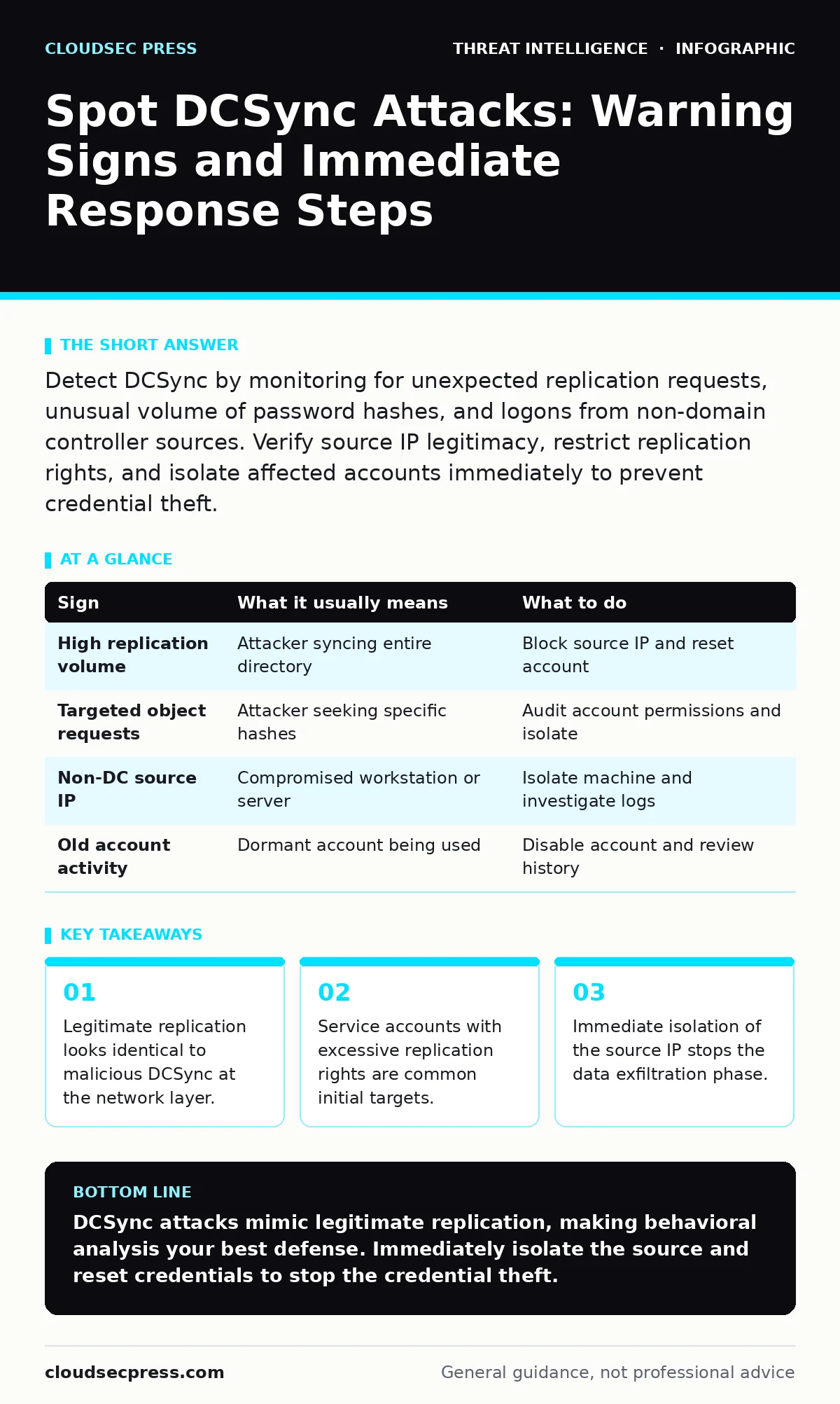
Detect DCSync by monitoring for unexpected replication requests, unusual volume of password hashes, and logons from non-domain controller sources. Verify source IP legitimacy, restrict replication rights, and isolate affected accounts immediately to prevent credential theft.
The Illusion of Normal Traffic
DCSync attacks exploit the Directory Replication Service Remote Protocol. This protocol allows domain controllers to synchronize directory data with each other. An attacker uses this same mechanism to request password hashes from any domain controller. The traffic appears as standard replication. You cannot distinguish it from legitimate traffic by inspecting network packets alone. The protocol uses standard ports and encryption. This makes network-based detection nearly impossible without deep inspection of the application layer.
Signs You Notice First
The most obvious sign is an alert from your identity protection system. These systems monitor for anomalous replication requests. You will see a spike in replication activity from a specific source. This source is rarely a domain controller. It is often a workstation or a server that should not be replicating data. The volume of data transferred is also a clue. Replicating the entire directory generates significant traffic. If a single machine requests millions of objects in minutes, that is abnormal.
Another early sign is failed logon attempts from the same source. The attacker may test stolen hashes against other systems. These failures generate event logs. You will see these logs on the target systems, not the domain controller. The source IP in these logs matches the IP that performed the replication request. This correlation confirms the attack chain.
Signs That Are Easy to Miss
Subtle signs hide in the metadata of the replication request. The attacker may request only specific user objects. This reduces the data volume and avoids volume-based alerts. You must look at the object attributes requested. Requests for password hashes and security identifiers are suspicious. Legitimate replication usually requests a broad set of attributes. Targeted requests indicate an attacker looking for specific credentials.
Check the timestamp of the last successful replication. If a source has not replicated data in months, a sudden burst is suspicious. This indicates a newly compromised account or a dormant service account being activated. The account performing the replication may have limited permissions. Attackers often use compromised service accounts that have replication rights but no administrative rights. These accounts fly under the radar of administrative monitoring.
Understanding the Replication Rights
Replication rights are not granted by default to all accounts. Only domain controllers have these rights by design. Administrators sometimes grant these rights to monitoring tools or backup solutions. This creates a persistent risk. If an attacker compromises one of these accounts, they gain the ability to sync data. You must audit which accounts have replication permissions. Remove these permissions from any account that is not a domain controller. This reduces the attack surface significantly.
Immediate Response Actions
When you detect a potential DCSync attack, act quickly. The first step is to verify the source. Check if the IP address belongs to a known domain controller. If it does not, isolate the machine. Block network access for that IP address. This stops the attacker from continuing the replication. Next, reset the password for the account that initiated the request. This invalidates any stolen credentials. Monitor for further activity from that account.
| Sign | What it usually means | What to do |
|---|---|---|
| High replication volume | Attacker syncing entire directory | Block source IP and reset account |
| Targeted object requests | Attacker seeking specific hashes | Audit account permissions and isolate |
| Non-DC source IP | Compromised workstation or server | Isolate machine and investigate logs |
| Old account activity | Dormant account being used | Disable account and review history |
Long-Term Mitigation Strategies
Preventing DCSync attacks requires strict access control. Implement the principle of least privilege. Only domain controllers should have replication rights. Use group policy to restrict these rights. Monitor for changes to replication permissions. Alert on any account that gains these rights. Regular audits help identify unauthorized changes. This reduces the risk of persistent access.
Integrating with Threat Intelligence
Understanding the context of the attack helps in response. You can use operational threat intelligence to identify known attacker tactics. This helps in prioritizing alerts. Incident triage processes should include checks for replication anomalies. This ensures that subtle attacks are not missed. Attacker persistence techniques often involve creating new accounts with replication rights. Monitoring for these changes is vital. You can also use IOC enrichment to check if the source IP is associated with known malicious activity.
This adds another layer of detection. The Pyramid of Pain framework suggests focusing on high-value indicators. Replication patterns are high-value because they are hard for attackers to change. Threat actor profiling can help predict which accounts are likely targets. SOAR platforms can automate the response to replication alerts. This speeds up the mitigation process. The dark web may contain stolen credentials from previous attacks. Monitoring for these credentials can help identify compromised accounts before they are used for DCSync.
Final Checks
After the incident, review your security controls. Ensure that replication rights are restricted. Update your monitoring rules to catch similar attacks. Train your security team to recognize these signs. Regular testing helps validate your detection capabilities. This ensures that your defenses remain effective.
Key takeaways
- Legitimate replication looks identical to malicious DCSync at the network layer.
- Service accounts with excessive replication rights are common initial targets.
- Immediate isolation of the source IP stops the data exfiltration phase.
DCSync attacks mimic legitimate replication, making behavioral analysis your best defense. Immediately isolate the source and reset credentials to stop the credential theft.
Frequently asked questions
How do I know if my domain controller is under attack?
Check for replication requests from non-domain controller IPs and unusual volume of data transfer.
Can DCSync be detected by antivirus software?
No, DCSync is a protocol abuse, not a malware file. You need identity protection or SIEM alerts.
What is the difference between DCSync and DCShadow?
DCSync reads data, while DCShadow writes false data to manipulate the directory.
How often should I audit replication rights?
Audit these rights regularly, especially after any changes to domain administration or service accounts.
How this guide was produced: written by the CloudSec Press editorial team with AI assistance, checked against the public references listed below, and reviewed when the facts change. See our editorial policy or report an error.