Why Is Personally Identifiable Information Important to Security
Treating personal data as a high-value asset forces you to build strict access controls that stop both external hackers and careless internal employees.

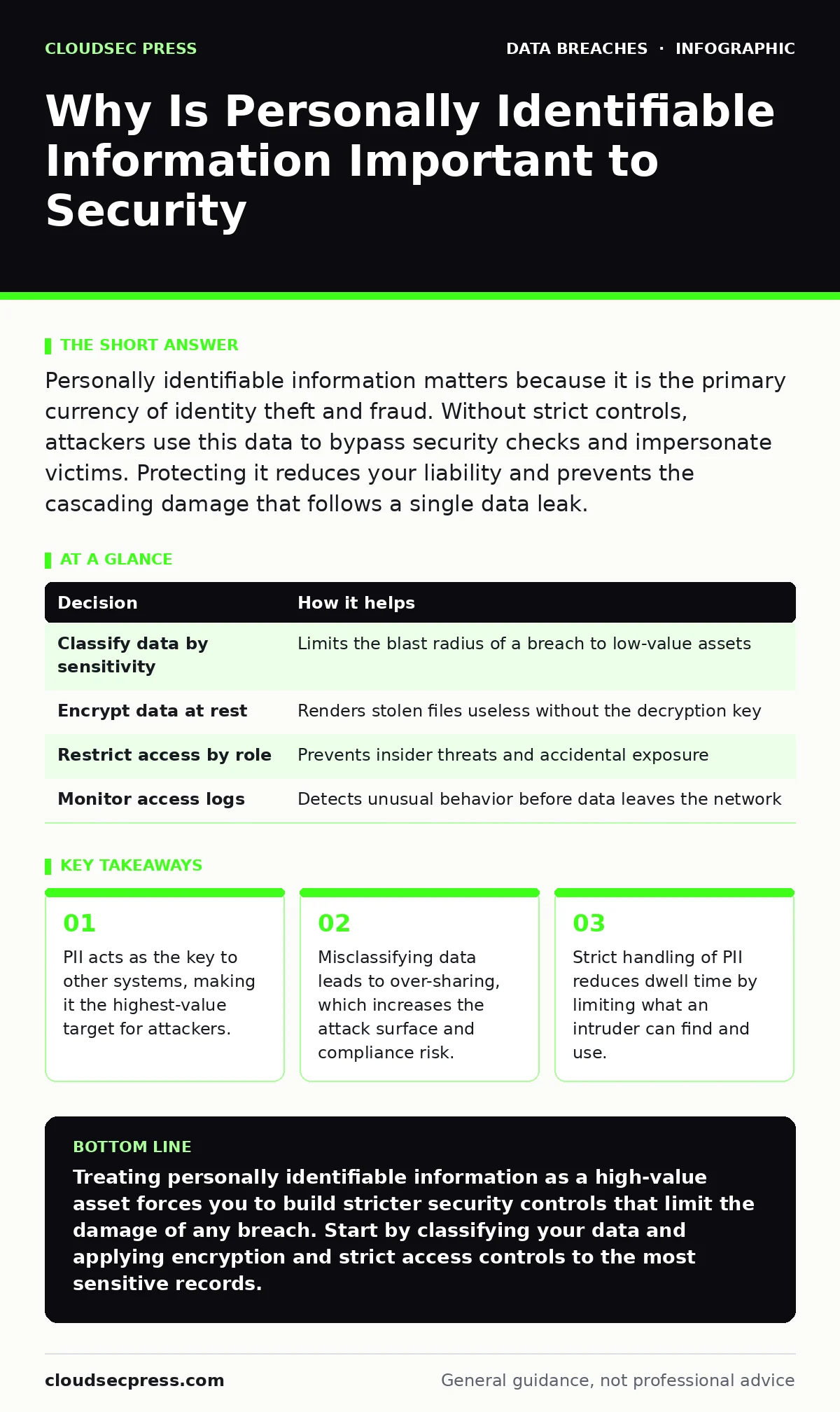
Personally identifiable information matters because it is the primary currency of identity theft and fraud. Without strict controls, attackers use this data to bypass security checks and impersonate victims. Protecting it reduces your liability and prevents the cascading damage that follows a single data leak.
Why Is Personally Identifiable Information Important
Personally identifiable information is important because it serves as the master key to a person’s digital and physical life. This data includes names, addresses, social security numbers, and financial details. Attackers do not steal this information for its own sake. They steal it to bypass multi-factor authentication, reset passwords, and open new credit lines. If you treat this data as ordinary text, you leave the door open for identity fraud. Protecting it is the first line of defense against financial and reputational harm.
The value of this data lies in its persistence. Unlike a session token that expires, a social security number remains valid for decades. This makes it a permanent liability. When you lose control of this data, you lose the ability to verify who is interacting with your systems. The cost of remediation far exceeds the cost of prevention. You must view this data as a high-risk asset that requires constant monitoring and strict access limits.
The Hidden Cost of Misclassification
Most organizations fail not because they lack tools, but because they misclassify data. They store sensitive customer records in the same database as public marketing content. This lack of separation means that a minor breach in the public section can expose the private section. You create a single point of failure for all your data.
Imagine a team that treats all data equally. They use the same backup procedures and access rights for everything. When a backup server is compromised, the attacker gets everything. Now suppose a team that tags data by sensitivity. The backup of public content is exposed, but the sensitive records are encrypted with a separate key that the attacker cannot access. The second team limits the damage to non-sensitive data. This separation is the core of data governance.
| Decision | How it helps |
|---|---|
| Classify data by sensitivity | Limits the blast radius of a breach to low-value assets |
| Encrypt data at rest | Renders stolen files useless without the decryption key |
| Restrict access by role | Prevents insider threats and accidental exposure |
| Monitor access logs | Detects unusual behavior before data leaves the network |
What Goes Wrong Without Controls
Without strict controls, data sprawl becomes inevitable. Employees copy files to local drives, share them via unsecured email, and store them on personal cloud accounts. You lose visibility into where your data lives. When an incident occurs, you cannot determine what was taken or who had access. This uncertainty increases the breach dwell time, which is the period between the initial intrusion and the discovery of the breach.
During this extended period, attackers move laterally through your network. They look for high-value targets. If they find unencrypted personally identifiable information, they exfiltrate it quickly. The longer they have access, the more they learn about your infrastructure. This knowledge allows them to bypass other security measures. You are fighting a war with no map.
The Link to Other Security Failures
Poor handling of personally identifiable information often overlaps with other security failures. For example, password leaks occur when attackers combine stolen usernames with common passwords. If you store passwords in plain text, you hand them the keys to the kingdom. Similarly, exposed API keys can grant direct access to databases containing this sensitive data.
Insider data theft is another risk. An employee with access to customer records can copy them for personal gain or malicious intent. Without audit logs, you may not notice the theft until it is too late. This is why you need a strong secrets management strategy. You must control who can access sensitive data and for how long. Temporary access reduces the window of opportunity for both insiders and compromised accounts.
Building a Defense Strategy
You must start by identifying where your sensitive data lives. Conduct a data inventory to map every storage location. This includes databases, file servers, cloud buckets, and employee devices. Once you know where the data is, you can apply appropriate controls. Encryption is non-negotiable for data at rest and in transit. This ensures that even if the data is stolen, it remains unreadable.
Next, implement strict access controls. Use the principle of least privilege. Users should only have access to the data they need to do their jobs. No one should have permanent admin access to production databases. Use just-in-time access for administrative tasks. This reduces the risk of credential theft. You should also enable multi-factor authentication for all accounts that can access sensitive data. This adds a layer of defense against stolen passwords.
Monitoring and Response
Monitoring is critical for detecting unauthorized access. Set up alerts for unusual data access patterns. For example, if a user downloads a large volume of records at 3 AM, trigger an alert. Investigate these anomalies immediately. You may catch an attacker in the act. This proactive approach reduces the impact of a breach.
You should also have an incident response plan ready. Define the steps to take when a breach is suspected. Isolate the affected systems, revoke access, and notify relevant parties. Speed matters. The faster you respond, the less damage occurs. Regular drills ensure that your team knows what to do under pressure. This preparation is part of a broader CIA triad approach, focusing on confidentiality, integrity, and availability.
Compliance and Trust
Compliance frameworks like SOC 2 require strict controls over sensitive data. Meeting these standards is not just about avoiding fines. It is about proving to your customers that you take their privacy seriously. Trust is hard to build and easy to lose. A single data breach can destroy your reputation. Customers will take their business elsewhere if they feel their data is unsafe.
By treating personally identifiable information with the highest level of care, you demonstrate professionalism and responsibility. This builds long-term trust with your customers. It also reduces your legal liability. You are less likely to face lawsuits if you can show that you had reasonable safeguards in place. Compliance is a baseline, not a ceiling. Aim for best practices that go beyond the minimum requirements.
Practical Steps for Teams
Start with a small pilot project. Choose one dataset and apply strict controls. Test your monitoring and response procedures. Identify gaps and fix them. Then scale this approach to other datasets. This iterative process allows you to learn and improve without overwhelming your team.
Train your employees on data handling best practices. They are the first line of defense. Teach them to recognize phishing attempts and to report suspicious activity. Create a culture of security awareness. When everyone understands the value of sensitive data, they are more likely to protect it. This human element is often the weakest link, but it can also be the strongest if properly trained.
Key takeaways
- PII acts as the key to other systems, making it the highest-value target for attackers.
- Misclassifying data leads to over-sharing, which increases the attack surface and compliance risk.
- Strict handling of PII reduces dwell time by limiting what an intruder can find and use.
Treating personally identifiable information as a high-value asset forces you to build stricter security controls that limit the damage of any breach. Start by classifying your data and applying encryption and strict access controls to the most sensitive records.
Frequently asked questions
What counts as personally identifiable information?
Any data that can identify a specific individual, such as names, addresses, social security numbers, email addresses, and financial details, counts as personally identifiable information.
Is encryption enough to protect this data?
No, encryption protects the data if it is stolen, but you still need strong access controls and monitoring to prevent unauthorized access in the first place.
How do I classify my data correctly?
Start by identifying data that can identify individuals or cause harm if leaked, then tag it with a high-sensitivity label and apply stricter controls than for public data.
What should I do if I suspect a leak?
Immediately isolate the affected systems, revoke access credentials, and investigate the scope of the leak to contain the damage and prevent further exposure.
How this guide was produced: written by the CloudSec Press editorial team with AI assistance, checked against the public references listed below, and reviewed when the facts change. See our editorial policy or report an error.