Data Controllers vs Processors: Clarifying Roles and Liability
Processors face direct legal penalties for security failures, while controllers remain liable for choosing negligent partners and failing to audit them.

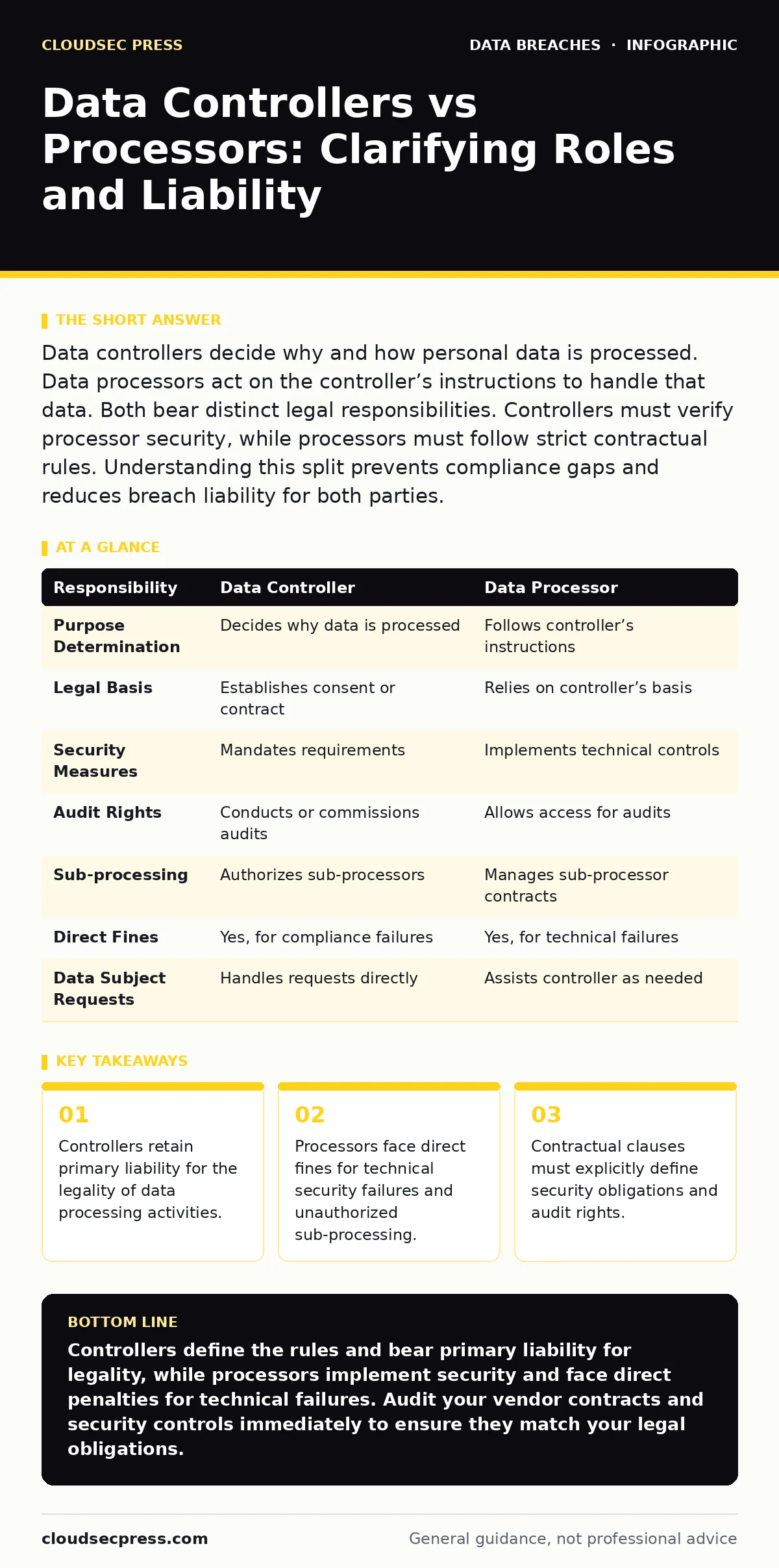
Data controllers decide why and how personal data is processed. Data processors act on the controller’s instructions to handle that data. Both bear distinct legal responsibilities. Controllers must verify processor security, while processors must follow strict contractual rules. Understanding this split prevents compliance gaps and reduces breach liability for both parties.
Who is the data controller?
The data controller is the entity that determines the purposes and means of processing personal data. You are the controller if you decide why data is collected and what happens to it. This role carries the primary burden of ensuring lawful processing. You must establish valid legal grounds, such as consent or contract performance, before any data handling begins.
The controller sets the strategy for data retention, access controls, and breach response. Even if you outsource technical tasks, you remain accountable for the overall compliance posture. Your decisions drive the risk profile of the entire data lifecycle. You must ensure that every downstream partner aligns with your privacy policies and legal obligations.
Who is the data processor?
The data processor is the entity that processes personal data on behalf of the controller. You do not decide why the data is collected or how it will be used beyond the agreed scope. Your primary obligation is to implement appropriate technical and organizational measures to protect the data. This includes encryption, access logging, and incident response planning. You must not process data for your own purposes without explicit permission. If you deviate from the controller’s instructions, you breach the contract and potentially the law. Your role is operational, not strategic, regarding data usage.
Can one entity be both controller and processor?
An entity can act as a controller for some data and a processor for other data. You must separate these roles clearly in your internal documentation and contracts. Imagine a company that collects customer emails for marketing (controller role) while also hosting employee payroll data for a client (processor role). Mixing these functions without clear boundaries creates compliance chaos.
You must maintain separate data inventories and security controls for each role. Failure to distinguish the roles can lead to unauthorized data sharing. You might accidentally use processor data for controller purposes, violating trust and law. Clear internal governance prevents this overlap from becoming a liability. See our guide on data classification to help separate these datasets effectively.
What are the key contractual differences?
Contracts between controllers and processors must define specific security obligations and liabilities. The controller must mandate the processor’s compliance with applicable laws and standards. The processor must agree to assist the controller with data subject requests and breach notifications. You must include clauses that allow the controller to audit the processor’s security practices.
The contract should specify how data is deleted or returned at the end of the service. Without these explicit terms, liability becomes ambiguous during an incident. You cannot rely on generic service level agreements to satisfy privacy law requirements. Detailed contracts protect both parties by clarifying expectations and consequences. Proper secrets management clauses ensure credentials are not mishandled during service transitions.
Who is liable in a data breach?
Both controllers and processors can face direct fines and legal action for a breach. The controller is liable if the breach results from inadequate vendor due diligence or poor contract terms. The processor is liable if the breach results from technical failures, such as unpatched systems or weak access controls. You cannot shift all liability to the other party through contract alone.
Regulators look at who had control over the specific failure point. If the processor failed to encrypt data at rest, they bear significant responsibility. If the controller failed to verify the processor’s security claims, they share the blame. Joint liability is common in complex supply chains. Read our analysis of data breaches to understand how liability shifts during investigations.
See also: Synthetic Identity Fraud Explained: How Fake Identities Steal Real Money
How do you manage sub-processors?
Processors must obtain explicit authorization before engaging sub-processors. You cannot pass data to a third-party vendor without the controller’s prior consent. This consent can be general for specific categories of services or specific for each vendor. You must ensure the sub-processor provides equivalent security guarantees. The original processor remains fully liable for the sub-processor’s actions.
You must flow down the same contractual obligations to the sub-processor. Failure to monitor sub-processors is a common cause of supply chain breaches. You must maintain an up-to-date list of all sub-processors and their locations. This transparency allows the controller to assess risk accurately. See our guide on insider data theft to understand how third-party access increases risk.
What happens with joint controllers?
Joint controllers determine the purposes and means of processing together. You must establish a clear arrangement that defines each party’s public responsibilities. This arrangement must inform data subjects about who is responsible for what. You cannot leave the division of tasks vague or implicit. Each joint controller remains liable for its own obligations, but both may be liable for the entire operation.
You must coordinate on data subject requests and breach notifications. Without a written agreement, regulators may hold both parties fully responsible for any failure. This structure requires constant communication and aligned security standards. You must regularly review the arrangement to ensure it reflects current practices. Refer to our guide on data classification to align your joint definitions.
How does encryption affect these roles?
Encryption shifts the risk profile but does not change the legal roles. If a processor encrypts data and holds the keys, they remain a processor. If the controller holds the keys and the processor only handles ciphertext, the processor’s liability for data exposure decreases. However, the processor still must protect the integrity and availability of the system.
You must define key management responsibilities in the contract. Poor key management can negate the benefits of encryption. You must ensure that encryption does not hinder the controller’s ability to fulfill data subject requests. Technical measures must align with legal obligations. See our guide on encryption in transit for technical implementation details.
| Responsibility | Data Controller | Data Processor |
|---|---|---|
| Purpose Determination | Decides why data is processed | Follows controller’s instructions |
| Legal Basis | Establishes consent or contract | Relies on controller’s basis |
| Security Measures | Mandates requirements | Implements technical controls |
| Audit Rights | Conducts or commissions audits | Allows access for audits |
| Sub-processing | Authorizes sub-processors | Manages sub-processor contracts |
| Direct Fines | Yes, for compliance failures | Yes, for technical failures |
| Data Subject Requests | Handles requests directly | Assists controller as needed |
What is the biggest compliance mistake?
The biggest mistake is assuming that signing a standard data processing agreement eliminates liability. You must actively verify that the processor meets the agreed security standards. Paper compliance does not prevent technical failures. You must conduct regular security assessments of your processors. Relying solely on self-assessment questionnaires is insufficient.
You must review evidence of their security controls, such as penetration test results. Ignoring red flags in vendor security reports exposes you to significant risk. You must treat vendor security as an extension of your own security program. Proactive monitoring prevents surprises when incidents occur. See our guide on leaked source code to understand how vendor negligence can expose your data.
How do you handle data localization?
Data localization laws require data to stay within specific geographic boundaries. The controller must ensure the processor complies with these restrictions. You must verify where the processor and its sub-processors store and process data. Cloud services often replicate data across regions for redundancy, which can violate localization rules. You must configure services to restrict data movement explicitly.
The processor must notify the controller if data leaves the approved region. Failure to enforce localization can result in severe penalties and data repatriation orders. You must map data flows carefully before signing contracts. This technical configuration is as critical as the legal clause. Refer to our guide on synthetic identity fraud to see how cross-border data misuse can compound risks.
Key takeaways
- Controllers retain primary liability for the legality of data processing activities.
- Processors face direct fines for technical security failures and unauthorized sub-processing.
- Contractual clauses must explicitly define security obligations and audit rights.
- Joint controllership requires clear written agreements to split specific responsibilities.
Controllers define the rules and bear primary liability for legality, while processors implement security and face direct penalties for technical failures. Audit your vendor contracts and security controls immediately to ensure they match your legal obligations.
Frequently asked questions
Can a cloud provider be a controller?
A cloud provider is usually a processor, but if they use customer data for their own analytics or advertising without explicit consent, they may become a joint controller or independent controller for that specific data.
Do I need a separate contract for every processor?
You need a data processing agreement for every entity that accesses personal data on your behalf, including sub-processors, to ensure liability and security obligations are clearly defined.
What if my processor goes bankrupt?
Your contract should specify data return or deletion procedures upon termination. You must have a backup plan to retrieve your data securely and quickly to avoid loss or exposure.
Does using an anonymized dataset change the role?
If data is truly anonymized so individuals cannot be identified, it falls outside privacy laws, and neither party is a controller or processor for that specific data. However, re-identification risks must be managed.
How this guide was produced: written by the CloudSec Press editorial team with AI assistance, checked against the public references listed below, and reviewed when the facts change. See our editorial policy or report an error.