Synthetic Identity Fraud Explained: How Fake Identities Steal Real Money
Criminals stitch real and fake data to build credit profiles that vanish before you detect the theft.
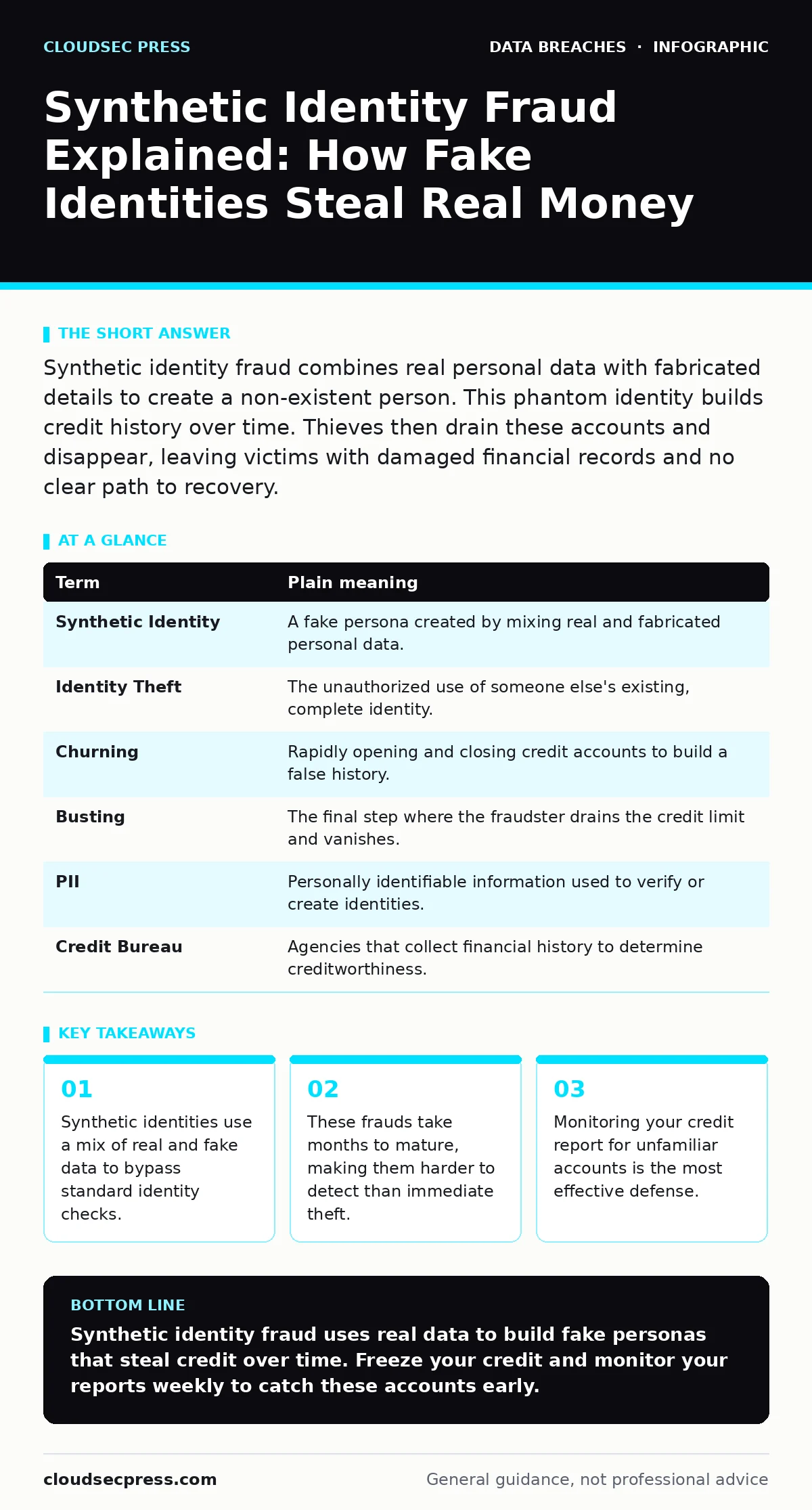
Synthetic identity fraud combines real personal data with fabricated details to create a non-existent person. This phantom identity builds credit history over time. Thieves then drain these accounts and disappear, leaving victims with damaged financial records and no clear path to recovery.
The Paper Doll Analogy
Imagine you are building a paper doll for a school project. You need a face, a body, and clothes. In synthetic identity fraud, the criminal takes a real face from a stolen database. This might be a Social Security number belonging to a child or an inactive citizen. They then attach a fake body and fake clothes to that real face. The result looks like a person, but no such person exists. This hybrid identity is the weapon.
The real data provides the anchor. Financial systems trust the Social Security number because it is valid. The fake name, address, and phone number provide the disguise. This combination allows the fraudster to open accounts in a name that does not exist. You cannot spot this by checking if the name matches the ID number alone. The system sees a valid number and a plausible name. It approves the application.
Key Terms in Plain English
Understanding the mechanics requires clear definitions. These terms appear frequently in security discussions. Knowing them helps you recognize the signs of an attack.
| Term | Plain meaning |
|---|---|
| Synthetic Identity | A fake persona created by mixing real and fabricated personal data. |
| Identity Theft | The unauthorized use of someone else's existing, complete identity. |
| Churning | Rapidly opening and closing credit accounts to build a false history. |
| Busting | The final step where the fraudster drains the credit limit and vanishes. |
| PII | Personally identifiable information used to verify or create identities. |
| Credit Bureau | Agencies that collect financial history to determine creditworthiness. |
How the Fraud Unfolds
The process is slow and deliberate. It is not a quick grab of a credit card number. It resembles payment card theft in motive but differs entirely in method. The fraudster starts with a small application. They might apply for a prepaid card or a small store credit line. They make a few small purchases and pay them off. This builds a positive payment history. The credit score rises.
Over months or years, the synthetic identity becomes "prime." It looks like a responsible customer. The fraudster then applies for larger credit lines. They max out these cards or take out loans. This is the busting phase. Once the money is gone, the identity is discarded. The real person whose Social Security number was used may never know. They have no account, no debt, and no memory of the events.
Why It Hits Ordinary Users
You might think this only affects businesses. It does not. Your data is the raw material. When a data breach exposes a database of customer records, criminals harvest the Social Security numbers. They do not need your full profile. They need just the anchor data. They buy the rest of the details from other sources or generate them.
This means your risk is not just about your own behavior. It is about where your data has been stored. If a company you used years ago suffered a breach, your anchor data is likely in circulation. The fraudster does not need to hack you directly. They need to find your data in a secondary market. This connects to the concept of data controllers and data processors. If either party fails to secure the data, your anchor becomes available for misuse.
The Hidden Cost of Detection
Standard fraud alerts often fail here. Why? Because the fraudster is paying the bills. For the first year or two, the synthetic identity is "good." It pays on time. It does not trigger the usual red flags of missed payments or sudden large charges. By the time the account is maxed out and abandoned, the fraud is complete.
This creates a unique problem for victims. You did not open the account. You did not use the credit. Yet, the debt is linked to your Social Security number. Disputing this is difficult. You must prove you are not the person who applied. But the application data looks real. The address might be real. The phone number might be real. This ambiguity delays resolution. It can take months to clear your name.
See also: Stop Insider Data Theft: Prevention Measures That Actually Work · Exposed Storage Buckets: The Hidden Risks and Fix
Simple Safety Habits
You cannot stop criminals from stealing data. You can, however, make it harder for them to use it. Start by monitoring your credit reports. The major bureaus offer free weekly reports. Look for new accounts you did not open. Look for inquiries you did not authorize.
Consider a credit freeze. This locks your credit file. No one can open new accounts in your name without you temporarily unfreezing it. This stops the initial application phase of synthetic identity fraud. It is free and reversible. It adds friction for the attacker. Friction is your friend.
Also, use strong, unique passwords for financial accounts. This protects against password spraying attacks. While this does not stop synthetic identity creation, it protects your existing accounts from being compromised. Think of it as layers of defense. One layer fails, another holds.
What to Do If You Suspect It
If you find an unknown account on your report, act quickly. Place a fraud alert on your credit file. This warns lenders to verify your identity before extending credit. Then, file a dispute with the credit bureau. Provide proof that you are not the account holder. This might include a copy of your driver's license or a utility bill.
Contact the creditor directly. Explain that the account was opened using a synthetic identity. Provide any documentation you have. Keep records of all communications. Follow up if you do not receive a response. Persistence matters. The system is not designed to handle this gracefully. You must push for resolution.
Remember, this is not your fault. You are the victim of a sophisticated crime. Do not let shame or confusion stop you. Take the steps. Freeze your credit. Dispute the accounts. Monitor your reports. This protects your future financial health.
The Role of Technology
Technology helps, but it is not a silver bullet. Encryption in transit protects data as it moves across networks. It prevents interception during login or purchase. However, it does not protect data at rest. If a server is breached, the encrypted data can be stolen and later decrypted.
Secrets management practices help companies protect their access keys. If a company loses its keys, attackers can access databases. This leads to more breaches. More breaches mean more anchor data for synthetic identities. You cannot control this directly. You can choose services that follow SOC 2 compliance standards. This indicates they have rigorous security controls. It reduces, but does not eliminate, risk.
The CIA triad of confidentiality, integrity, and availability is the foundation. Synthetic identity fraud attacks integrity. The data is no longer a true representation of a person. It is a hybrid. Defending against this requires constant vigilance and proactive monitoring.
Key takeaways
- Synthetic identities use a mix of real and fake data to bypass standard identity checks.
- These frauds take months to mature, making them harder to detect than immediate theft.
- Monitoring your credit report for unfamiliar accounts is the most effective defense.
Synthetic identity fraud uses real data to build fake personas that steal credit over time. Freeze your credit and monitor your reports weekly to catch these accounts early.
Frequently asked questions
Can I sue the company that leaked my data?
You may have legal recourse, but it is complex and often requires class action suits. Consult an attorney specializing in data privacy.
Does a credit freeze stop me from applying for loans?
Yes, but you can temporarily unfreeze it online or by phone. It takes effect immediately in most states.
How long does it take to remove a synthetic account?
It can take several weeks to months. The bureau must investigate, and the creditor must confirm the fraud.
Is this the same as identity theft?
No. Identity theft uses your complete, existing identity. Synthetic fraud creates a new, fake identity using parts of yours.
How this guide was produced: written by the CloudSec Press editorial team with AI assistance, checked against the public references listed below, and reviewed when the facts change. See our editorial policy or report an error.