Stop Insider Data Theft: Prevention Measures That Actually Work
Most insider theft succeeds because defenses focus on external attackers, leaving internal data access paths wide open and unmonitored for unusual behavior.
Prevent insider data theft by enforcing least privilege access, monitoring user behavior for anomalies, and encrypting sensitive files at rest. Focus on reducing the amount of data any single user can access and detecting when access patterns deviate from the norm.
The Hidden Cost of Internal Access
Insider data theft rarely looks like a dramatic movie scene. It usually involves an employee or contractor copying files they already have permission to view. The challenge is that standard security tools are designed to stop strangers at the gate, not trusted people inside the building. When you grant access, you implicitly trust the user. That trust becomes a liability when intentions change or credentials are stolen.
You must shift your mindset from perimeter defense to data-centric security. The goal is not to block all movement, but to make unauthorized movement difficult to hide and expensive to execute. This approach protects against both malicious insiders who intend to steal data and negligent insiders who accidentally expose it.
Start With Least Privilege Access
The most effective way to reduce risk is to remove access rights that are not strictly necessary. Many organizations grant broad access to simplify onboarding or avoid friction for employees. This creates a large attack surface where a single compromised account can access vast amounts of sensitive information.
Implement role-based access control to tie permissions to job functions rather than individual identities. Review these permissions regularly. When an employee changes roles, their old access should be revoked automatically. This process, known as access recertification, ensures that privileges align with current responsibilities. It reduces the number of accounts that can reach critical data, limiting the potential damage from any single insider event.
Monitor Behavior, Not Just Identity
Authentication confirms who you are, but it does not confirm what you are doing. A user logging in from a new device might be traveling for work, or they might be an attacker with stolen credentials. You need to distinguish between normal and abnormal behavior.
Deploy user entity and behavior analytics to establish a baseline for each user. The system learns typical access times, data types accessed, and volume of downloads. When a user suddenly accesses files outside their usual scope or downloads large amounts of data at 2 AM, the system flags the anomaly. This allows security teams to investigate before data is exfiltrated. It catches threats that static rules miss because it focuses on context rather than just identity.
Encrypt Data at Rest
Encryption protects data even if an insider bypasses network controls. If a user copies a file to a local drive or an external device, encryption ensures they cannot read it without the decryption key. This adds a layer of protection that survives the initial theft.
Use full disk encryption on all corporate devices. For highly sensitive data, consider file-level encryption with strict key management. The key must be stored separately from the data and accessed only through authorized channels. This prevents users from simply copying encrypted files and reading them later. It forces the insider to maintain a connection to the corporate environment to access the content, which increases the chance of detection.
What Does Not Work Alone
Many organizations rely on data loss prevention tools that only monitor network traffic. These tools scan outbound emails and web uploads for sensitive keywords. While useful, they fail to stop insiders who use approved channels or physical media. An insider can copy data to a USB drive or take photos of a screen, bypassing network monitors entirely.
You must combine network monitoring with endpoint controls and behavior analytics. No single tool covers all vectors. A layered approach ensures that if one control fails, another catches the threat.
See also: Exposed Storage Buckets: The Hidden Risks and Fix · Synthetic Identity Fraud: 6 Myths That Keep You Exposed
Practical Prevention Measures
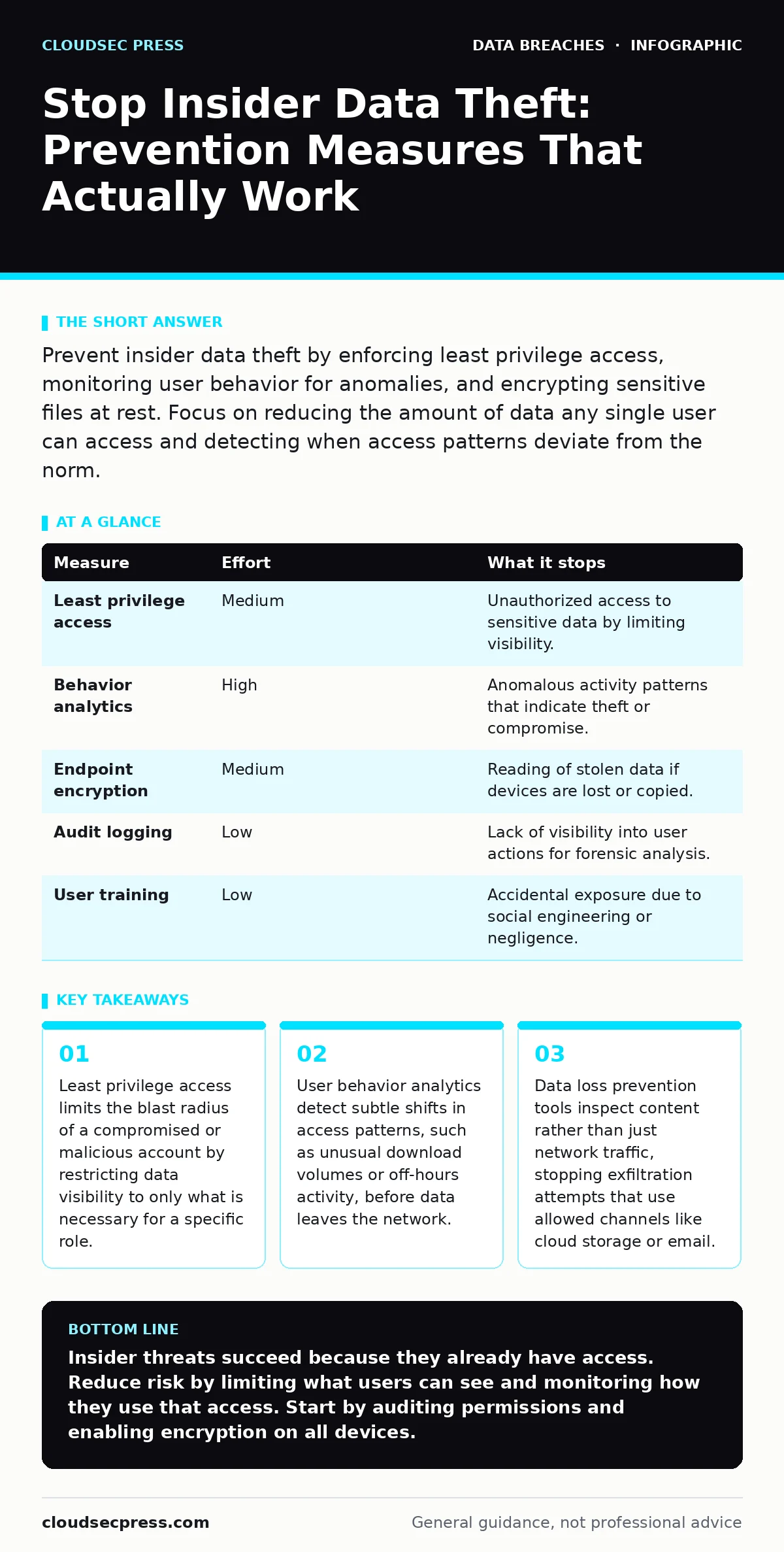
The following table ranks measures by the amount of risk they remove. Prioritize high-impact, lower-effort actions first.
| Measure | Effort | What it stops |
|---|---|---|
| Least privilege access | Medium | Unauthorized access to sensitive data by limiting visibility. |
| Behavior analytics | High | Anomalous activity patterns that indicate theft or compromise. |
| Endpoint encryption | Medium | Reading of stolen data if devices are lost or copied. |
| Audit logging | Low | Lack of visibility into user actions for forensic analysis. |
| User training | Low | Accidental exposure due to social engineering or negligence. |
The Role of Culture and Policy
Technical controls are not enough if the culture encourages hoarding data or bypassing security for convenience. Employees who feel pressured to meet deadlines may take shortcuts that expose data. You need clear policies that define acceptable use and consequences for violations.
Regular training helps employees understand the risks of insider threats. It is not just about telling them to "be careful." It must explain how their actions contribute to security and what to report. Create a channel for reporting suspicious behavior without fear of retaliation. This encourages early detection of potential issues before they escalate into breaches.
Closing Checklist
Take these three steps today to reduce your exposure to insider data theft.
- Audit access rights for all users with access to sensitive data and remove unnecessary permissions.
- Enable detailed audit logging for all data access and storage activities to ensure visibility.
- Verify that all corporate devices have full disk encryption enabled to protect data at rest.
Refer to our guide on secrets management for details on protecting API keys and credentials that insiders often target. Understanding the CIA triad helps you balance confidentiality with the availability needs of your workforce. For more on external threats, see data breaches and encryption in transit.
Key takeaways
- Least privilege access limits the blast radius of a compromised or malicious account by restricting data visibility to only what is necessary for a specific role.
- User behavior analytics detect subtle shifts in access patterns, such as unusual download volumes or off-hours activity, before data leaves the network.
- Data loss prevention tools inspect content rather than just network traffic, stopping exfiltration attempts that use allowed channels like cloud storage or email.
Insider threats succeed because they already have access. Reduce risk by limiting what users can see and monitoring how they use that access. Start by auditing permissions and enabling encryption on all devices.
Frequently asked questions
How do I detect a malicious insider without violating privacy?
Focus on data access patterns rather than personal communications. Monitor metadata like file access times and volumes, not the content of private messages, to maintain legal and ethical standards.
Is user training enough to prevent insider theft?
Training reduces accidental leaks but does not stop determined malicious insiders. Combine education with technical controls like least privilege and monitoring to create a defense-in-depth strategy.
What is the difference between insider threat and insider risk?
Insider threat refers to malicious intent, while insider risk includes accidental actions. Both require similar controls because the outcome—data exposure—is the same, and intent is hard to prove in real-time.
Do I need to monitor contractors differently than employees?
Contractors often have temporary access and less loyalty to the organization. Apply stricter least privilege controls and monitor their activity more closely, as they are statistically higher risk for data theft.
How this guide was produced: written by the CloudSec Press editorial team with AI assistance, checked against the public references listed below, and reviewed when the facts change. See our editorial policy or report an error.