Synthetic Identity Fraud: 6 Myths That Keep You Exposed
Synthetic identities are not fake people but hybrid profiles that slip past standard identity verification checks by blending real and fabricated data points.

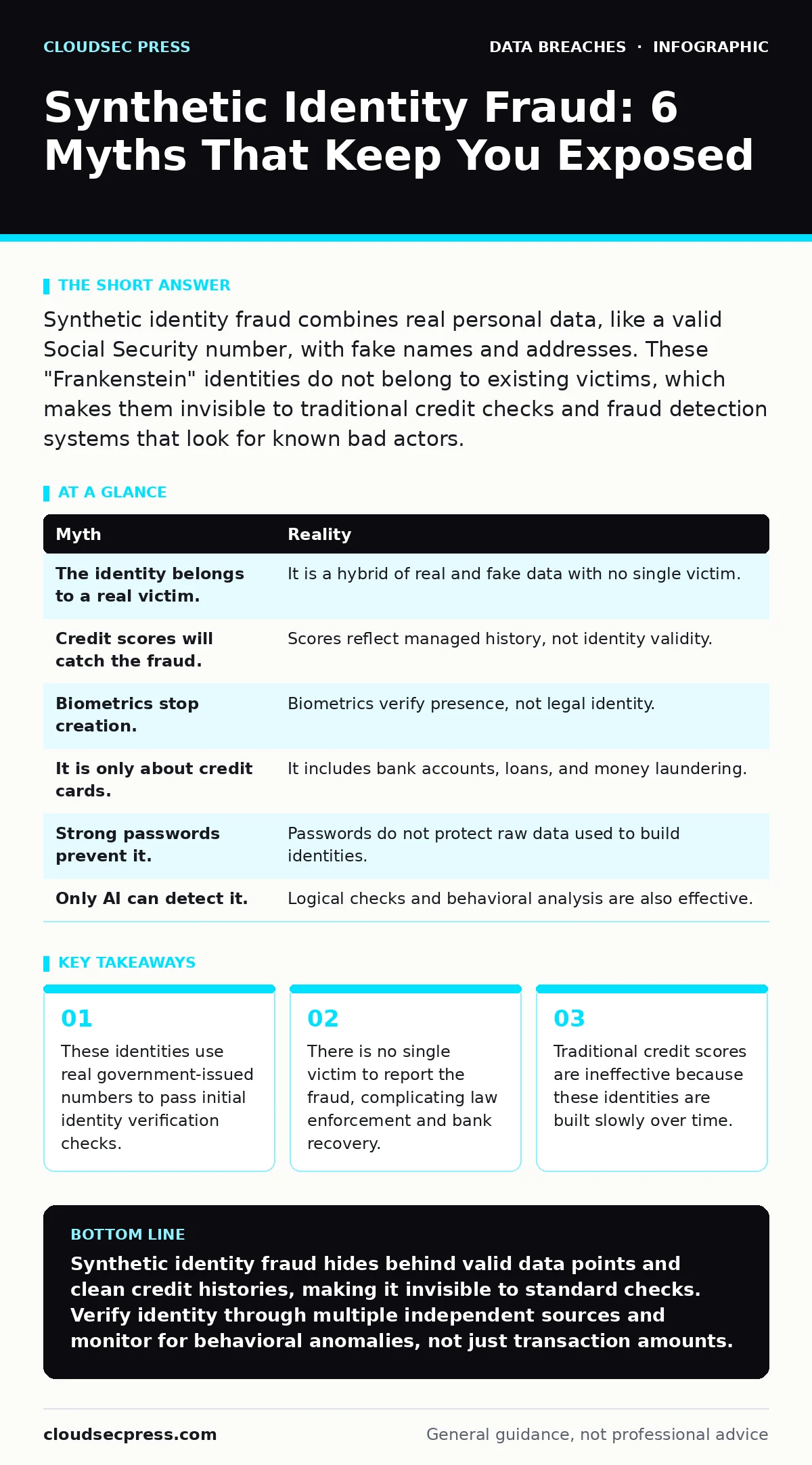
Synthetic identity fraud combines real personal data, like a valid Social Security number, with fake names and addresses. These "Frankenstein" identities do not belong to existing victims, which makes them invisible to traditional credit checks and fraud detection systems that look for known bad actors.
Myth: The Identity Belongs to a Real Person Who Was Hacked
Reality: There is no single human victim behind a synthetic identity. The fraudster constructs a persona by combining genuine data elements with fabricated ones. For example, they might use a real Social Security number that belongs to a child, a deceased person, or someone whose number was exposed in a past data breaches, but they pair it with a completely invented name, date of birth, and address.
Because the name and the government identifier do not match in any central database, traditional identity checks often fail to flag the discrepancy. The system sees a valid number and a plausible name, assuming they belong together. This creates a ghost identity that does not exist in the real world. You cannot notify a victim because the person associated with the real data was not the one being impersonated in the traditional sense.
This distinction matters for response protocols. When you deal with standard identity theft, you contact the victim to freeze their credit. With synthetic fraud, there is no victim to alert, and the credit file for the real owner of the SSN remains clean until the fraudster decides to cash out.
Myth: Credit Scores Will Catch the Fraud Early
Reality: Credit scoring models are designed to predict risk based on historical behavior, not to detect the creation of new personas. Fraudsters know this, so they do not apply for large loans immediately. Instead, they open small credit-builder accounts or store cards to establish a payment history. This is called "aging" the identity.
Over months or years, the synthetic identity builds a pristine credit profile. It pays on time, keeps balances low, and appears indistinguishable from a responsible consumer. By the time the fraudster applies for a substantial loan or line of credit, the identity has a high credit score. The financial institution sees a low-risk applicant with a long history of good behavior.
This slow-burn approach exploits the trust placed in credit bureaus. The system rewards consistency, and the fraudster provides exactly that. You cannot rely on a credit score to warn you that an account is synthetic, because the score reflects the fraudster's careful management, not the truth of the identity.
Myth: Biometrics Will Stop Synthetic Identity Creation
Reality: Biometric verification, such as facial recognition or fingerprint scanning, confirms that a person is present and matches a stored template. It does not verify that the person is who they claim to be in a legal or financial context. If a fraudster obtains a high-quality photo or video of a real person, they can use it to pass liveness checks.
Many synthetic identity attacks do not even require the physical presence of the person whose data was stolen. The fraudster uses the real data for background checks and the fake data for the application. If the system only checks that a face matches a photo on file, it misses the fact that the name and address are fabricated.
Biometrics solve the problem of presentation attacks, not identity fabrication. They ensure you are talking to a human, not a script. They do not ensure that the human is the legal owner of the financial account. You need document verification and data cross-referencing, not just biometric matching, to catch these hybrids.
Myth: It Is Just a Credit Card Issue
Reality: While payment card theft is common, synthetic identity fraud extends far beyond retail purchases. Fraudsters use these identities to open bank accounts, apply for government benefits, or secure utility services. They may use the identity to launder money by depositing illicit funds into a bank account opened in the fake name.
In some cases, the goal is not immediate cash but long-term asset building. The fraudster might secure a mortgage or a business loan, default on it, and walk away. The collateral is lost, but the fraudster has no legal liability because the identity is fake. This causes significant losses for financial institutions and undermines the stability of the lending market.
The scope of the threat requires a broader defense strategy. Focusing only on transaction monitoring for credit cards leaves other channels open. You must monitor for account opening anomalies, not just spending patterns.
Myth: Better Passwords Will Prevent the Attack
Reality: Password leaks are a source of data, but changing passwords does not stop the creation of synthetic identities. The fraudsters do not need to guess your password; they need your raw data. They acquire this data from dark web markets, insider threats, or large-scale data breaches.
Once they have your Social Security number, date of birth, and address, they can create a new identity. They do not log into your existing accounts. They create new ones. Your password strength is irrelevant to their ability to open a new bank account or apply for a loan under a fake name.
Security must shift from access control to data integrity. You need to protect the data at rest and in transit, but you also need to monitor for the misuse of that data. Encryption in transit protects data moving across networks, but it does not help if the data is stolen from a poorly secured database.
See also: Stop Insider Data Theft: Prevention Measures That Actually Work · Exposed Storage Buckets: The Hidden Risks and Fix
Myth: It Is Impossible to Detect Without AI
Reality: Advanced machine learning helps, but basic logical checks can reveal synthetic identities. Look for inconsistencies in the data. A new identity with a perfect credit score and no history of missed payments is suspicious. An address that does not match the utility records or the voter registration database is a red flag.
Behavioral analysis is also effective. Does the user interact with the website in a human way? Do they use the account in a way that matches the demographic profile? These are not just AI tasks. Simple rule-based systems can flag anomalies when you define the rules correctly.
Do not rely solely on black-box algorithms. Understand the logic behind your detection methods. If you do not know why a transaction was flagged, you cannot improve your defenses. Transparency in your detection logic allows you to adapt to new fraud tactics.
| Myth | Reality |
|---|---|
| The identity belongs to a real victim. | It is a hybrid of real and fake data with no single victim. |
| Credit scores will catch the fraud. | Scores reflect managed history, not identity validity. |
| Biometrics stop creation. | Biometrics verify presence, not legal identity. |
| It is only about credit cards. | It includes bank accounts, loans, and money laundering. |
| Strong passwords prevent it. | Passwords do not protect raw data used to build identities. |
| Only AI can detect it. | Logical checks and behavioral analysis are also effective. |
Key takeaways
- These identities use real government-issued numbers to pass initial identity verification checks.
- There is no single victim to report the fraud, complicating law enforcement and bank recovery.
- Traditional credit scores are ineffective because these identities are built slowly over time.
Synthetic identity fraud hides behind valid data points and clean credit histories, making it invisible to standard checks. Verify identity through multiple independent sources and monitor for behavioral anomalies, not just transaction amounts.
Frequently asked questions
How do I know if I am a victim of synthetic identity fraud?
You likely will not know, as there is no direct victim. You may see unauthorized accounts opened with your data, but the name on those accounts will be different.
Can I freeze my credit to stop this?
A credit freeze prevents new accounts from being opened in your name, but it does not stop fraudsters from using your data to create a new identity with a different name.
What is the difference between this and identity theft?
Identity theft uses a real person's complete identity. Synthetic fraud creates a new person using a mix of real and fake data.
Should I use a credit monitoring service?
Credit monitoring can alert you to new accounts, but it may not catch synthetic identities until they have already established a credit history.
How this guide was produced: written by the CloudSec Press editorial team with AI assistance, checked against the public references listed below, and reviewed when the facts change. See our editorial policy or report an error.