OSINT for Small Business: Practical Threat Monitoring
Open-source intelligence transforms public data into early warnings, allowing small teams to detect exposure before attackers exploit it.
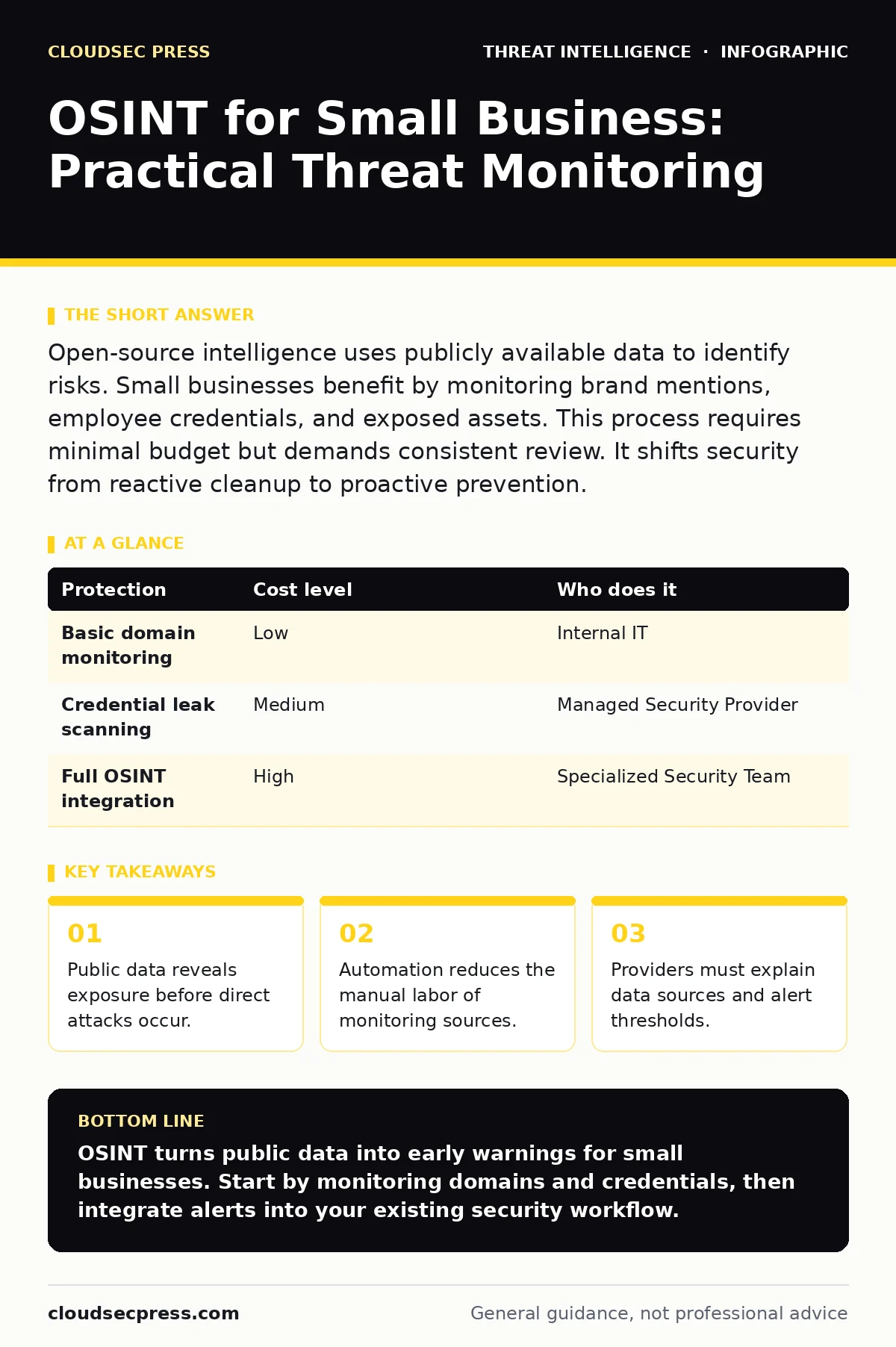
Open-source intelligence uses publicly available data to identify risks. Small businesses benefit by monitoring brand mentions, employee credentials, and exposed assets. This process requires minimal budget but demands consistent review. It shifts security from reactive cleanup to proactive prevention.
Why OSINT Matters at Small Scale
Open-source intelligence (OSINT) gathers data from public sources. It does not involve hacking or illegal access. Small businesses often believe they are too small to attract attackers. This assumption is dangerous. Attackers use automated tools to scan all internet-connected devices. They do not discriminate by company size.
OSINT helps you see what attackers see. It identifies exposed servers, leaked credentials, and fake websites. These indicators appear in public databases long before an attack happens. Ignoring them leaves your digital perimeter open. You cannot protect what you do not know exists.
The cost of entry is low. Many data sources are free. The real investment is time. Without a process, data becomes noise. With a process, it becomes intelligence. This shift changes security from a guessing game to a measured practice.
Practical Steps for Monitoring
Start by defining what you need to protect. List your domain names, social media handles, and key employee names. These are your digital assets. You need to monitor them for misuse.
- Domain monitoring: Check for new registrations similar to your brand. Cybersquatting often precedes phishing campaigns.
- Credential checking: Use services that scan for leaked passwords. If employees reuse passwords, a breach elsewhere compromises your firm.
- Asset discovery: Identify open ports and services. Unintended exposure creates easy entry points for attackers.
Automate the collection where possible. Manual checks are inconsistent. Tools can run daily scans and report only changes. This reduces the workload for your IT staff. You focus on anomalies, not routine data.
Integrating with Existing Security
OSINT data is raw. It needs context to be useful. Integrate it with your existing security tools. This creates a feedback loop. When an alert triggers, you can act quickly.
Consider how tactical threat intelligence fits into your workflow. Tactical intelligence provides specific indicators of compromise (IOCs). These include malicious IP addresses and file hashes. OSINT feeds these IOCs into your firewall or email filter. This blocks known bad traffic before it reaches users.
This integration supports incident triage. When an alert fires, you need to know if it is real. OSINT context helps you prioritize. A match against a known bad domain is high priority. A match against a benign but noisy source is lower. This distinction saves time during an incident.
Asking the Right Questions
You may not have the expertise to manage OSINT internally. An IT provider can help. But you must verify their capability. Many providers offer generic monitoring. You need specific, actionable intelligence.
Ask your provider about their data sources. They should name the specific feeds they use. Generic answers like "we monitor the web" are insufficient. You need to know if they check dark web forums or breach databases.
Ask about alert thresholds. How do they decide what is an alert? False alarms waste your time. True positives require action. A good provider balances sensitivity with precision. They should explain their logic for filtering noise.
| Protection | Cost level | Who does it |
|---|---|---|
| Basic domain monitoring | Low | Internal IT |
| Credential leak scanning | Medium | Managed Security Provider |
| Full OSINT integration | High | Specialized Security Team |
Hidden Costs and Trade-offs
OSINT is not free in terms of effort. The main cost is analysis. Tools generate data. Humans must interpret it. Without a clear process, data piles up. This is called alert fatigue. Staff stop paying attention to warnings.
Another hidden cost is reputation management. OSINT can reveal sensitive information about your employees. You must have a policy for handling this data. Respect privacy laws. Do not store personal data unnecessarily.
There is also the cost of integration. Connecting OSINT feeds to your security tools takes time. It requires technical skill. If you skip this step, you have two separate systems. You will miss correlations. This gap leaves you vulnerable to sophisticated attacks.
See also: Cyber Espionage Prevention Checklist: Stop Silent Data Theft · Tactical Threat Intelligence Explained: Actionable Indicators for Defense
Beyond Basic Monitoring
As you mature, you can expand your OSINT practice. Look into threat actor profiling. Understanding who targets your industry helps you predict their methods. It is not about naming specific groups. It is about understanding their tactics and motives.
Consider IOC enrichment. This process adds context to indicators. A single IP address tells you little. Enriched data tells you the location, the host, and previous associations. This depth helps you assess risk more accurately.
You might also explore digital forensics and incident response. OSINT provides the initial clues. Forensics confirms the impact. This combination creates a complete picture of an attack. It helps you improve your defenses after the event.
Building a Sustainable Process
Sustainability is key. You cannot run OSINT as a one-time project. It must be continuous. Threats evolve daily. Your data must reflect this reality.
Set a regular review schedule. Weekly or monthly reviews work for most small businesses. Document findings. Track trends. This history helps you spot changes. A sudden increase in phishing attempts, for example, signals a campaign.
Train your staff. They are the first line of defense. Teach them to recognize the threats OSINT identifies. If you find a fake website, tell your employees. Ask them to report similar links. This human layer complements your technical tools.
Finally, review your strategy annually. Tools change. Data sources change. Your business changes. Adjust your OSINT program to match your current reality. Keep it simple. Keep it effective.
Key takeaways
- Public data reveals exposure before direct attacks occur.
- Automation reduces the manual labor of monitoring sources.
- Providers must explain data sources and alert thresholds.
OSINT turns public data into early warnings for small businesses. Start by monitoring domains and credentials, then integrate alerts into your existing security workflow.
Frequently asked questions
Is OSINT legal for small businesses to use?
Yes, OSINT uses only publicly available data. It does not involve unauthorized access to systems or private data. It is a standard practice for risk assessment.
How often should we check for new threats?
Daily automated checks are recommended for critical assets. Manual reviews can be weekly. The frequency depends on your industry risk and resource availability.
Can OSINT prevent all cyber attacks?
No, OSINT cannot prevent all attacks. It improves detection and response times. It reduces the window of exposure but does not eliminate risk. You still need strong internal security controls.
Do we need expensive software for OSINT?
Not necessarily. Many free tools provide basic monitoring. However, comprehensive coverage often requires paid services. The cost depends on the depth of data you need.
How this guide was produced: written by the CloudSec Press editorial team with AI assistance, checked against the public references listed below, and reviewed when the facts change. See our editorial policy or report an error.