Digital Forensics and Incident Response: 8 Questions Answered
Forensic integrity fails when evidence is copied before the original is verified, a mistake that invalidates legal proceedings and obscures attacker tactics.

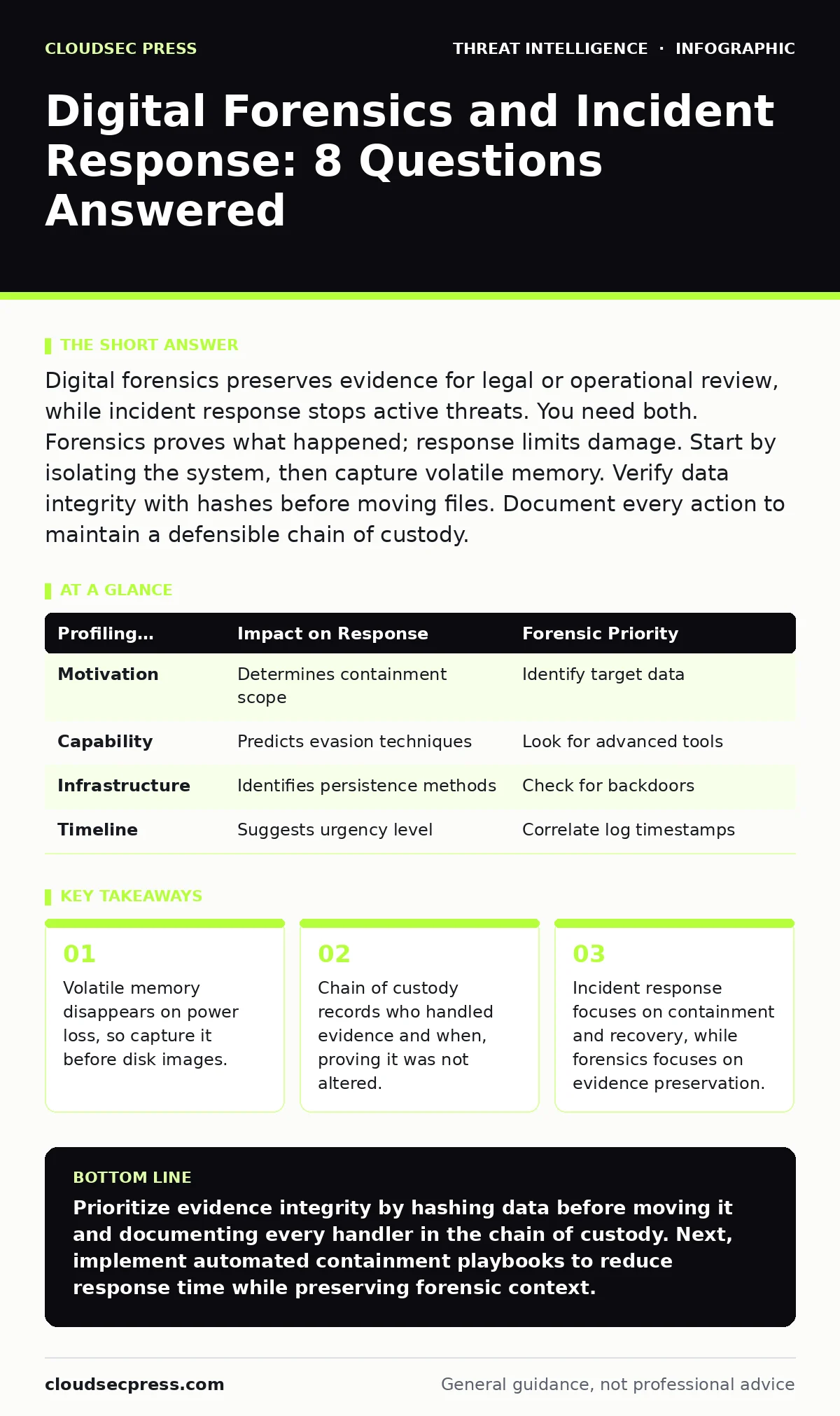
Digital forensics preserves evidence for legal or operational review, while incident response stops active threats. You need both. Forensics proves what happened; response limits damage. Start by isolating the system, then capture volatile memory. Verify data integrity with hashes before moving files. Document every action to maintain a defensible chain of custody.
What is the difference between digital forensics and incident response?
Digital forensics identifies what occurred and preserves evidence, while incident response contains the threat and restores operations. Forensics is retrospective and legalistic; response is immediate and operational. You often perform both simultaneously, but the goals conflict. Forensics requires preserving the system state exactly as found, which can delay containment. Response requires changing the state to stop the attack, which can destroy evidence. You must decide which priority serves your organization better in each specific scenario.
How do you preserve evidence integrity during an investigation?
You preserve evidence integrity by creating cryptographic hashes of all data before moving or copying it. A hash is a fixed-length string of characters that represents the unique content of a file. If the file changes by even one bit, the hash changes completely. Calculate the hash of the original source first. Then calculate the hash of the copy. If the hashes match, the copy is identical to the original. Store the original hash values securely. This proves to auditors or courts that the evidence has not been tampered with.
In what order should you collect volatile data?
You collect volatile data from the most temporary to the most permanent storage locations. Volatile data disappears when power is removed. Start with CPU registers and cache, which vanish instantly. Next, capture running processes and network connections. Then, collect the system clock and active user sessions. After that, save the random access memory (RAM). Finally, image the hard drive or solid-state drive. This order prevents you from losing critical context, like active encryption keys or network tunnels, before you capture the static disk data.
How do you maintain a defensible chain of custody?
A defensible chain of custody requires a detailed log of every person who handled the evidence and when. Record the date, time, and purpose of each transfer. Include the names and roles of all handlers. Note where the evidence is stored and the security measures protecting it. Any gap in this log creates reasonable doubt about the evidence's authenticity. In legal contexts, a broken chain of custody can render evidence inadmissible. In operational contexts, it undermines confidence in the investigation's findings. Treat the log as seriously as the evidence itself.
What is the role of a SIEM in forensic investigations?
A Security Information and Event Management (SIEM) system aggregates logs from multiple sources to provide a unified view of activity. It does not replace forensics but accelerates the initial triage. SIEMs correlate events that individual logs might miss. For example, a login failure followed by a successful login from a different country appears normal in isolation. The SIEM flags this sequence as suspicious. This correlation helps investigators focus on relevant data. However, SIEMs often store summarized data, not raw logs. You must retrieve raw logs from source systems for detailed forensic analysis.
See also: Ransomware Recovery Plans: 8 Practices for Downtime Reduction · Cyber Espionage Prevention Checklist: Stop Silent Data Theft
How does threat actor profiling influence your response strategy?
Threat actor profiling helps you anticipate the next move based on past behavior and resources. Understanding the attacker's motivation, technical capability, and typical tactics allows you to prioritize containment efforts. A financially motivated group may focus on exfiltrating credit card data. A state-sponsored group may focus on destroying infrastructure or stealing intellectual property. Knowing the likely goal helps you decide which systems to isolate first. This approach is more efficient than treating all incidents as equally dangerous. See our guide on threat actor profiling for deeper insights into behavioral patterns.
| Profiling Element | Impact on Response | Forensic Priority |
|---|---|---|
| Motivation | Determines containment scope | Identify target data |
| Capability | Predicts evasion techniques | Look for advanced tools |
| Infrastructure | Identifies persistence methods | Check for backdoors |
| Timeline | Suggests urgency level | Correlate log timestamps |
Why do standard indicators of compromise often fail?
Standard indicators of compromise (IOCs) such as IP addresses or file hashes are easily changed by attackers. Modern threat actors use fast-flux networks that rotate IP addresses frequently. They also compile unique malware variants for each victim, changing the file hash. Relying solely on static IOCs leads to false negatives. You need to enrich these indicators with context. This process, called IOC enrichment, adds reputation data, geolocation, and historical behavior to the raw indicator. It helps distinguish between a malicious IP and a compromised legitimate server.
How does process injection evade traditional detection?
Process injection allows malware to run its code inside a legitimate, trusted process. This technique hides malicious activity from security tools that monitor process creation. Instead of creating a new suspicious process, the attacker injects code into a system process like svchost.exe. The security tool sees a legitimate process running, so it does not alert. This makes detection difficult because the behavior looks normal. Forensic analysis must examine memory dumps to find injected code that does not belong to the legitimate process. Our guide on process injection explains the technical mechanics of this evasion.
What is the purpose of honeytokens in incident response?
Honeytokens are decoy data elements placed in systems to detect unauthorized access. They look valuable to attackers but serve no legitimate business function. When an attacker interacts with a honeytoken, it triggers an alert. This provides early warning of a breach. Honeytokens can be fake database credentials, dummy files, or inactive user accounts. They are passive and do not require complex monitoring infrastructure. Unlike honeypots, which are complex systems, honeytokens are simple and low-maintenance. They help you detect lateral movement inside your network. Read more about honeytokens in our dedicated guide.
How do you automate the initial response steps?
You automate initial response steps using Security Orchestration, Automation, and Response (SOAR) platforms. SOAR connects different security tools and executes predefined playbooks. When a SIEM detects a threat, the SOAR platform can automatically isolate the affected endpoint. It can also block the malicious IP address at the firewall. This reduces the time between detection and containment. Automation ensures consistent response actions and frees analysts for complex tasks. However, automation must be carefully tested to avoid disrupting critical business operations. See our guide on SOAR for implementation strategies.
What are the limitations of automated forensic tools?
Automated forensic tools speed up data collection and analysis but lack human intuition. They can miss subtle anomalies that a human analyst would notice. They also generate false positives, requiring manual review. Over-reliance on automation can lead to tunnel vision, where investigators only look for what the tool is configured to find. Human analysts must interpret the context of the findings. They must connect disparate pieces of evidence into a coherent narrative. Automation is a force multiplier, not a replacement for skilled investigation.
How do DCSync attacks compromise domain controllers?
DCSync attacks mimic the behavior of a domain controller to request password hashes from other controllers. The attacker does not need to be on the network segment of the domain controller. They only need valid credentials with specific replication rights. This allows them to extract all password hashes from the Active Directory database. Once they have these hashes, they can perform pass-the-hash attacks to move laterally. This technique bypasses many traditional perimeter defenses. Detecting DCSync requires monitoring for unusual replication requests and privilege escalation events. Our guide on DCSync attacks details the specific event IDs to watch.
Key takeaways
- Volatile memory disappears on power loss, so capture it before disk images.
- Chain of custody records who handled evidence and when, proving it was not altered.
- Incident response focuses on containment and recovery, while forensics focuses on evidence preservation.
Prioritize evidence integrity by hashing data before moving it and documenting every handler in the chain of custody. Next, implement automated containment playbooks to reduce response time while preserving forensic context.
Frequently asked questions
Can I use forensic tools on a live system?
Yes, but you must document every action taken on the live system. Live forensics captures volatile data but alters the system state, which can affect legal admissibility.
How long should I keep forensic evidence?
Retention periods depend on legal requirements and industry regulations. Keep evidence until all legal proceedings are closed and the statute of limitations has expired.
Is cloud forensics different from on-premises forensics?
Yes, cloud forensics relies on API access and shared responsibility models. You often cannot access the physical hardware, so you must rely on cloud provider logs and snapshots.
Can I use open-source tools for incident response?
Yes, many open-source tools are effective for initial triage and evidence collection. Ensure they are updated and validated for use in your specific environment.
How this guide was produced: written by the CloudSec Press editorial team with AI assistance, checked against the public references listed below, and reviewed when the facts change. See our editorial policy or report an error.