Cyber Espionage Prevention Checklist: Stop Silent Data Theft
Most espionage succeeds because defenders monitor for loud attacks while quiet credential theft drains sensitive data over months without triggering standard alerts.

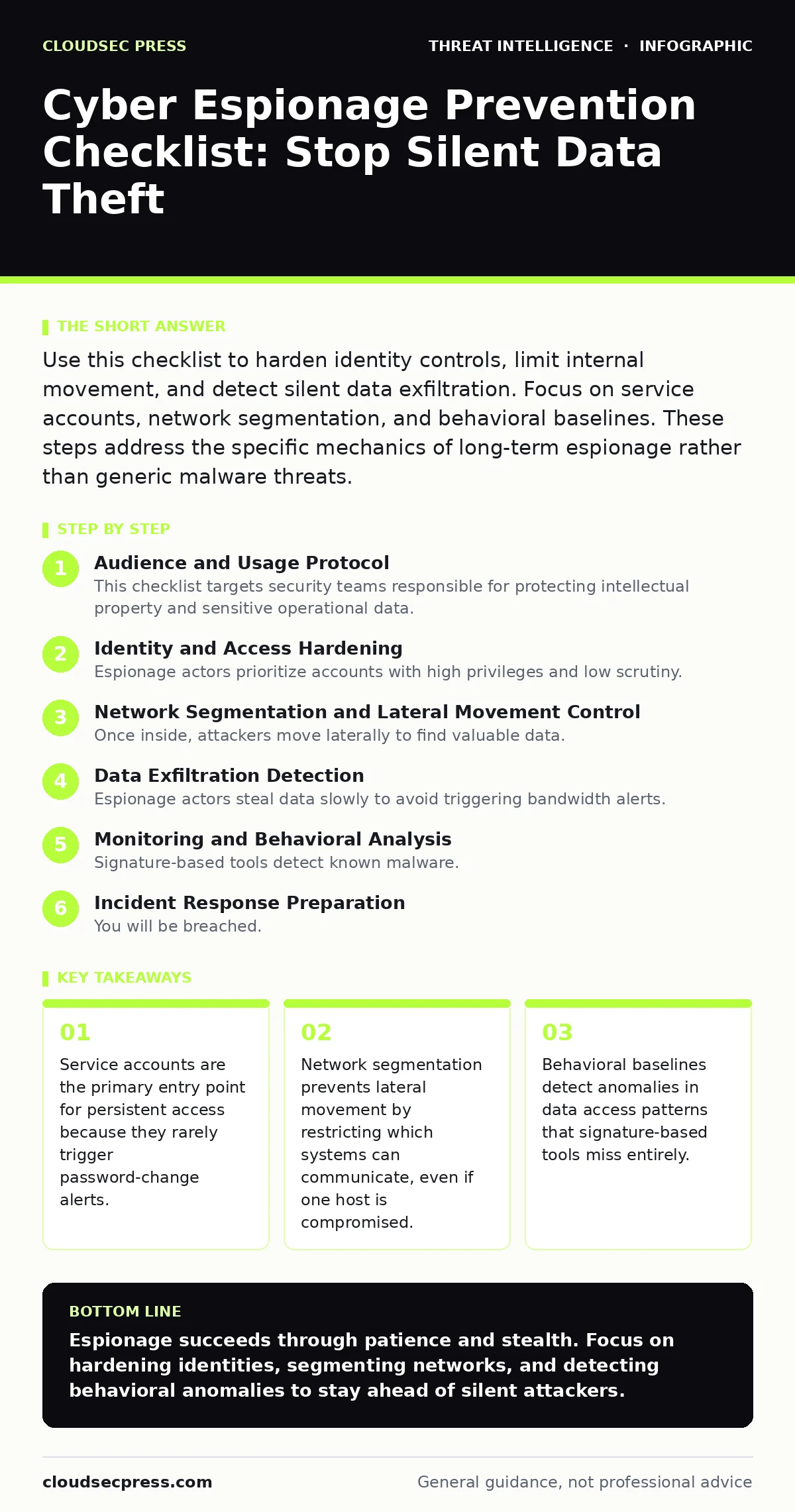
Use this checklist to harden identity controls, limit internal movement, and detect silent data exfiltration. Focus on service accounts, network segmentation, and behavioral baselines. These steps address the specific mechanics of long-term espionage rather than generic malware threats.
Audience and Usage Protocol
This checklist targets security teams responsible for protecting intellectual property and sensitive operational data. You use it to audit your current defenses against long-term, low-profile intrusion attempts. Espionage differs from ransomware because the attacker wants to remain hidden. You cannot rely on loud indicators. You must assume an adversary has already entered your network. Focus on reducing the value of any single breach. Limit the damage an attacker can cause once they have initial access.
Identity and Access Hardening
Espionage actors prioritize accounts with high privileges and low scrutiny. Standard user accounts change passwords frequently. Service accounts do not. This makes them ideal for maintaining long-term access.
- Enforce just-in-time access for administrative tasks: Privileged access should be temporary and approved, reducing the window for credential theft.
- Audit service account permissions quarterly: These accounts often accumulate unnecessary rights over time, giving attackers broader access than needed.
- Disable legacy authentication protocols: Older protocols like NTLM lack modern security features, making credential replay attacks easier.
- Implement phishing-resistant multi-factor authentication: Passwords alone cannot stop credential theft, but hardware keys or FIDO2 tokens can.
- Monitor for impossible travel logins: Geographic anomalies in login attempts often indicate stolen credentials being used from a different location.
Network Segmentation and Lateral Movement Control
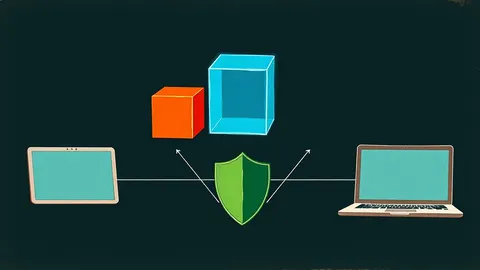
Once inside, attackers move laterally to find valuable data. They exploit trust relationships between systems. You must break these trust paths. Segmentation forces attackers to jump between isolated zones. Each jump requires new credentials or exploits. This increases the risk of detection.
- Segment critical data stores from general user networks: Isolating sensitive databases prevents casual access by compromised workstations.
- Restrict SMB traffic to necessary hosts only: Server Message Block is a common protocol for lateral movement, limiting it reduces attack paths.
- Disable unused inter-network routing rules: Old firewall rules often permit traffic that is no longer required, creating hidden backdoors.
- Monitor internal DNS queries for anomalies: Unusual domain lookups can indicate command-and-control communication or data staging.
Imagine an attacker compromises a marketing laptop. Without segmentation, they can scan the entire network. With segmentation, they are stuck in the marketing VLAN. They cannot reach the engineering servers. This forces them to find a new entry point, which is harder and riskier.
Data Exfiltration Detection
Espionage actors steal data slowly to avoid triggering bandwidth alerts. They compress and encrypt data before sending it out. Standard volume-based alerts miss this. You must look at the destination and the behavior, not just the size.
- Block unauthorized cloud storage uploads: Preventing uploads to personal cloud accounts stops easy data theft without complex tools.
- Monitor for large outbound transfers to new IPs: Sudden data flows to unknown addresses often indicate exfiltration to a new command server.
- Inspect encrypted traffic for metadata anomalies: While you cannot read encrypted content, unusual packet sizes or timing can reveal hidden data channels.
- Restrict USB device usage on sensitive systems: Physical media remains a reliable way to move data without network detection.
Monitoring and Behavioral Analysis
Signature-based tools detect known malware. They do not detect custom scripts or legitimate tools used maliciously. You need to understand normal behavior to spot deviations. This is where SIEM systems become critical. You must correlate logs from multiple sources. A single odd event is noise. A pattern of odd events is an attack.
- Baseline normal user behavior profiles: Establishing what is normal for each user allows you to spot deviations like logging in at 3 AM.
- Alert on bulk data downloads by non-admin users: Normal users rarely download large volumes of sensitive files, making this a strong indicator.
- Monitor for process injection techniques: Attackers often inject code into legitimate processes to hide their activity from standard process lists.
- Review failed login attempts across multiple accounts: Spraying passwords against many accounts is a common initial access technique.
See also: The CIA Triad: Meaning, Definition, and Practical Application · Formjacking: How Small Businesses Lose Customer Data
Incident Response Preparation
You will be breached. The goal is to detect it quickly and limit damage. Your incident triage process must account for espionage. Unlike ransomware, the system may look healthy. The data is already gone. You need specific procedures for silent breaches.
- Document data classification and critical assets: You cannot protect what you do not know, and you cannot prioritize what you have not valued.
- Test backup integrity regularly: Ensuring you can restore from clean backups prevents attackers from demanding ransom or destroying evidence.
- Conduct tabletop exercises for silent breaches: Practicing scenarios where no malware is detected prepares your team for subtle attacks.
- Maintain offline forensic images: Keeping offline copies of critical systems allows you to investigate without altering live evidence.
Continuous Improvement and Threat Intelligence
Static defenses fail. You must adapt. Use threat intelligence to understand what attackers are doing. Understand the Pyramid of Pain to prioritize your defenses. It is harder for attackers to change their tools and techniques than to change their IP addresses. Focus on detecting the harder-to-change indicators.
- Subscribe to industry-specific threat feeds: Generic feeds contain noise. Industry-specific feeds highlight relevant tactics and tools.
- Update detection rules based on new TTPs: Tactics, Techniques, and Procedures change. Your rules must evolve to match.
- Participate in information sharing groups: Learning from others' breaches helps you anticipate attacks before they happen.
- Review and update security policies annually: Policies that are not reviewed become outdated and ineffective.
Understanding threat actor naming conventions helps you communicate risks clearly. It ensures everyone understands who is attacking and why. This clarity improves response speed.
Key takeaways
- Service accounts are the primary entry point for persistent access because they rarely trigger password-change alerts.
- Network segmentation prevents lateral movement by restricting which systems can communicate, even if one host is compromised.
- Behavioral baselines detect anomalies in data access patterns that signature-based tools miss entirely.
Espionage succeeds through patience and stealth. Focus on hardening identities, segmenting networks, and detecting behavioral anomalies to stay ahead of silent attackers.
Frequently asked questions
How do I detect if an attacker is using DCSync attacks?
Monitor for replication requests from non-domain controllers. DCSync mimics normal replication, but only controllers should initiate it.
Are honeytokens effective against espionage actors?
Yes, if placed in sensitive areas. Espionage actors often search for credentials. Triggering a fake token alerts you to their presence.
Can firewalls prevent lateral movement?
Internal firewalls can restrict traffic between segments. Properly configured rules stop unauthorized communication between hosts.
How does the dark web relate to cyber espionage?
Stolen data is often sold or shared on dark web forums. Monitoring these sites can reveal breaches before they are public.
How this guide was produced: written by the CloudSec Press editorial team with AI assistance, checked against the public references listed below, and reviewed when the facts change. See our editorial policy or report an error.