The CIA Triad: Meaning, Definition, and Practical Application
The CIA triad is not about espionage agencies but a structural framework for defining how data behaves when systems fail or policies are ignored.
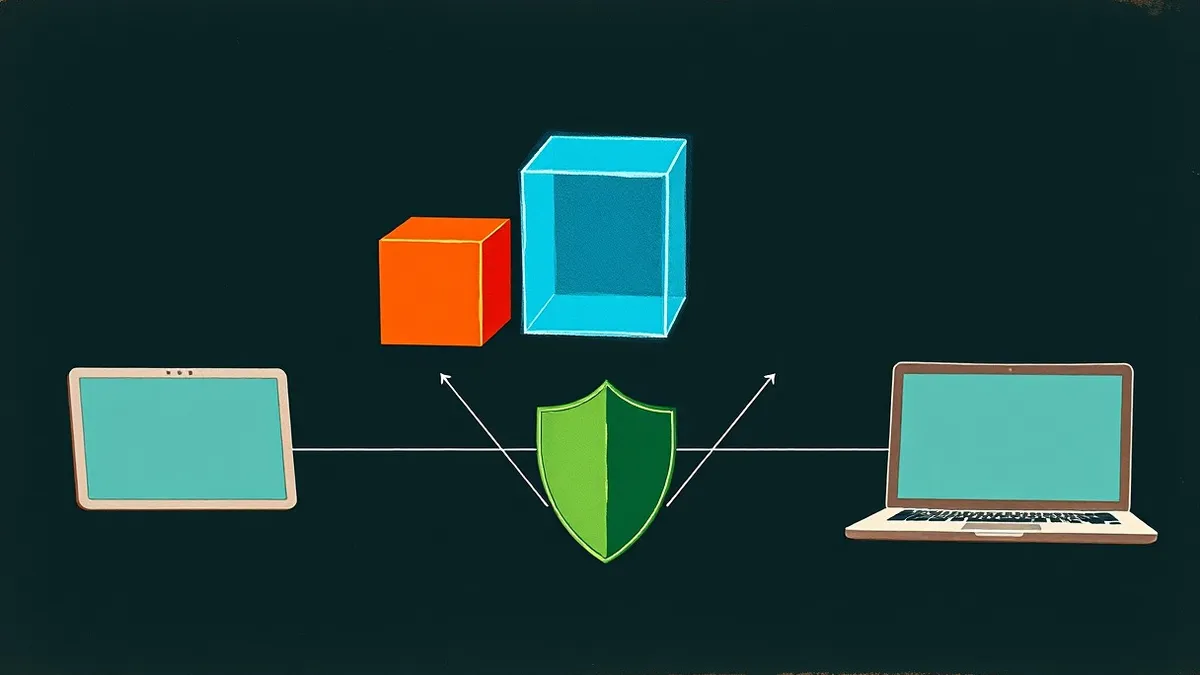
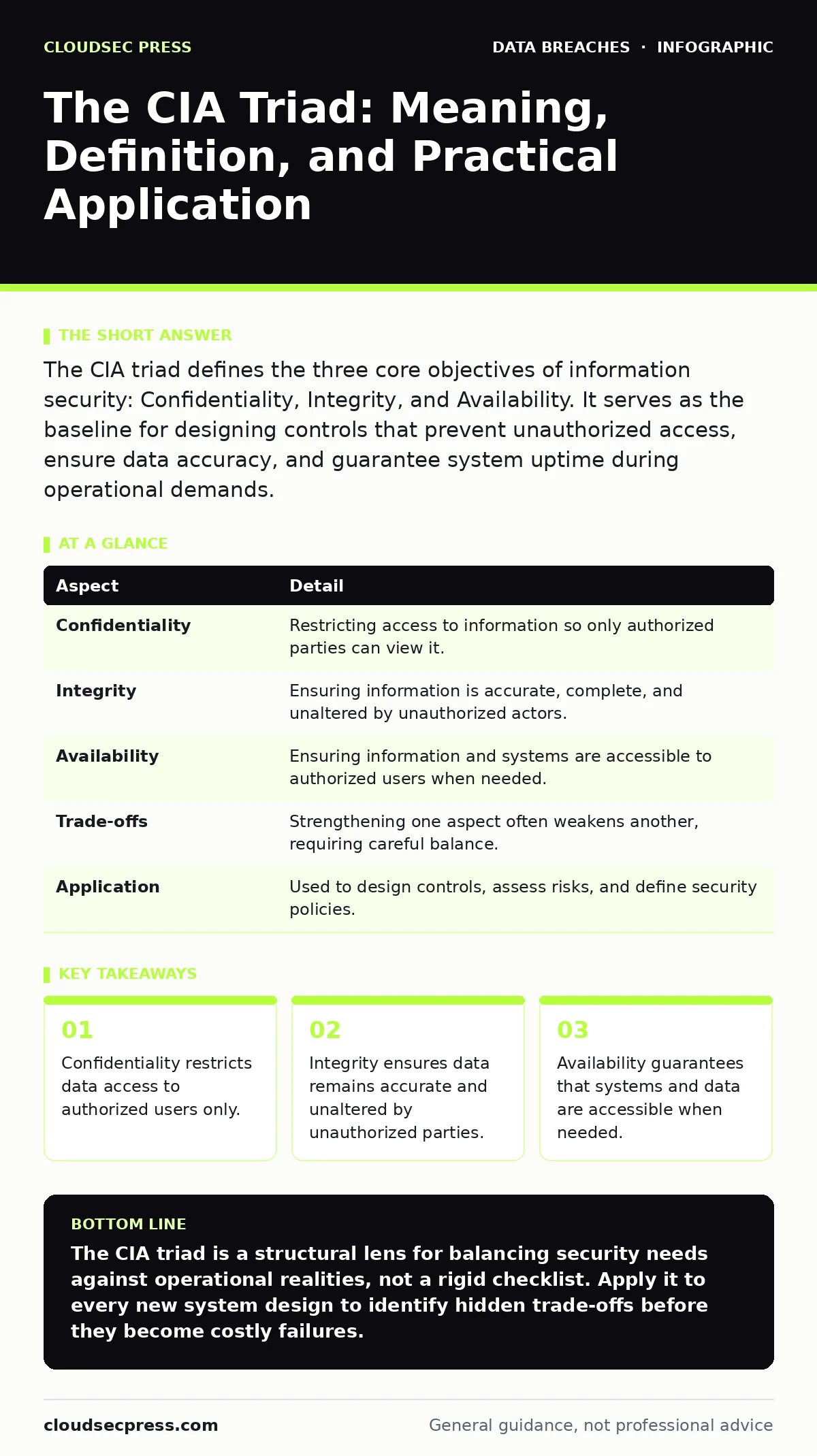
The CIA triad defines the three core objectives of information security: Confidentiality, Integrity, and Availability. It serves as the baseline for designing controls that prevent unauthorized access, ensure data accuracy, and guarantee system uptime during operational demands.
Beyond the Spy Thriller Misconception
When you hear "CIA," you likely picture intelligence agencies and covert operations. In cybersecurity, the acronym stands for something entirely different: Confidentiality, Integrity, and Availability. This model provides the foundational logic for almost every security control you encounter. It moves beyond vague ideas of "safety" to define specific states that data must maintain.
The term emerged in the late 1970s and early 1980s as computer networks grew more complex. Security professionals needed a common language to describe what they were trying to protect. Instead of listing every possible threat, they identified three primary properties of information. If any one of these properties is compromised, the system is considered insecure. This framework remains relevant because it applies to physical locks, digital encryption, and network firewalls with equal validity.
| Aspect | Detail |
|---|---|
| Confidentiality | Restricting access to information so only authorized parties can view it. |
| Integrity | Ensuring information is accurate, complete, and unaltered by unauthorized actors. |
| Availability | Ensuring information and systems are accessible to authorized users when needed. |
| Trade-offs | Strengthening one aspect often weakens another, requiring careful balance. |
| Application | Used to design controls, assess risks, and define security policies. |
Confidentiality: The Gatekeeper
Confidentiality ensures that sensitive information is not disclosed to unauthorized individuals, entities, or processes. This is the most visible aspect of security for most users. You see it when you log into a bank account or send an encrypted message. The mechanism here is access control. Systems must verify identity and enforce permissions before revealing data.
Imagine you send a letter to a friend. You place it in an envelope and seal it. This is confidentiality. If a courier opens the envelope and reads the contents, confidentiality is broken. In digital terms, this means using encryption in transit to scramble data as it moves across networks. It also means using strong secrets management practices to ensure only specific applications can read database credentials.
Confidentiality does not mean data is hidden from everyone. It means data is hidden from those who should not see it. A doctor needs to see your medical records; a marketing intern does not. The control must distinguish between the two. If the distinction fails, you face a data breach scenario where private information leaks to the wrong audience.
Integrity: The Trust Anchor
Integrity focuses on the accuracy and trustworthiness of data. It ensures that information has not been altered in an unauthorized manner. This includes protection against accidental changes, such as corruption during storage, and malicious changes, such as an attacker modifying a transaction amount. Integrity is about provenance. You must be able to trust that the data you see is the data that was originally created.
Consider a software update. Your device downloads a new version of an application. Before installing it, the system checks a digital signature. This signature proves the code came from the legitimate developer and has not been tampered with. If the signature fails, integrity is compromised, and the installation stops. This prevents attackers from injecting malicious code into legitimate software updates.
Integrity failures are often harder to detect than confidentiality breaches. You might not know your data has been altered until you act on it. Suppose a financial record is changed by one cent. The error may go unnoticed for months. This is why systems use checksums and hashes to verify data consistency over time. Without these checks, you cannot distinguish between a legitimate edit and a sabotage attempt.
Availability: The Operational Floor
Availability ensures that authorized users can access information and systems when they need them. This is often the most neglected aspect of the triad. It is easy to focus on keeping data secret or accurate, but if the system is down, the data is useless. Availability covers hardware failures, network outages, and deliberate attacks that overwhelm resources.
Denial of Service (DoS) attacks target availability directly. An attacker floods a server with traffic, causing it to crash or become unresponsive. Legitimate users cannot access the service. This is not about stealing data; it is about stopping business operations. To maintain availability, organizations use redundancy. They duplicate servers, networks, and storage so that if one component fails, another takes over.
Availability also depends on maintenance. Systems must be updated and patched to prevent bugs from causing crashes. However, updates can also cause downtime if not managed carefully. This creates a tension with integrity and confidentiality. You must balance the need for secure updates with the need for continuous operation. A system that is always patched but never available fails its primary purpose.
The Hidden Costs of Balance
The CIA triad is not a checklist where you maximize all three equally. In practice, these goals often conflict. Strengthening one can weaken another. This trade-off is the central challenge of security engineering. You must decide which aspect matters most for each specific asset.
For example, adding more layers of authentication improves confidentiality. However, it may slow down the login process, reducing availability for users. If the login process is too complex, users may abandon it, leading to poor adoption. Conversely, making a system highly available by keeping it always online increases its exposure to attacks, potentially threatening confidentiality. You cannot have absolute security in all three areas simultaneously.
This balancing act requires context. A public website needs high availability and moderate confidentiality. A military command system needs high confidentiality and integrity, with lower availability tolerances. Understanding these trade-offs prevents you from implementing controls that hinder business goals. It forces you to prioritize based on actual risk rather than theoretical perfection.
See also: 7 Payment Card Theft Mistakes That Leave Your Business Open · Formjacking: How Small Businesses Lose Customer Data
Common Misinterpretations
Many professionals misunderstand the scope of the CIA triad. A common error is treating it as a static set of rules rather than a dynamic framework. Security is not a destination; it is a continuous process. The triad provides the metrics for that process. It tells you what to measure, not how to fix every problem.
Another mistake is assuming that confidentiality is the only goal. This is particularly true in consumer-facing applications. Companies often focus on preventing password leaks while ignoring data integrity. If an attacker can modify user profiles or transaction histories, the system is broken even if no data was stolen. Integrity failures can be more damaging because they undermine trust in the system’s core functions.
Finally, people often ignore the human element. Technical controls can enforce confidentiality and integrity, but they cannot force availability if staff are unavailable to respond to incidents. Insider data theft remains a risk regardless of technical barriers. The triad must be applied to people, processes, and technology. Without this holistic view, security gaps remain.
Integrating the Triad into Daily Work
You use the CIA triad every time you design a system or review a policy. Start by identifying the data assets you need to protect. Then, assess the threats to each of the three properties. Ask specific questions. Who should see this data? How do you know it hasn’t changed? What happens if the server goes down?
These questions drive your control selection. For confidentiality, you might implement role-based access control. For integrity, you might use version control systems. For availability, you might set up automated backups and failover mechanisms. Each control addresses a specific aspect of the triad. By mapping controls to the triad, you ensure coverage without redundancy.
Reviewing your security posture through this lens also helps with compliance. Frameworks like SOC 2 rely on the principles of the CIA triad. Auditors look for evidence that you manage confidentiality, integrity, and availability. By aligning your daily practices with these concepts, you make audits smoother and more effective. It transforms security from a reactive cost into a structured discipline.
Key takeaways
- Confidentiality restricts data access to authorized users only.
- Integrity ensures data remains accurate and unaltered by unauthorized parties.
- Availability guarantees that systems and data are accessible when needed.
The CIA triad is a structural lens for balancing security needs against operational realities, not a rigid checklist. Apply it to every new system design to identify hidden trade-offs before they become costly failures.
Frequently asked questions
Is the CIA triad still relevant in cloud computing?
Yes, the principles apply equally to cloud environments, though the implementation of controls shifts from physical hardware to software-defined policies and shared responsibilities.
How does the CIA triad differ from security frameworks?
The triad defines the core objectives of security, while frameworks like SOC 2 provide specific controls and procedures to achieve those objectives in a standardized way.
Can a system be secure without all three aspects?
No, a compromise in any one aspect constitutes a security failure, though the severity and impact depend on the specific context and value of the data involved.
Does the CIA triad cover privacy?
Privacy is related to confidentiality but includes legal and ethical dimensions regarding data collection and usage, which go beyond the technical scope of the triad.
How this guide was produced: written by the CloudSec Press editorial team with AI assistance, checked against the public references listed below, and reviewed when the facts change. See our editorial policy or report an error.