7 Payment Card Theft Mistakes That Leave Your Business Open
Misconfigured cloud storage and unpatched plugins expose card data far more often than sophisticated hacking attempts ever do.

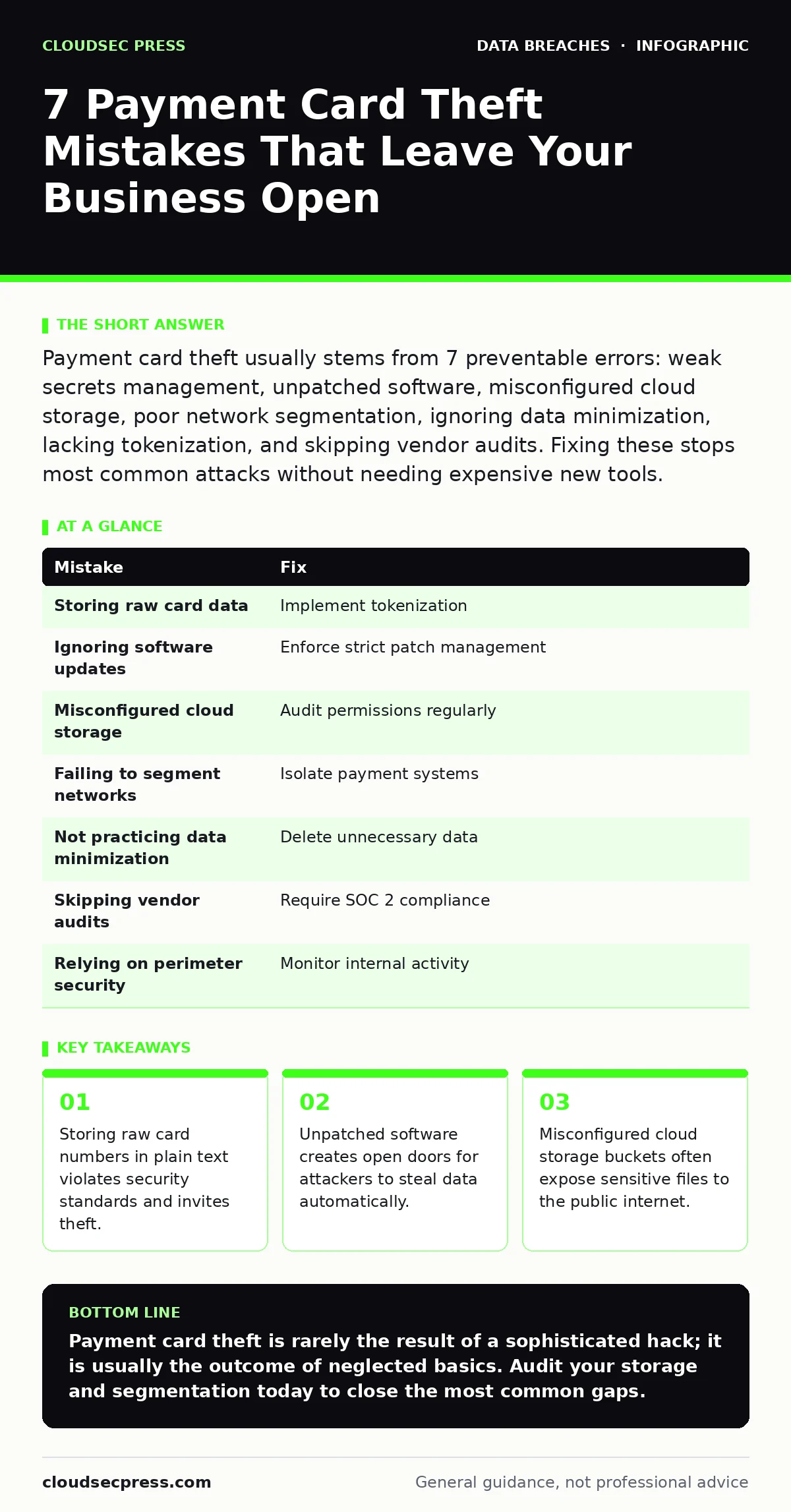
Payment card theft usually stems from 7 preventable errors: weak secrets management, unpatched software, misconfigured cloud storage, poor network segmentation, ignoring data minimization, lacking tokenization, and skipping vendor audits. Fixing these stops most common attacks without needing expensive new tools.
Mistake 1: Storing Raw Card Data in Plain Text
Organizations often retain full magnetic stripe data or magnetic equivalent data because legacy systems require it for transaction processing. This practice violates the core principles of the CIA triad by exposing data to unauthorized access. When you store raw card numbers, you create a high-value target for attackers. If a database is breached, the thief gets everything they need to commit fraud immediately. The risk is not theoretical; it is the primary reason for massive fines and loss of merchant privileges.
Why it hurts:
Storing primary account numbers in plain text means any attacker who gains read access to the database can copy the entire dataset. There is no encryption layer to slow them down or render the data useless. This direct exposure turns a minor intrusion into a catastrophic event. You lose customer trust and face severe regulatory penalties because you failed to protect the most sensitive element of the transaction.
The fix:
Implement tokenization to replace sensitive data with non-sensitive equivalents. Tokenization swaps the real card number for a random string that holds no value outside your specific payment processor. You keep only the last four digits for display purposes. This ensures that even if your database is stolen, the thief only gets useless tokens. For deeper insights on handling sensitive data, review our guide on data controllers and data processors to understand your legal obligations.
Mistake 2: Ignoring Software Updates and Patching
Developers and system administrators frequently delay installing security patches for web servers, plugins, and operating systems. They prioritize feature development or fear breaking existing functionality. This negligence leaves known vulnerabilities open for exploitation. Attackers use automated bots to scan the internet for these specific weaknesses. They do not need to be clever; they just need to find a system that has not been updated.
Why it hurts:
Unpatched software provides a direct entry point for attackers to execute code on your servers. Once inside, they can move laterally to databases containing payment information. The delay between a vulnerability being discovered and a patch being released is often short. By the time you realize the danger, attackers have already harvested card details from thousands of unpatched systems.
The fix:
Establish a strict patch management policy that prioritizes security updates for all internet-facing components. Test patches in a staging environment before deploying them to production to avoid downtime. Automate the update process where possible to reduce human error. Regularly scan your infrastructure for missing patches. This proactive approach closes the door before attackers can knock.
Mistake 3: Misconfigured Cloud Storage Buckets
Cloud storage services are powerful but complex. Users often create storage buckets for backups or logs and accidentally set them to public access. This mistake is one of the most common causes of data breaches in modern cloud environments. A single click or a default setting error can expose millions of records to anyone on the internet. The data is not stolen through a hack; it is simply left unlocked.
Why it hurts:
Publicly accessible storage buckets allow anyone to download your data without authentication. Attackers use search engines and specialized tools to find these exposed buckets automatically. They do not need to break into your network. They just need to find the URL. This exposure leads to immediate data loss and significant reputational damage because it demonstrates a lack of basic security hygiene.
The fix:
Conduct regular audits of your cloud storage permissions to ensure no buckets are set to public. Use automated tools to scan for misconfigurations and alert you immediately. Implement least privilege access controls so that only specific applications or users can access sensitive data. Review our guide on secrets management to understand how to protect the credentials that control these resources.
Mistake 4: Failing to Segment Networks
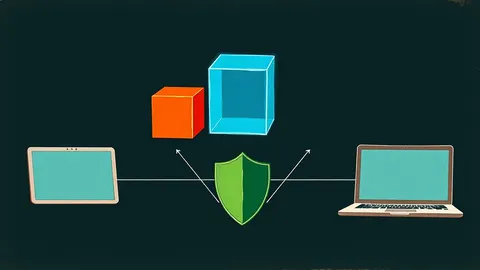
Many organizations place all servers, including those handling payments, on the same flat network. This design assumes that one security perimeter is enough to protect everything. When an attacker compromises a low-security system, such as a guest Wi-Fi device or a marketing server, they can move freely across the entire network. They can reach the payment servers without encountering any additional barriers.
Why it hurts:
Lack of network segmentation allows lateral movement. Once inside, attackers can scan for and exploit vulnerabilities on any connected device. They can access databases, internal tools, and administrative consoles. This increases the blast radius of any single compromise. A small breach becomes a total system failure because there are no internal walls to stop the attacker.
The fix:
Divide your network into separate zones based on function and sensitivity. Place payment processing systems in an isolated segment with strict access controls. Use firewalls to restrict traffic between these segments. Only allow specific, necessary communication paths. This containment strategy limits the damage of an intrusion and makes it harder for attackers to reach critical data.
Mistake 5: Not Practicing Data Minimization
Businesses often collect more customer data than they need for immediate transactions. They store names, addresses, and full card numbers for "future marketing" or "analytics." This accumulation of data creates a larger attack surface. Every piece of data you store is a potential liability. If it is not essential for the current business operation, it should not exist in your production environment.
Why it hurts:
Excessive data collection increases the value of your system to attackers. More data means more identities to steal and more opportunities for synthetic identity fraud. It also complicates your security efforts because you have more systems and more data to protect. Reducing the amount of data you hold reduces the potential impact of a breach.
The fix:
Delete any data that is not strictly necessary for the transaction or legal compliance. Retain only the last four digits of card numbers for customer service purposes. Use third-party processors to handle the sensitive data so it never touches your servers. This approach reduces your liability and makes your systems less attractive to attackers.
See also: Cyber Espionage Prevention Checklist: Stop Silent Data Theft · The CIA Triad: Meaning, Definition, and Practical Application
Mistake 6: Skipping Vendor Security Audits
Many organizations outsource payment processing or customer data management to third-party vendors. They assume these vendors are secure because they are reputable. However, a weak link in your supply chain can expose your customers' data. If a vendor suffers a breach, your business may still be held responsible for the loss. You cannot outsource your risk entirely.
Why it hurts:
Third-party vendors often have access to your data or systems. If they lack proper security controls, attackers can use them as a gateway to your environment. A breach at a vendor can disrupt your operations and expose your customer data. You lose control over how the data is protected, making it difficult to respond to incidents quickly.
The fix:
Require all vendors to undergo regular security audits, such as SOC 2 assessments. Review their security reports and ensure they meet your standards. Include security requirements in your contracts and define incident response responsibilities. Conduct periodic reviews to ensure continued compliance. This due diligence protects your business from risks outside your direct control.
Mistake 7: Relying on Perimeter Security Alone
Traditional security models focus on protecting the network perimeter with firewalls and antivirus software. This approach assumes that threats come from outside the network. However, modern attacks often originate from inside, whether from a compromised employee account or a malicious insider. Perimeter defenses do nothing to stop threats that are already inside your system.
Why it hurts:
Once an attacker bypasses the perimeter, they have free rein to explore the network. Perimeter security provides no visibility into internal activities. You cannot detect or stop data exfiltration if you are only looking at the edge. This blind spot allows attackers to steal data over long periods without being detected.
The fix:
Implement internal monitoring and anomaly detection to identify suspicious behavior within the network. Use multi-factor authentication for all administrative access. Monitor data transfers and flag unusual volumes or destinations. This layered approach ensures that even if the perimeter is breached, you can detect and respond to the threat.
| Mistake | Fix |
|---|---|
| Storing raw card data | Implement tokenization |
| Ignoring software updates | Enforce strict patch management |
| Misconfigured cloud storage | Audit permissions regularly |
| Failing to segment networks | Isolate payment systems |
| Not practicing data minimization | Delete unnecessary data |
| Skipping vendor audits | Require SOC 2 compliance |
| Relying on perimeter security | Monitor internal activity |
Key takeaways
- Storing raw card numbers in plain text violates security standards and invites theft.
- Unpatched software creates open doors for attackers to steal data automatically.
- Misconfigured cloud storage buckets often expose sensitive files to the public internet.
Payment card theft is rarely the result of a sophisticated hack; it is usually the outcome of neglected basics. Audit your storage and segmentation today to close the most common gaps.
Frequently asked questions
What is the difference between encryption and tokenization?
Encryption scrambles data using a mathematical key, while tokenization replaces data with a random value that cannot be reversed without a separate mapping table.
Do I need to be PCI DSS compliant if I use a third-party processor?
Yes, you still have responsibilities for protecting your network and how you handle data, even if the processor handles the actual transactions.
How often should I update my software?
You should install critical security patches as soon as they are tested and verified, ideally within days of release.
Can tokenization prevent all types of data breaches?
Tokenization prevents the misuse of stolen data, but it does not prevent attackers from gaining access to your systems or stealing other types of information.
How this guide was produced: written by the CloudSec Press editorial team with AI assistance, checked against the public references listed below, and reviewed when the facts change. See our editorial policy or report an error.