How Payment Card Theft Works: The Full Attack Chain
Most card theft fails not at the point of sale, but during the quiet period when stolen data sits idle in a compromised server before being sold.
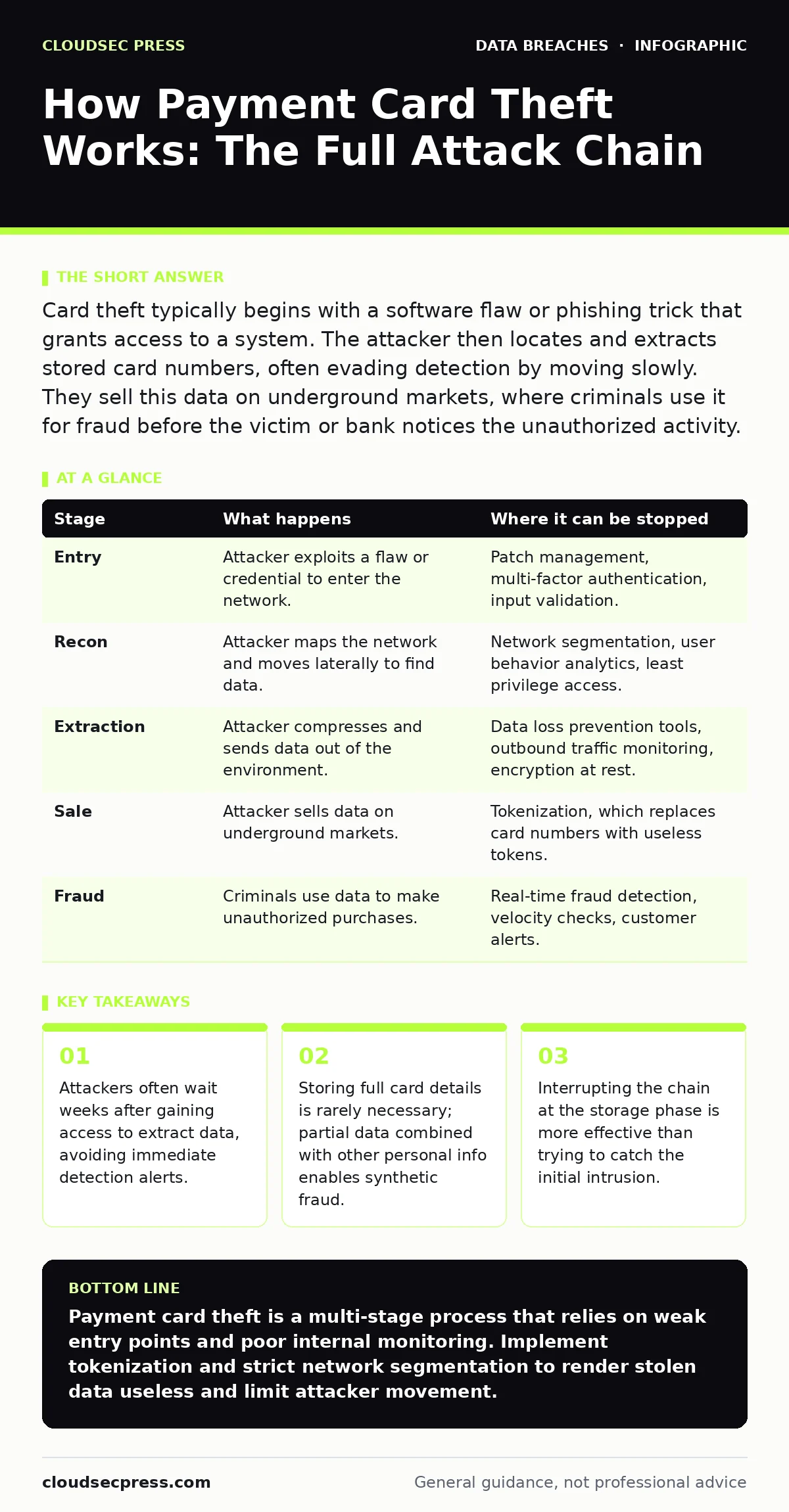
Card theft typically begins with a software flaw or phishing trick that grants access to a system. The attacker then locates and extracts stored card numbers, often evading detection by moving slowly. They sell this data on underground markets, where criminals use it for fraud before the victim or bank notices the unauthorized activity.
The Initial Entry Point
Most payment card theft does not begin with a magical hack of a bank mainframe. It starts with a much simpler breach of a merchant’s website, a point-of-sale terminal, or an employee’s laptop. The attacker needs only one path into the network. This path is often a software vulnerability that has not been patched, a misconfigured cloud storage bucket, or a weak login credential.
Imagine a small online retailer that uses a common shopping cart plugin. The plugin has a known flaw that allows an attacker to bypass login screens. The attacker exploits this flaw to gain administrative access. They now sit inside the network with the same privileges as the store owner. This initial step is rarely complex. It relies on the target failing to maintain basic software hygiene.
This stage is where many organizations focus their defense. They install firewalls and intrusion detection systems. However, these tools often miss low-and-slow attacks that mimic normal traffic. If the attacker enters through a legitimate user account, the system sees no anomaly. The breach is already happening before any alarm sounds.
Reconnaissance and Lateral Movement
Once inside, the attacker does not immediately steal credit card numbers. Doing so would trigger alerts and lock accounts. Instead, they spend time mapping the environment. This process is called reconnaissance. They look for servers that handle payment processing, databases that store customer records, and backups that might contain sensitive information.
The attacker moves laterally across the network. They use the credentials of the initial compromised account to access other systems. They might install a backdoor, which is a hidden method of maintaining access even if the original flaw is fixed. This ensures that if the merchant patches the shopping cart plugin, the attacker can still get back in.
This phase relies on poor network segmentation. In many organizations, the web server that displays product pages sits on the same network as the database that stores payment info. If the attacker compromises the web server, they have a direct path to the sensitive data. Separating these environments forces the attacker to jump additional hurdles, increasing the chance of detection.
Data Extraction and Exfiltration
After locating the valuable data, the attacker prepares to extract it. They often compress the data into a single file to make it easier to move. They may also encrypt the data to hide its contents from network monitors. This is not encryption for security, but for stealth. The attacker holds the key, not the victim.
The exfiltration process is carefully timed. Attackers often transfer data in small chunks over long periods. This technique, known as low-and-slow exfiltration, keeps the traffic volume below the thresholds that trigger security alerts. They might send the data to a cloud storage service they control, or to a hidden web server.
This is where the CIA triad concept of confidentiality breaks down. The data leaves the secure boundary. If the organization monitors outbound traffic for unusual patterns, such as large uploads to unknown destinations, they can interrupt this stage. Many organizations do not monitor outbound traffic closely, assuming that internal threats are less likely than external ones. This assumption is often fatal.
The Underground Market
The stolen data does not stay with the attacker. They sell it. The underground market for payment card data is highly organized. Attackers act as suppliers, selling to intermediaries who then sell to carders, the criminals who use the stolen data for fraud. The price of a card depends on its completeness. A card number with an expiration date and CVV code is worth more than a number alone.
Sometimes, attackers sell partial data. If they only have the card number and the customer’s name, they might sell it to fraudsters who specialize in synthetic identity fraud. These criminals combine the stolen card data with fabricated personal information to create new identities. They apply for credit lines using these fake identities, making the fraud harder to trace back to the original breach.
This stage highlights a hidden cost of data breaches. The damage is not just the immediate financial loss from fraudulent charges. It is the long-term risk of identity theft and the reputational damage to the brand. The cardholder may never know their data was stolen until they are denied credit years later.
Fraudulent Transactions
The end game is financial gain. Carders use the stolen data to make purchases. They often buy high-value, easily resellable items like electronics or gift cards. They may also make small test transactions to verify that the card is active before making larger purchases. This testing helps them avoid triggering fraud detection systems that look for sudden, large spending spikes.
Some attackers use automated bots to attempt thousands of transactions simultaneously. This method relies on the speed of the attack. If the bot can make a purchase and confirm it before the bank’s fraud system flags the account, the transaction succeeds. The attacker then cashes out the gift cards or sells the electronics for clean money.
This is where the victim usually notices the problem. They receive an alert from their bank or see an unauthorized charge on their statement. By this time, the data has already left the merchant’s system. The merchant is liable for the fraud if they were not compliant with security standards. This liability is a major driver for regulations like SOC 2, which requires regular audits of security controls.
See also: Synthetic Identity Fraud Explained: How Fake Identities Steal Real Money
Interrupting the Chain
Each stage of the attack chain offers an opportunity to stop the theft. Prevention is most effective at the entry point. Keeping software updated and using secrets management tools to protect credentials can block the initial intrusion. However, since breaches often happen through overlooked flaws, defense in depth is necessary.
Detecting the attack during the reconnaissance phase is difficult but possible. Monitoring for unusual internal traffic patterns can reveal lateral movement. If a web server starts communicating with a database it never touched before, that is a red flag. Implementing strict network segmentation limits the damage if an attacker does get in.
Stopping the exfiltration requires monitoring outbound traffic. Look for large data transfers to unknown destinations. Encrypting data at rest ensures that even if an attacker accesses the database, they cannot read the contents without the decryption keys. This is distinct from encryption in transit, which protects data while it moves across the network. Both are necessary for full protection.
| Stage | What happens | Where it can be stopped |
|---|---|---|
| Entry | Attacker exploits a flaw or credential to enter the network. | Patch management, multi-factor authentication, input validation. |
| Recon | Attacker maps the network and moves laterally to find data. | Network segmentation, user behavior analytics, least privilege access. |
| Extraction | Attacker compresses and sends data out of the environment. | Data loss prevention tools, outbound traffic monitoring, encryption at rest. |
| Sale | Attacker sells data on underground markets. | Tokenization, which replaces card numbers with useless tokens. |
| Fraud | Criminals use data to make unauthorized purchases. | Real-time fraud detection, velocity checks, customer alerts. |
The Role of Insider Threats
Not all card theft comes from outside hackers. Sometimes, an employee with legitimate access steals the data. This is known as insider data theft. The employee might be motivated by money, revenge, or coercion. They have the keys to the kingdom, so they do not need to exploit software flaws.
Defending against insider threats requires different controls. You cannot block an employee who is supposed to access the data. Instead, you monitor their activity. If an employee downloads a large number of customer records at 3 AM, that is suspicious. Implementing strict access controls and reviewing logs regularly can catch these behaviors.
This connects to the broader issue of password leaks. If an employee reuses passwords across personal and work accounts, a breach on a personal site can give an attacker the employee’s work credentials. The attacker then acts as an insider. This is why unique, strong passwords and multi-factor authentication are critical.
Conclusion of the Chain
The cycle of payment card theft is continuous. As defenses improve, attackers adapt. They shift from exploiting software flaws to targeting human error. They use phishing to steal credentials, bypassing technical controls entirely. They use AI to generate convincing phishing emails that are harder to detect.
Organizations must adopt a mindset of continuous improvement. Security is not a one-time project. It is an ongoing process of monitoring, testing, and adjusting. Regular penetration testing can reveal weaknesses before attackers do. Training employees to recognize phishing attempts can block the initial entry point.
The goal is not to prevent every breach, which is impossible. The goal is to make the attack difficult and expensive. If an attacker has to jump through multiple hurdles to get the data, they may move on to an easier target. This concept, known as increasing the attacker’s effort, is a core principle of modern security.
Key takeaways
- Attackers often wait weeks after gaining access to extract data, avoiding immediate detection alerts.
- Storing full card details is rarely necessary; partial data combined with other personal info enables synthetic fraud.
- Interrupting the chain at the storage phase is more effective than trying to catch the initial intrusion.
Payment card theft is a multi-stage process that relies on weak entry points and poor internal monitoring. Implement tokenization and strict network segmentation to render stolen data useless and limit attacker movement.
Frequently asked questions
Can two-factor authentication stop payment card theft?
Two-factor authentication prevents attackers from using stolen passwords to enter your network. It stops the initial entry point but does not protect data already inside the system if the attacker finds another way in.
What is tokenization and how does it help?
Tokenization replaces sensitive card numbers with unique, random identifiers called tokens. If a database is breached, the attacker only gets tokens that cannot be used for purchases, rendering the stolen data useless.
How long does it take for a card to be used after a breach?
Attackers often wait weeks or months to extract data to avoid detection. However, once the data is on the underground market, it can be used for fraud within days or even hours.
Is encryption enough to protect card data?
Encryption protects data if it is stolen, but only if the encryption keys are secure. If the attacker also steals the keys, they can decrypt the data. Tokenization is often a safer alternative for payment data.
How this guide was produced: written by the CloudSec Press editorial team with AI assistance, checked against the public references listed below, and reviewed when the facts change. See our editorial policy or report an error.