SOC 2 Explained: How Trust Is Built in the Cloud
SOC 2 is not a single test you pass but a continuous framework that proves how your vendors handle customer data behind the scenes.
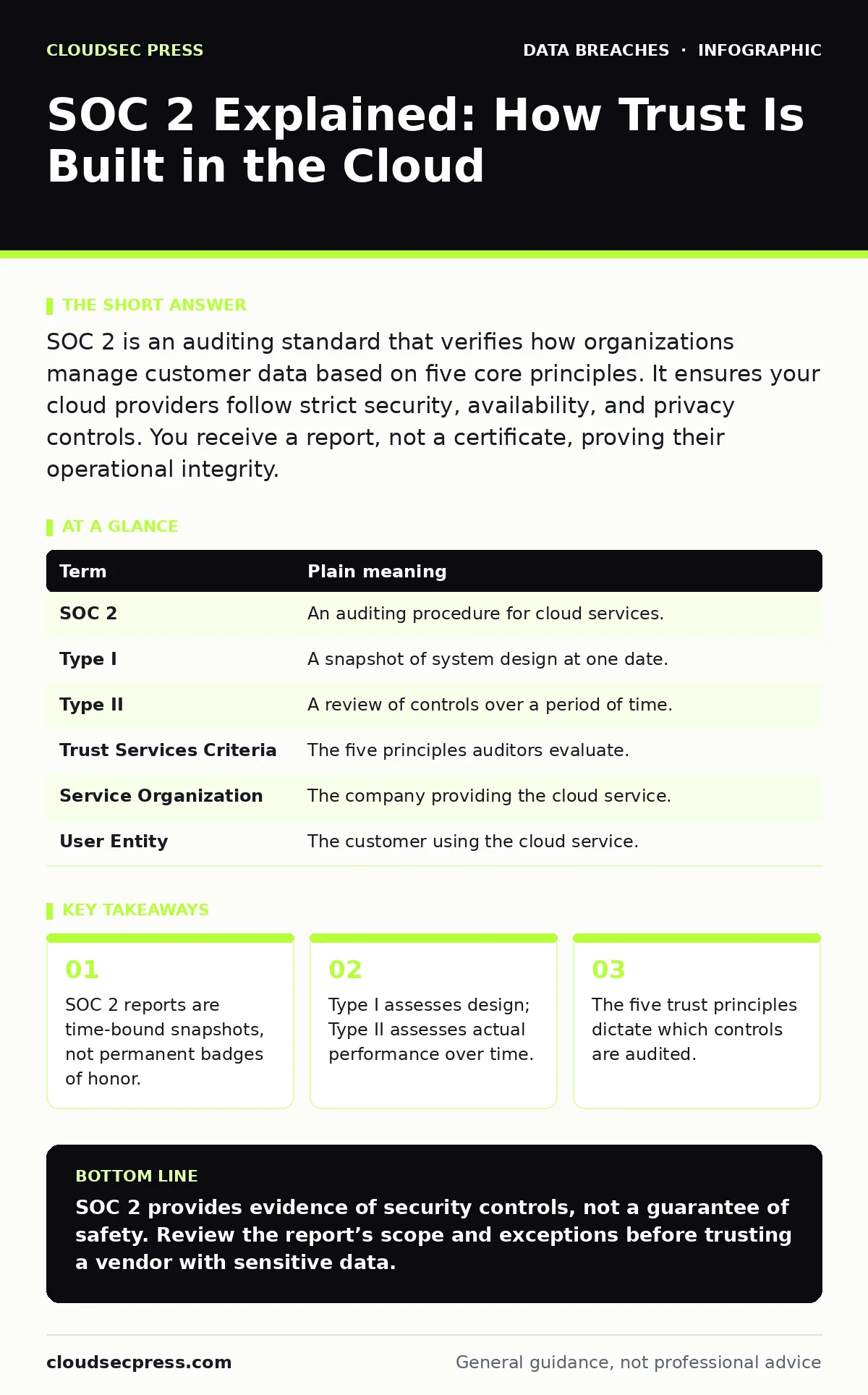
SOC 2 is an auditing standard that verifies how organizations manage customer data based on five core principles. It ensures your cloud providers follow strict security, availability, and privacy controls. You receive a report, not a certificate, proving their operational integrity.
The Library Analogy
Imagine you store your most valuable books in a public library. You do not visit daily to guard them. Instead, you trust the library’s rules. The librarian checks IDs at the door. The shelves are locked at night. The heating system prevents mold. SOC 2 is the independent inspection that confirms these rules exist and actually work. It shifts trust from a handshake to documented evidence.
Defining the Core Terms
Most readers confuse the standard with the report. SOC 2 stands for Service Organization Control 2. It is a framework created by the AICPA. The framework relies on five Trust Services Criteria. These are security, availability, processing integrity, confidentiality, and privacy. Security is the only mandatory principle. The others are optional depending on your service.
| Term | Plain meaning |
|---|---|
| SOC 2 | An auditing procedure for cloud services. |
| Type I | A snapshot of system design at one date. |
| Type II | A review of controls over a period of time. |
| Trust Services Criteria | The five principles auditors evaluate. |
| Service Organization | The company providing the cloud service. |
| User Entity | The customer using the cloud service. |
Type I Versus Type II
A Type I report is like checking the blueprints of a house. It confirms the locks are the right model and the walls are thick enough. It tells you nothing about whether the door was left open last Tuesday. A Type II report is like reviewing the security camera footage for three months. It proves the locks were actually used. Most serious buyers require Type II. Type I is often a starting point for startups.
The Five Trust Principles
You must know which principles apply to your vendor. Security covers protection against unauthorized access. Availability ensures the system works when needed. Processing integrity means data is complete, valid, and timely. Confidentiality protects sensitive information like trade secrets. Privacy handles personal data rights. A vendor might only claim security and availability. This is common for infrastructure providers. They do not touch your personal data.
Why You Get a Report, Not a Badge
SOC 2 does not issue certificates. You cannot display a SOC 2 logo on your website. The auditor issues a report to your management. You share that report with customers under an NDA. This prevents misuse of the trust signal. A vendor could fail a control next month. A static badge would lie. The report is a living document. It reflects a specific period of operation.
See also: Cloud Security Architecture Diagram: Map Controls to Reduce Risk · 7 Payment Card Theft Mistakes That Leave Your Business Open
Common Points of Confusion
Many believe SOC 2 is a compliance law. It is not. It is a professional standard. Another confusion is scope. SOC 2 covers the vendor’s environment, not yours. If your employees leak passwords, SOC 2 does not cover that. That falls under general data breaches or password leaks. You must secure your side of the connection. The vendor secures theirs.
Imagine a bank vault. SOC 2 proves the vault is strong. It does not prove you locked your house door before going to the bank. You still need strong access controls. This overlaps with the CIA triad. Confidentiality, integrity, and availability are the goals SOC 2 measures.
Hidden Costs and Trade-offs
Audits are expensive. Vendors pass these costs to you. Higher prices for cloud services often reflect SOC 2 compliance. There is also a delay. Getting audited takes months. Startups may struggle with this timeline. Some vendors cut corners on non-critical controls. They focus only on what the auditor checks. This creates blind spots. You must review the scope carefully.
Try This Now
- Read the "scope" section to see which systems are included.
- Check the "exceptions" list for any failed controls.
Do not accept a summary. Read the full report. Look for recent changes in their infrastructure. If they changed providers, the old report may be irrelevant. This diligence protects you from insider data theft or leaked source code that might occur if controls were weak.
Key takeaways
- SOC 2 reports are time-bound snapshots, not permanent badges of honor.
- Type I assesses design; Type II assesses actual performance over time.
- The five trust principles dictate which controls are audited.
SOC 2 provides evidence of security controls, not a guarantee of safety. Review the report’s scope and exceptions before trusting a vendor with sensitive data.
Frequently asked questions
Is SOC 2 the same as ISO 27001?
No. ISO 27001 is a certification for an information security management system. SOC 2 is a report on specific controls. Many vendors hold both.
How often must a SOC 2 audit happen?
Typically annually. Some high-risk industries require more frequent reviews. The report covers a specific period, usually 12 months.
Can I share the SOC 2 report publicly?
No. The report contains sensitive details about the vendor’s security posture. Sharing it violates the NDA and exposes their weaknesses.
What if the vendor fails a control?
They must provide a remediation plan. You should assess the risk of that failure. Minor administrative failures are less risky than technical gaps.
How this guide was produced: written by the CloudSec Press editorial team with AI assistance, checked against the public references listed below, and reviewed when the facts change. See our editorial policy or report an error.