Attack Surface Management: Benefits, Limits, and Real-World Value
Tracking every exposed asset reveals hidden risks but creates noise that slows response times without proper filtering and context.

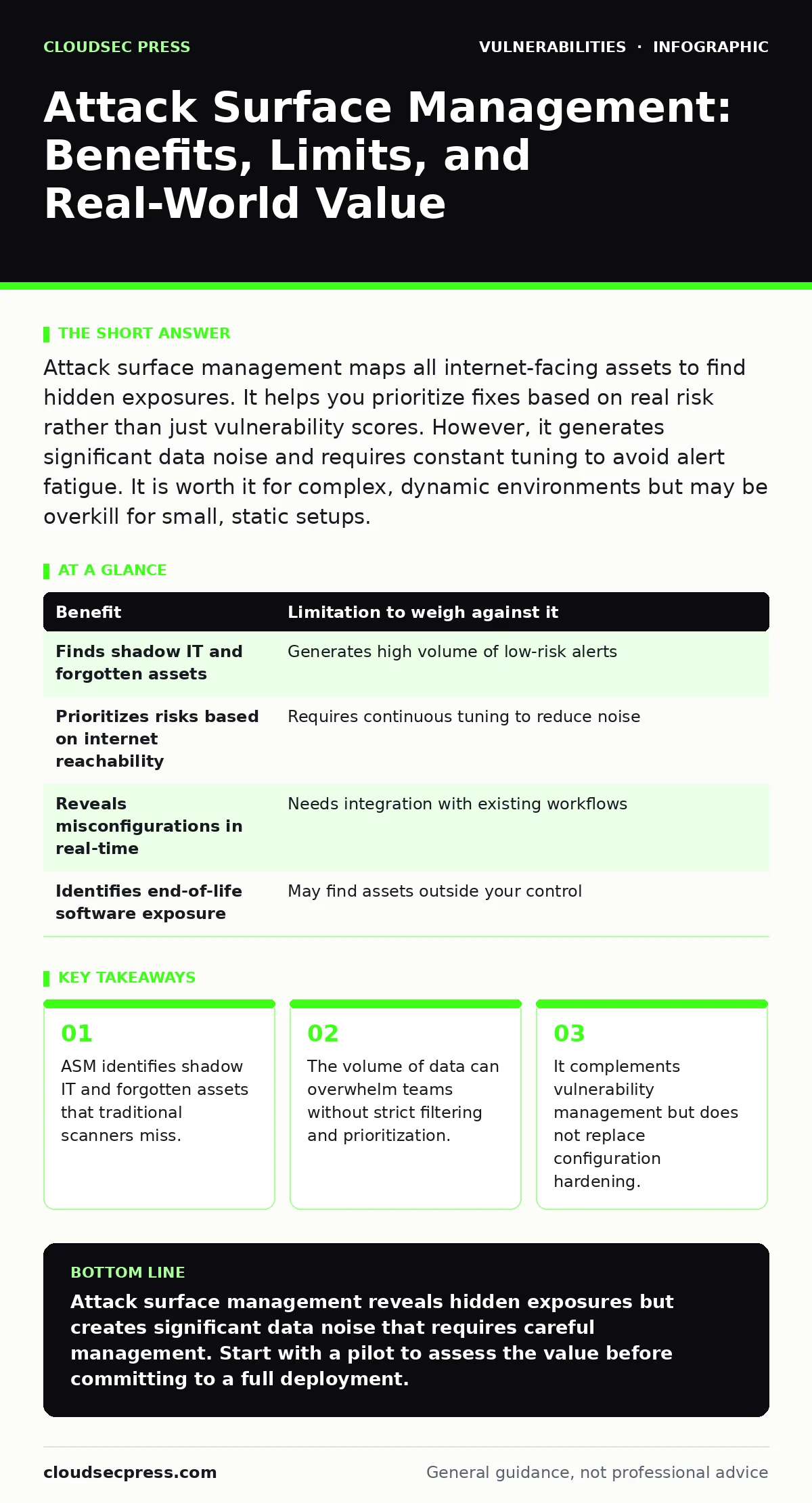
Attack surface management maps all internet-facing assets to find hidden exposures. It helps you prioritize fixes based on real risk rather than just vulnerability scores. However, it generates significant data noise and requires constant tuning to avoid alert fatigue. It is worth it for complex, dynamic environments but may be overkill for small, static setups.
Defining the Visible Edge
Attack surface management (ASM) is the continuous process of discovering, classifying, and monitoring all external assets that could be targeted by an attacker. Unlike internal network scans, ASM looks outward from the internet to see what you have exposed. This includes servers, APIs, domains, and even forgotten cloud storage buckets. The goal is to know exactly what an adversary can see before they do.
Traditional security tools often focus on what you own and control. ASM focuses on what is reachable. This shift in perspective reveals assets you may have created and forgotten, or services spun up by other teams without security oversight. You gain visibility into the true perimeter, not just the documented one.
The Power of Discovery
The primary benefit of ASM is finding the unknown unknowns. You might think you have ten web servers, but ASM might find twelve, including two test environments left open after a project ended. These hidden assets are often poorly secured because they are not part of your regular patching cycle.
Imagine a developer spins up a cloud instance for testing and forgets to delete it. That instance becomes a permanent entry point. ASM detects this drift between your intended infrastructure and your actual exposure. It allows you to remediate these gaps before they are exploited. This continuous discovery is the core value proposition of the practice.
Prioritization Through Context
Knowing you have a vulnerability is only half the battle. Knowing whether that vulnerability is reachable and exploitable from the internet is what matters. ASM provides context that internal scanners cannot. It tells you if a vulnerable service is actually exposed to the public.
This context allows you to prioritize fixes based on real risk. A critical vulnerability on an internal-only printer is less urgent than a medium-severity issue on a public-facing login portal. ASM helps you allocate limited security resources where they matter most. It moves you from a state of panic to a state of calculated risk reduction.
The Noise Problem
The major limitation of ASM is the volume of data it generates. Every new subdomain, IP address, or open port appears as a potential finding. Without strict filtering, your team gets buried in alerts. Most of these alerts are false positives or low-risk items that do not require immediate action.
This noise leads to alert fatigue. When your team sees hundreds of findings daily, they start ignoring them. Critical issues get lost in the clutter. You must invest time in tuning your ASM tools to ignore benign noise. This tuning is not a one-time task but an ongoing effort that consumes security staff time.
Integration Challenges
ASM tools rarely work in isolation. They need to connect with your vulnerability management programs and ticketing systems to be useful. If the data does not flow automatically, your team has to manually correlate findings. This manual work is slow and error-prone.
Furthermore, ASM often identifies assets that are not managed by your IT department. You might find a server owned by marketing or finance. Getting those teams to act on security findings requires strong governance and clear processes. Without cross-departmental cooperation, ASM findings gather dust without remediation.
See also: Router Firmware Vulnerabilities: 10 Critical Questions Answered · CSAF Security Advisories Explained: Machine-Readable Vulnerability Data
Balancing Benefits and Limits
To decide if ASM fits your needs, you must weigh its discovery power against its operational cost. The table below outlines the key trade-offs you will face when implementing this practice.
| Benefit | Limitation to weigh against it |
|---|---|
| Finds shadow IT and forgotten assets | Generates high volume of low-risk alerts |
| Prioritizes risks based on internet reachability | Requires continuous tuning to reduce noise |
| Reveals misconfigurations in real-time | Needs integration with existing workflows |
| Identifies end-of-life software exposure | May find assets outside your control |
When It Is Worth It
ASM is worth it when your environment is large, dynamic, and complex. If you use cloud services extensively, your attack surface changes daily. New instances are created, APIs are deployed, and domains are registered. Manual tracking is impossible in this scenario.
It is also worth it if you are in a highly regulated industry or have a high profile. Adversaries will look for any weakness. ASM helps you stay ahead of them by continuously validating your perimeter. If you have struggled with breaches caused by forgotten assets, ASM provides the visibility you need to prevent recurrence.
Consider your ability to act on findings. If you have the team and processes to remediate issues, ASM adds value. If you find things but cannot fix them, the tool becomes a source of anxiety rather than security.
When It Is Not
ASM is not worth it for small organizations with a static, minimal footprint. If you have five servers and they rarely change, a simple manual inventory suffices. The cost of the tool and the time to manage it outweighs the benefits.
It is also not a substitute for basic security hygiene. If you are not doing configuration hardening or regular patch testing, ASM will just highlight your negligence. Fix the basics first. ASM amplifies your existing security posture; it does not create one from scratch.
Do not implement ASM if you lack the resources to integrate it with your vulnerability management programs. Unintegrated data is just noise. You need a workflow that takes ASM findings and turns them into actionable tickets. Without that, you are just collecting data.
Moving Beyond Discovery
ASM is a starting point, not an end state. Once you have identified your assets, you must secure them. This means applying security bulletins promptly and ensuring no server-side request forgery (SSRF) vulnerabilities exist in your applications.
You should also maintain a software bill of materials (SBOM) for your applications. This helps you understand what components are running on your exposed assets. When a new vulnerability emerges, you can quickly determine if your exposed systems are affected.
ASM works best when combined with n-day vulnerabilities tracking. If a new exploit is released, you need to know if your exposed assets are vulnerable. ASM helps you answer that question quickly. It turns a potential crisis into a manageable incident.
Key takeaways
- ASM identifies shadow IT and forgotten assets that traditional scanners miss.
- The volume of data can overwhelm teams without strict filtering and prioritization.
- It complements vulnerability management but does not replace configuration hardening.
Attack surface management reveals hidden exposures but creates significant data noise that requires careful management. Start with a pilot to assess the value before committing to a full deployment.
Frequently asked questions
Does ASM replace vulnerability scanning?
No, ASM complements vulnerability scanning by providing context on which vulnerabilities are externally reachable. You still need scanners to find the vulnerabilities themselves.
How often should ASM scans run?
ASM should run continuously or at least daily to capture changes in your dynamic environment. Weekly scans may miss temporary exposures.
Can ASM find internal network issues?
No, ASM focuses on internet-facing assets. It cannot see inside your private network unless those assets are exposed to the public.
Is ASM suitable for small businesses?
It depends on your complexity. If you have a small, static footprint, manual tracking may suffice. If you use cloud services heavily, ASM can help manage the dynamic exposure.
How this guide was produced: written by the CloudSec Press editorial team with AI assistance, checked against the public references listed below, and reviewed when the facts change. See our editorial policy or report an error.