Vulnerability Scanning vs Penetration Testing: Key Differences Explained
Scanning finds known flaws automatically, while penetration testing simulates human attackers to exploit chains of weaknesses that tools miss.
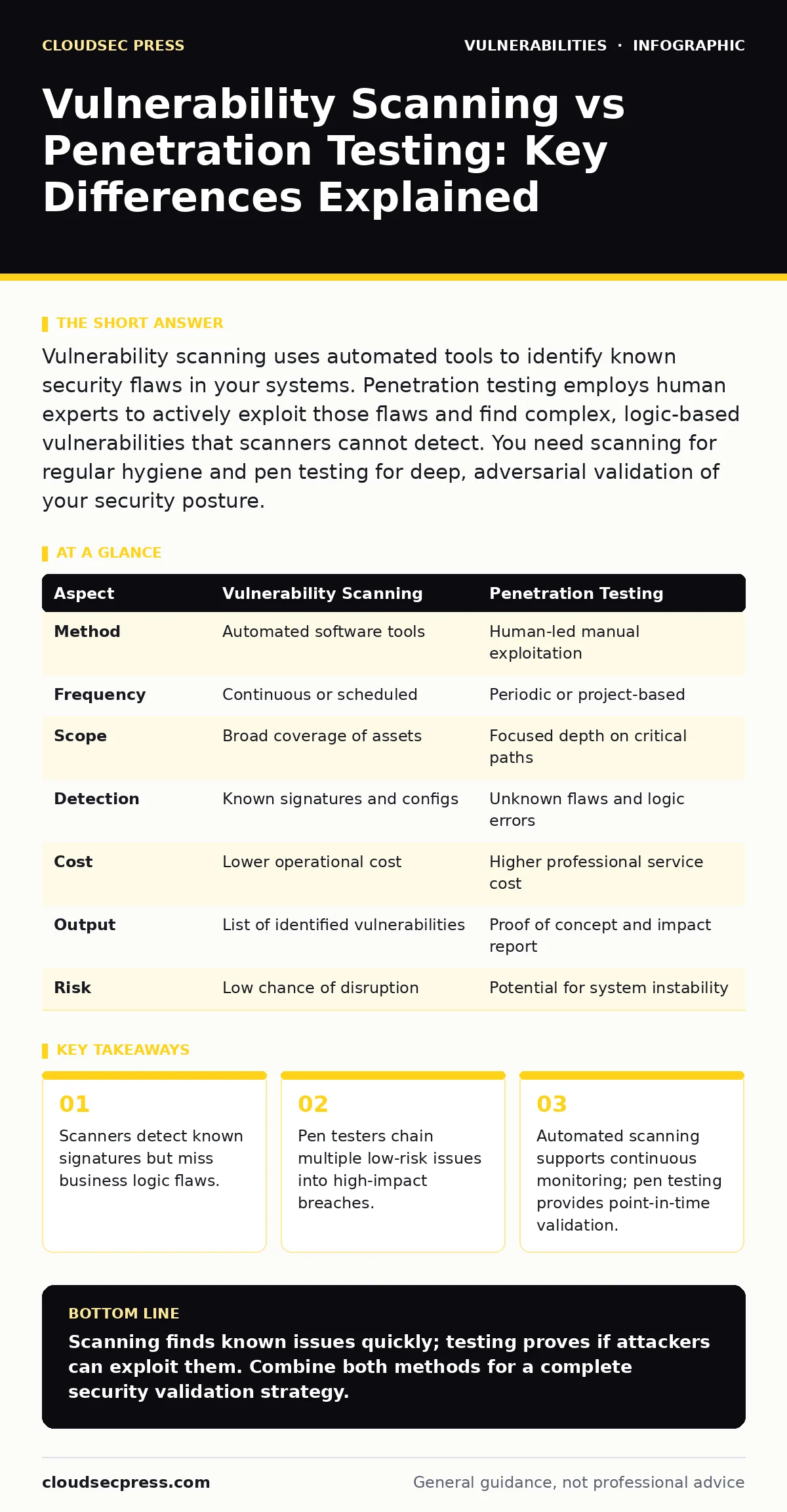
Vulnerability scanning uses automated tools to identify known security flaws in your systems. Penetration testing employs human experts to actively exploit those flaws and find complex, logic-based vulnerabilities that scanners cannot detect. You need scanning for regular hygiene and pen testing for deep, adversarial validation of your security posture.
The Core Difference Between Scanning and Testing
Vulnerability scanning and penetration testing serve distinct purposes in cybersecurity. Scanning is an automated process that checks systems against databases of known flaws. It identifies missing patches, misconfigurations, and default credentials. Penetration testing is a manual, adversarial simulation. A human expert attempts to break into your environment using creative techniques. Scanning tells you what is broken. Penetration testing tells you what an attacker can do with those breaks.
What Is Vulnerability Scanning?
Vulnerability scanning uses software to probe your network and applications. The tool sends requests to ports and services, comparing responses against a signature database. It flags issues like outdated software versions or open ports. This process is fast, repeatable, and scalable. It covers large environments efficiently. However, it lacks context. A scanner cannot understand that two minor misconfigurations, when combined, allow unauthorized access. It reports symptoms, not consequences.
What Is Penetration Testing?
Penetration testing involves a skilled practitioner attempting to compromise your systems. The tester researches your organization, identifies entry points, and exploits weaknesses. They may use social engineering, physical access, or advanced code execution. The goal is to reach a specific objective, such as accessing sensitive data. This approach reveals complex vulnerabilities, such as business logic errors that automated tools ignore. It proves whether your defenses stop a determined adversary.
Vulnerability Scanning vs Penetration Testing Comparison
| Aspect | Vulnerability Scanning | Penetration Testing |
|---|---|---|
| Method | Automated software tools | Human-led manual exploitation |
| Frequency | Continuous or scheduled | Periodic or project-based |
| Scope | Broad coverage of assets | Focused depth on critical paths |
| Detection | Known signatures and configs | Unknown flaws and logic errors |
| Cost | Lower operational cost | Higher professional service cost |
| Output | List of identified vulnerabilities | Proof of concept and impact report |
| Risk | Low chance of disruption | Potential for system instability |
Scanning provides a wide net. It catches the obvious issues quickly. Penetration testing provides a deep dive. It uncovers the hidden pathways an attacker would use. Neither replaces the other. They address different layers of security risk.
When to Choose Vulnerability Scanning
Choose scanning when you need regular, broad coverage of your infrastructure. It fits into routine maintenance cycles. Use it to track patch compliance across hundreds of servers. It helps you prioritize remediation efforts based on severity scores. Scanning is ideal for maintaining baseline security hygiene. It ensures that known vulnerabilities are addressed promptly.
- Monitor new assets for known flaws
- Track patch management effectiveness
- Identify misconfigurations at scale
- Support compliance requirements
Scanning works best when combined with a robust IT asset inventory. You cannot protect what you do not know exists. Ensure your scanner sees all endpoints, including cloud instances and containers.
See also: Data Classification Errors That Leave Cloud Systems Exposed
When to Choose Penetration Testing
Choose penetration testing when you need to validate your defenses against realistic attacks. It is necessary before launching critical applications or after major architecture changes. Use it to test complex authentication flows or payment processing logic. Pen testing reveals whether your security controls actually work under pressure. It exposes gaps that automated tools cannot see.
- Validate security of critical business logic
- Test defenses against advanced adversaries
- Assess impact of chained vulnerabilities
- Prepare for high-stakes compliance audits
Consider the risks involved. A pen test can disrupt services if not managed carefully. Coordinate with your operations team. Define clear rules of engagement.
Where Scanning and Testing Overlap
Both methods aim to reduce your attack surface. They complement each other in a mature security program. Scanning identifies the targets. Testing validates the severity. You might use scanning to find a potential issue, then have a tester verify if it is exploitable. This hybrid approach balances cost and accuracy. It ensures you do not waste resources on false positives.
Integrate findings from both into your attack surface management strategy. Track remediation progress. Prioritize fixes based on actual risk, not just scanner scores. Regular patch testing ensures that updates do not break your applications before you deploy them widely.
Common Mistakes to Avoid
Organizations often treat scanning as a substitute for testing. This creates a false sense of security. Scanners miss command injection flaws that require specific input sequences. They also fail to detect issues in end-of-life software that no longer receives signatures. Another error is running pen tests only once. Threat actors evolve. Your defenses must be revalidated regularly.
Ensure your software bill of materials (SBOM) is up to date. This helps testers understand your dependencies. It also aids in identifying vulnerabilities in third-party components. Review HTTP security headers configuration manually. Scanners often misinterpret header values, leading to inaccurate reports.
Integrating Both into Your Strategy
A balanced approach uses scanning for breadth and testing for depth. Schedule automated scans weekly or daily. Conduct penetration tests quarterly or after significant changes. Use scanning data to guide the tester’s focus. This makes the pen test more efficient and relevant. Document all findings. Create a feedback loop between development and security teams.
This synergy improves your overall security posture. It reduces the likelihood of successful breaches. It also optimizes your security budget. You spend resources on the most impactful fixes.
Key takeaways
- Scanners detect known signatures but miss business logic flaws.
- Pen testers chain multiple low-risk issues into high-impact breaches.
- Automated scanning supports continuous monitoring; pen testing provides point-in-time validation.
Scanning finds known issues quickly; testing proves if attackers can exploit them. Combine both methods for a complete security validation strategy.
Frequently asked questions
Can I use vulnerability scanning instead of penetration testing?
No. Scanning misses logic flaws and complex attack chains that only human testers can find.
How often should I perform penetration testing?
Test after major changes and at least annually for critical systems.
Do scanners detect zero-day vulnerabilities?
No. Scanners rely on known signatures. Zero-days are unknown and require manual analysis.
Is penetration testing safe for production systems?
It carries risk. Always coordinate with operations and define strict rules of engagement.
How this guide was produced: written by the CloudSec Press editorial team with AI assistance, checked against the public references listed below, and reviewed when the facts change. See our editorial policy or report an error.