Why Security Culture Determines Your Organization's True Risk
Technical controls fail when human habits contradict them, making cultural alignment the decisive factor in preventing unauthorized access and data loss.
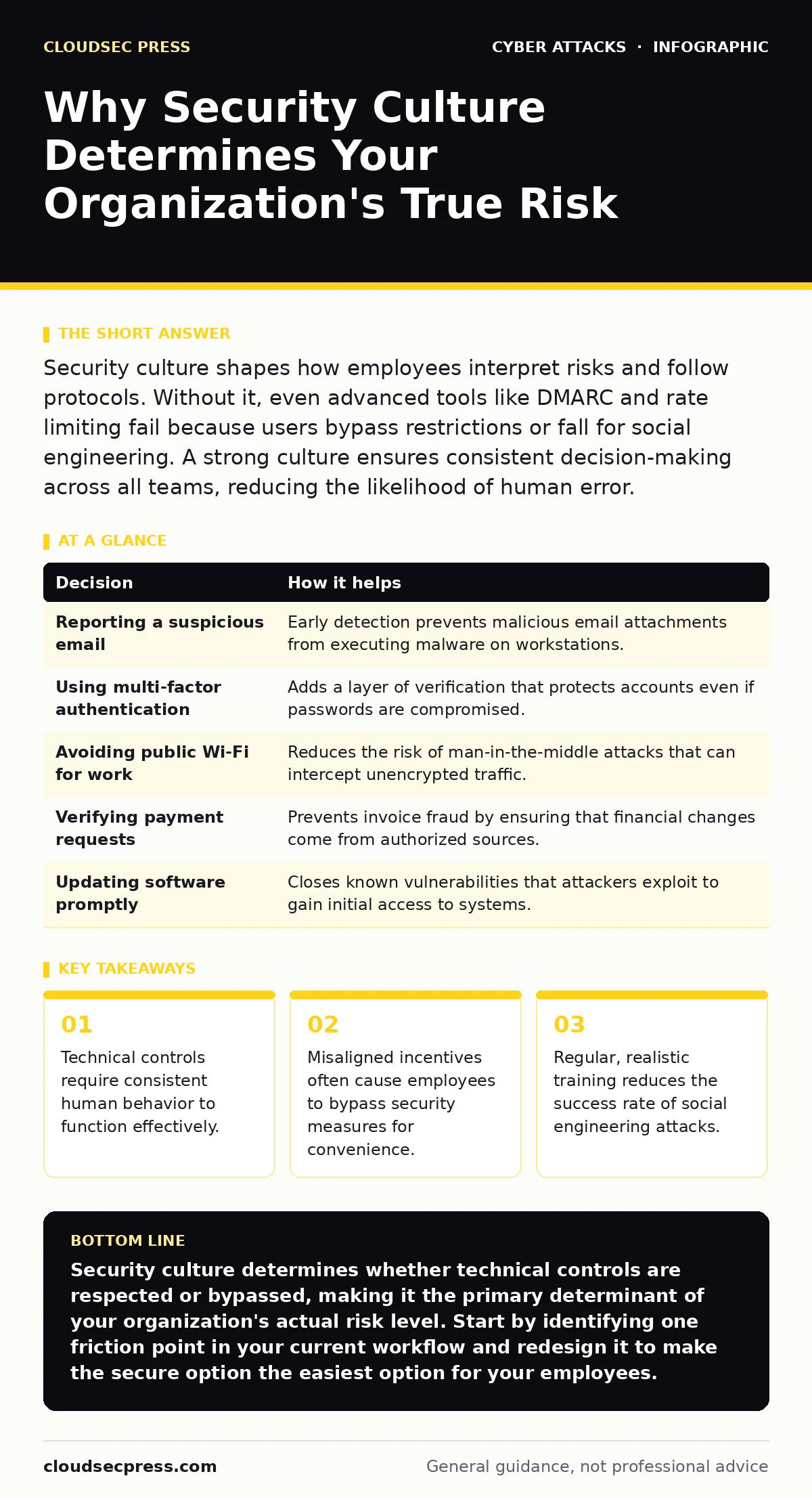
Security culture shapes how employees interpret risks and follow protocols. Without it, even advanced tools like DMARC and rate limiting fail because users bypass restrictions or fall for social engineering. A strong culture ensures consistent decision-making across all teams, reducing the likelihood of human error.
The Hidden Gap Between Policy and Practice
You can install the most sophisticated firewall in the industry, but it offers no protection if an employee willingly hands over their credentials. Security culture is the collection of shared beliefs, values, and behaviors that determine how your team responds to risk. It is not a training module or a compliance checklist. It is the invisible framework that guides daily decisions when no one is watching.
Most organizations treat security as a technical problem to be solved with software. This approach ignores the human element that ultimately controls access to systems. When culture and technology are misaligned, the weakest link becomes the person who needs to get work done. That person will find a way around the restriction, creating a vulnerability that no tool can detect.
The Cost of Convenience Over Security
Imagine two hypothetical teams facing the same challenge: accessing a remote server from a coffee shop. Team A has a culture that prioritizes speed and views security protocols as bureaucratic hurdles. Team B has a culture that views security as an enabler of reliable service.
Team A’s member connects to open Wi-Fi and uses a personal device to bypass the company’s strict VPN requirement. They believe they are being efficient. In reality, they have exposed the network to session hijacking, where an attacker intercepts the connection to steal active login tokens. Team B’s member uses the official mobile hotspot and the approved remote access tool. They take longer to connect, but they maintain the integrity of the session.
This contrast highlights a non-obvious consequence: convenience is not just a comfort preference. It is a security decision. When culture rewards speed over safety, employees will consistently choose the risky path. The organization pays for this choice in incident response costs and reputational damage.
Decisions Shaped by Cultural Norms
Security culture influences micro-decisions that occur hundreds of times a day. These small choices accumulate to define your actual security posture. Without a supportive culture, policies become suggestions rather than rules.
| Decision | How it helps |
|---|---|
| Reporting a suspicious email | Early detection prevents malicious email attachments from executing malware on workstations. |
| Using multi-factor authentication | Adds a layer of verification that protects accounts even if passwords are compromised. |
| Avoiding public Wi-Fi for work | Reduces the risk of man-in-the-middle attacks that can intercept unencrypted traffic. |
| Verifying payment requests | Prevents invoice fraud by ensuring that financial changes come from authorized sources. |
| Updating software promptly | Closes known vulnerabilities that attackers exploit to gain initial access to systems. |
These decisions seem trivial in isolation. Together, they form a defense-in-depth strategy. A culture that encourages these behaviors ensures that every employee acts as a sensor for potential threats. This distributed awareness is far more effective than relying solely on automated tools.
What Happens When Culture Fails
When security culture is weak, employees do not see themselves as part of the defense. They view security teams as adversaries who slow them down. This mindset leads to shadow IT, where users adopt unauthorized tools to get their jobs done. These tools often lack proper security controls, creating blind spots for the organization.
Consider the impact on email security. Even with robust DMARC policies in place, an employee who does not understand phishing will click a link that leads to a credential harvesting site. The technical control stops spoofed emails, but it cannot stop a user from voluntarily entering their password on a fake login page. The failure here is not in the technology, but in the lack of education and awareness that should be part of the culture.
Another hidden cost is the erosion of trust. When employees are punished for reporting mistakes, they stop reporting them. This creates a hidden pool of unresolved incidents. The organization remains unaware of the problem until it escalates into a major breach. A healthy culture encourages reporting without fear of retribution, allowing the security team to address issues before they spread.
Building a Culture of Shared Responsibility
Building security culture requires more than annual training videos. It requires integrating security into the workflow. This means designing systems that make the secure choice the easy choice. If logging in is difficult, users will find ways to stay logged in indefinitely. If sharing files is risky, provide a secure alternative that is just as fast.
Leaders must model the behavior they expect. If executives bypass security protocols for convenience, they signal that the rules do not matter. Consistency from the top down reinforces the idea that security is a shared value. This alignment reduces the cognitive load on employees, as they no longer have to guess whether security is a priority or an obstacle.
Teams use culture to navigate ambiguous situations. When faced with a novel threat, such as a new type of formjacking script on a vendor site, a culturally aware team will pause and verify. A team without this culture will proceed, assuming the risk is low because they have no formal guidance. The difference lies in the internalized habit of caution.
See also: DKIM Explained: How Email Signatures Prevent Spoofing · QR Code Phishing Prevention Checklist for Secure Scanning
The Role of Continuous Feedback
Security culture is not static. It evolves as threats change and new technologies are adopted. Continuous feedback loops are necessary to keep the culture relevant. This includes regular, realistic simulations of attacks. These exercises reveal where the culture breaks down.
For instance, if a simulation shows that many employees share passwords to collaborate, the culture has failed to provide a secure collaboration tool. The solution is not to punish the employees, but to fix the underlying friction. Address the root cause, and the behavior will change. This approach builds trust and demonstrates that security supports productivity, not hinders it.
Beyond Technical Controls
Technical controls are necessary, but they are not sufficient. They provide the tools, but culture provides the will to use them correctly. An organization with strong technical controls but weak culture is like a house with a high fence but an unlocked door. The fence keeps out casual intruders, but a determined attacker will find the open door.
By focusing on culture, you address the human factors that technical controls cannot manage. You create an environment where security is a natural part of work, not an afterthought. This alignment reduces the attack surface and improves the organization’s resilience. The result is a security posture that is not just compliant, but genuinely effective.
Key takeaways
- Technical controls require consistent human behavior to function effectively.
- Misaligned incentives often cause employees to bypass security measures for convenience.
- Regular, realistic training reduces the success rate of social engineering attacks.
Security culture determines whether technical controls are respected or bypassed, making it the primary determinant of your organization's actual risk level. Start by identifying one friction point in your current workflow and redesign it to make the secure option the easiest option for your employees.
Frequently asked questions
How do you measure security culture?
Measure it by tracking behaviors, not just compliance scores. Look at the rate of reported incidents, the speed of patch adoption, and the results of phishing simulations. High reporting rates indicate trust, while low rates may indicate fear or apathy.
Can a small team have a strong security culture?
Yes, and it is often easier in smaller teams because norms are established more quickly. However, as the team grows, these norms must be explicitly documented and reinforced to prevent dilution. Consistency is key at any size.
What is the biggest barrier to improving security culture?
The biggest barrier is usually leadership inconsistency. If leaders do not follow the rules, employees will not take them seriously. Culture trickles down, so executives must demonstrate the behaviors they expect from the rest of the organization.
How does culture help against slowloris attacks?
Culture itself does not stop slowloris attacks, which are technical denial-of-service attacks. However, a strong culture ensures that teams implement proper rate limiting and infrastructure monitoring. It fosters the vigilance needed to detect and mitigate such attacks quickly.
How this guide was produced: written by the CloudSec Press editorial team with AI assistance, checked against the public references listed below, and reviewed when the facts change. See our editorial policy or report an error.