SaaS Access Reviews: Definition, Purpose, and Execution
SaaS access reviews prevent privilege creep by systematically verifying user permissions, stopping dormant accounts from becoming silent entry points for attackers.

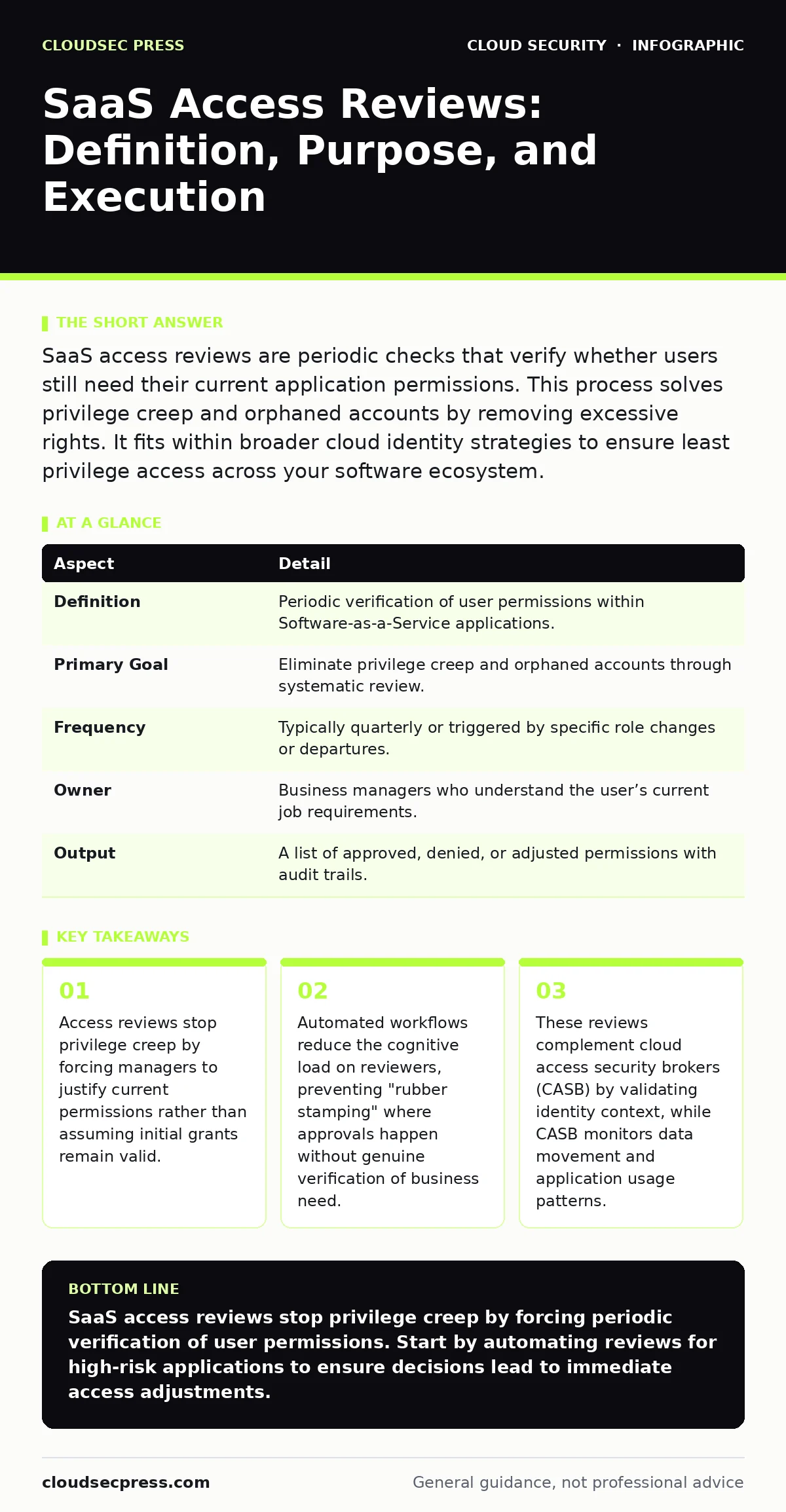
SaaS access reviews are periodic checks that verify whether users still need their current application permissions. This process solves privilege creep and orphaned accounts by removing excessive rights. It fits within broader cloud identity strategies to ensure least privilege access across your software ecosystem.
The Library Card Analogy
Imagine a public library where every patron receives a master key upon joining. The key opens every book, every storage room, and the manager’s office. After three years, the patron leaves town. The library does not take the key back. The patron keeps it. Another person borrows the key to find a specific novel. They enter the manager’s office by accident. The library’s security model failed because it never verified who still needed access to what.
SaaS access reviews function as the library’s annual audit. They check every key holder. They ask if the key is still necessary. They revoke access for those who no longer need it. This simple act prevents dormant accounts from becoming silent entry points.
| Aspect | Detail |
|---|---|
| Definition | Periodic verification of user permissions within Software-as-a-Service applications. |
| Primary Goal | Eliminate privilege creep and orphaned accounts through systematic review. |
| Frequency | Typically quarterly or triggered by specific role changes or departures. |
| Owner | Business managers who understand the user’s current job requirements. |
| Output | A list of approved, denied, or adjusted permissions with audit trails. |
The Problem of Privilege Creep
Users accumulate permissions over time. This phenomenon is called privilege creep. When an employee moves from marketing to sales, they keep their marketing tools. They gain sales tools. They might temporarily need finance tools for a project. They rarely return those finance tools. After two years, the employee holds access to three departments. If an attacker compromises that account, they inherit three departments’ worth of data.
Orphaned accounts are a related risk. These are accounts that remain active after an employee leaves or changes roles significantly. The employee no longer logs in. The account sits idle. Attackers scan for these dormant accounts because they often have weak monitoring. An access review forces a decision: keep the access or remove it. Indecision defaults to revocation in a secure system.
Core Components of a Review
A functional access review requires three distinct elements. First, you need a complete inventory of identities. This includes human users, service accounts, and application-to-application connections. Second, you need a clear definition of roles. A "viewer" role differs from an "editor" role. The review must distinguish between these levels. Third, you need a responsible reviewer. This is usually the user’s direct manager. The manager knows if the user still performs the duties that require those permissions.
The review process itself follows a strict workflow. The system identifies users with specific permissions. It sends a notification to the manager. The manager evaluates each user. The manager approves or revokes access. The system logs the decision. This log serves as evidence for compliance audits and internal investigations.
Integration with Cloud Defenses
Access reviews do not operate in a vacuum. They fit into a layered security strategy. You must understand the difference between IaaS, PaaS and SaaS security to place this control correctly. Infrastructure security handles servers. Platform security handles development environments. SaaS security handles application access. Access reviews belong to the identity layer of SaaS security.
These reviews work alongside cloud access security brokers (CASB). A CASB monitors data flowing in and out of applications. It detects unusual downloads or unauthorized file shares. Access reviews ensure the identity initiating those actions has a valid reason to be there. One controls the data path. The other controls the identity permission. They reinforce each other.
Consider cloud security architecture as a whole. Access reviews are a control point. They sit between identity providers and application permissions. If your architecture relies on static passwords, reviews are less effective. You should pair reviews with multi-factor authentication. This ensures that even if a permission is mistakenly kept, the attacker still faces a barrier to entry.
Common Misconceptions and Errors
Many organizations treat access reviews as a compliance checkbox. This is a fundamental error. If reviewers simply click "approve" for every name on the list, the review provides zero security value. This behavior is called rubber stamping. It happens when the list is too long or the context is missing. You must limit the scope of each review. Group users by role. Provide context about what the permission allows.
Another mistake is relying solely on manual spreadsheets. Spreadsheets do not enforce logic. They do not integrate with identity providers. They cannot automatically revoke access based on a decision. Automated tools connect to the SaaS application’s API. They pull real-time data. They push revocation commands immediately. This reduces human error and speeds up the process.
See also: Cloud Migration Security Checklist: Stop Data Leaks Before Launch · Identity and Access Management System: How It Controls Cloud Access
The Hidden Cost of Complexity
SaaS environments are complex. Employees use dozens of applications. Some are approved. Some are shadow IT. An access review must cover all of them. This creates a hidden cost: cognitive load. Managers do not want to review 50 applications for 20 employees. They will skip steps. They will approve everything to finish the task.
You must simplify the review experience. Group permissions by business function. Hide low-risk applications from the primary review. Focus on high-privilege accounts. Admin accounts, finance systems, and customer databases need strict scrutiny. Basic newsletter subscriptions do not. Prioritization makes the review manageable. It ensures that attention goes where the risk is highest.
Automating the Review Cycle
Automation is not optional for effective reviews. Manual processes fail at scale. You need a system that integrates with your identity provider. This system should pull user lists from HR systems. It should match users to their current roles. It should identify discrepancies.
The automation should also handle the follow-up. If a manager does not respond, the system should escalate. If the manager approves, the system should log it. If the manager revokes, the system should immediately disable the access. This closed loop ensures that decisions result in action. It prevents the gap between policy and reality.
Beyond the Basic Review
Advanced organizations use continuous access evaluation. Instead of periodic snapshots, the system checks permissions in real time. It uses context signals. Is the user logging in from a new country? Is the access request happening at 3 AM? The system can dynamically adjust permissions. It can require step-up authentication. It can block access entirely.
This moves beyond static reviews. It adapts to behavior. It reduces the reliance on manual checks. It requires more sophisticated tooling, but it provides stronger protection. It aligns with the principle of least privilege by ensuring access is granted only when needed and verified.
Key takeaways
- Access reviews stop privilege creep by forcing managers to justify current permissions rather than assuming initial grants remain valid.
- Automated workflows reduce the cognitive load on reviewers, preventing "rubber stamping" where approvals happen without genuine verification of business need.
- These reviews complement cloud access security brokers (CASB) by validating identity context, while CASB monitors data movement and application usage patterns.
SaaS access reviews stop privilege creep by forcing periodic verification of user permissions. Start by automating reviews for high-risk applications to ensure decisions lead to immediate access adjustments.
Frequently asked questions
How often should we perform SaaS access reviews?
Quarterly reviews are standard for most organizations. High-risk applications may require monthly reviews or continuous monitoring. Trigger-based reviews upon role changes are also highly effective.
Who should approve access reviews?
Direct managers are best suited to approve access. They understand the employee’s current responsibilities. HR or IT can assist with the process, but they lack the context to judge business necessity.
Do access reviews replace multi-factor authentication?
No. Access reviews manage permissions. Multi-factor authentication verifies identity. Both are necessary. One ensures the right people have access. The other ensures those people are who they claim to be.
What happens if a manager is unavailable?
Establish an escalation path. If a manager does not respond within a set timeframe, the system should escalate to their supervisor. Unresolved reviews should default to revocation to maintain security.
How this guide was produced: written by the CloudSec Press editorial team with AI assistance, checked against the public references listed below, and reviewed when the facts change. See our editorial policy or report an error.