CASB Best Practices: Secure Cloud Data Without Breaking Access
Most cloud security failures occur not because threats bypassed the broker, but because the broker was configured to enforce policies that business units could not sustain.

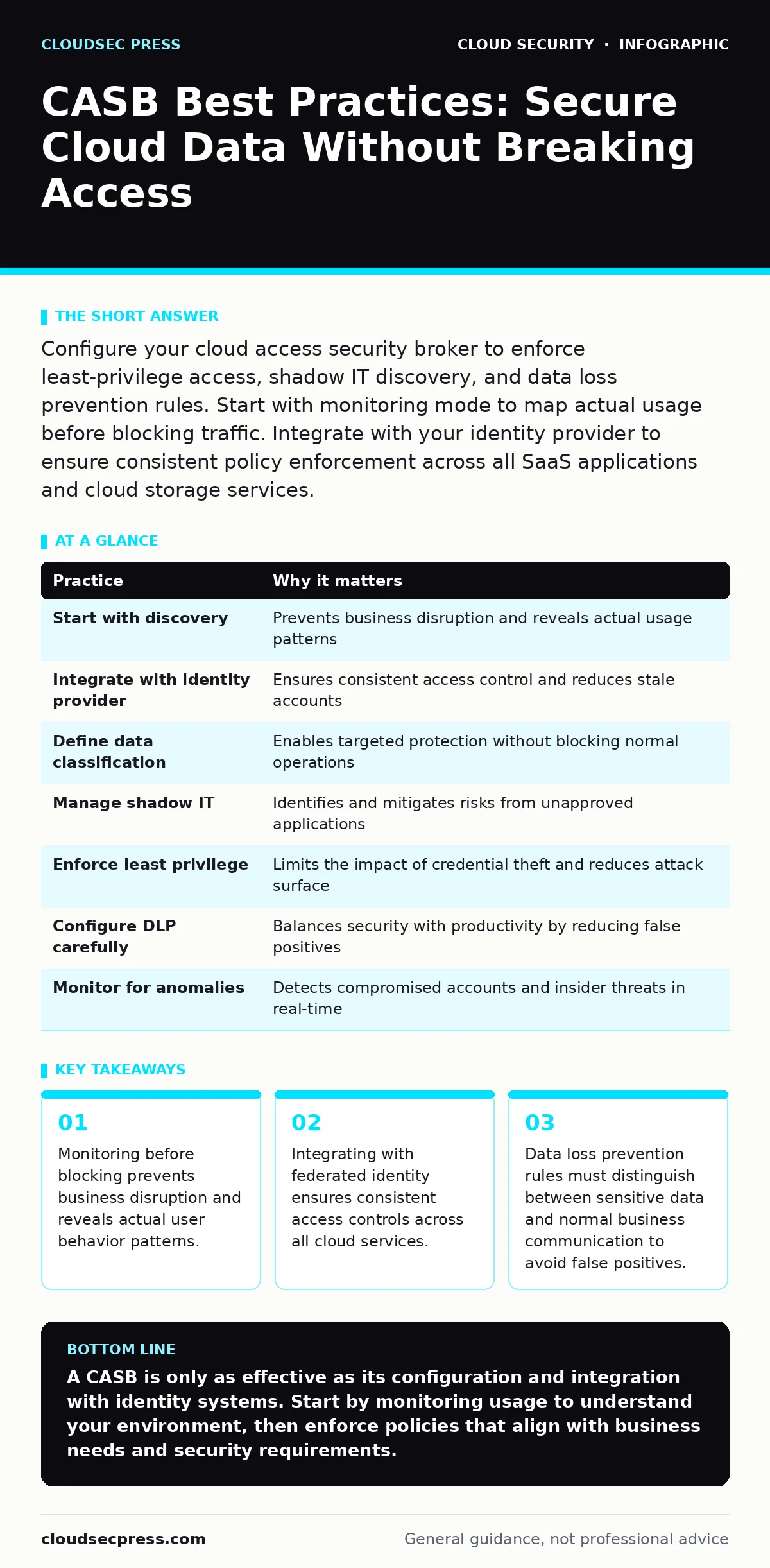
Configure your cloud access security broker to enforce least-privilege access, shadow IT discovery, and data loss prevention rules. Start with monitoring mode to map actual usage before blocking traffic. Integrate with your identity provider to ensure consistent policy enforcement across all SaaS applications and cloud storage services.
Start With Discovery, Not Enforcement
Deploying a cloud access security broker (CASB) with strict blocking rules immediately creates friction. Users find workarounds, often leading to unmanaged shadow IT that is harder to secure later. The broker acts as an intermediary between users and cloud services, allowing you to inspect traffic and enforce policies.
Begin by placing the CASB in monitoring mode. This allows the system to log all cloud interactions without interrupting them. You will see which applications employees use, how they share data, and where risks concentrate. This baseline data is necessary for writing policies that actually fit your workflow.
Integrate With Federated Identity
A CASB cannot enforce access control if it does not know who the user is or what permissions they hold. Relying on local CASB user accounts creates a management nightmare and leads to privilege creep. Integrating with your identity provider ensures that access decisions are consistent with your broader security strategy.
Use standard protocols like SAML or OIDC to connect the CASB to your identity provider. This allows the broker to apply policies based on group membership, role, or device status. If a user leaves the company, their access to cloud apps is revoked instantly through the identity provider, not through manual CASB updates. This reduces the risk of SaaS account takeover by ensuring stale accounts are never active.
Define Data Classification Rules
Not all data requires the same level of protection. Applying heavy encryption or blocking rules to every file slows down productivity and generates alert fatigue. You must define what constitutes sensitive data before the CASB can protect it effectively.
Create clear rules for data types such as financial records, intellectual property, or personal information. The CASB uses these definitions to scan content and metadata. When a rule is triggered, the broker can encrypt the file, prevent download, or alert administrators. Without precise classification, the system cannot distinguish between a harmless draft and a leaked contract.
Manage Shadow IT Systematically
Employees will use cloud applications that IT has not approved. This shadow IT bypasses standard security controls and creates blind spots. The CASB can identify these connections by inspecting DNS queries, SSL certificates, or traffic patterns.
Do not simply block every unknown application. Some tools are necessary for specific teams. Instead, categorize shadow IT by risk level. High-risk applications with poor security practices should be blocked or replaced. Low-risk tools can be allowed but monitored for data exfiltration. This approach balances security with operational reality.
Enforce Least Privilege Access
Default access settings in many cloud services are permissive. Users often have more permissions than they need, increasing the blast radius of a compromise. The CASB can enforce least privilege by restricting actions based on user role and context.
Review access logs to identify unnecessary permissions. For example, a marketing user should not have administrative access to a cloud storage bucket. The CASB can block upload or delete actions for users who do not need them. This reduces the impact of credential theft, as stolen accounts have limited capabilities. This aligns with broader cloud security architecture principles that emphasize granular control.
See also: Cloud Security Architecture Diagram: Map Controls to Reduce Risk · 7 Payment Card Theft Mistakes That Leave Your Business Open
Configure Data Loss Prevention Carefully
Data loss prevention (DLP) rules within a CASB can stop sensitive information from leaving your environment. However, overly aggressive DLP rules block legitimate business activities. This leads users to disable security features or use personal devices to bypass controls.
Test DLP rules against a sample of normal business traffic before enabling them globally. Look for false positives where the system flags routine communications as leaks. Refine the rules to target specific patterns, such as credit card numbers or source code. This ensures that protection does not become a barrier to productivity.
Monitor for Anomalous Behavior
Static rules cannot catch every threat. User behavior changes when an account is compromised or when an insider acts maliciously. The CASB can detect anomalies by comparing current activity against historical baselines.
Look for unusual login locations, impossible travel, or sudden spikes in data downloads. These indicators suggest a security incident. The CASB can trigger alerts or require re-authentication when anomalies are detected. This adds a layer of defense that complements traditional perimeter security, much like how secure access service edge (SASE) integrates network and security functions.
Regularly Review and Update Policies
Cloud services and user behaviors change over time. Policies that were effective last year may be obsolete or counterproductive today. Stale policies create security gaps and unnecessary friction.
Schedule quarterly reviews of CASB policies. Remove rules that no longer apply and update thresholds for anomaly detection. Engage with business units to understand new workflows and adjust policies accordingly. This continuous improvement ensures that the CASB remains aligned with your security goals and operational needs.
| Practice | Why it matters |
|---|---|
| Start with discovery | Prevents business disruption and reveals actual usage patterns |
| Integrate with identity provider | Ensures consistent access control and reduces stale accounts |
| Define data classification | Enables targeted protection without blocking normal operations |
| Manage shadow IT | Identifies and mitigates risks from unapproved applications |
| Enforce least privilege | Limits the impact of credential theft and reduces attack surface |
| Configure DLP carefully | Balances security with productivity by reducing false positives |
| Monitor for anomalies | Detects compromised accounts and insider threats in real-time |
| Review policies regularly | Keeps security measures aligned with changing business needs |
Align With Broader Security Frameworks
A CASB does not exist in isolation. It must work with other security tools to provide a cohesive defense. Ignoring integration opportunities leaves gaps in your security posture.
Ensure the CASB shares data with your security information and event management (SIEM) system. This allows for correlated analysis and faster incident response. Also, consider how the CASB fits into your serverless security risks strategy, as cloud functions may access data protected by the broker. This holistic view ensures that security controls reinforce each other rather than working at cross-purposes.
Key takeaways
- Monitoring before blocking prevents business disruption and reveals actual user behavior patterns.
- Integrating with federated identity ensures consistent access controls across all cloud services.
- Data loss prevention rules must distinguish between sensitive data and normal business communication to avoid false positives.
A CASB is only as effective as its configuration and integration with identity systems. Start by monitoring usage to understand your environment, then enforce policies that align with business needs and security requirements.
Frequently asked questions
How do I choose between API-based and proxy-based CASB?
API-based CASBs offer deeper visibility into SaaS applications but require app support. Proxy-based CASBs inspect traffic but may miss encrypted or direct API calls. Use both for comprehensive coverage.
Can a CASB prevent data breaches entirely?
No. A CASB reduces risk by enforcing policies and detecting anomalies, but it cannot stop all threats. It is one layer in a broader security strategy.
Do I need a CASB if I use a firewall?
Yes. Traditional firewalls inspect network traffic, not application-level data or user behavior. A CASB provides visibility into SaaS usage and data movement that firewalls miss.
How often should I update CASB policies?
At least quarterly, or whenever there are significant changes in business operations, cloud services, or security threats. Regular reviews ensure policies remain effective and relevant.
How this guide was produced: written by the CloudSec Press editorial team with AI assistance, checked against the public references listed below, and reviewed when the facts change. See our editorial policy or report an error.