Secure Access Service Edge (SASE): 10 FAQs Answered
SASE merges network and security functions into a single cloud service, but it shifts the risk from perimeter defenses to identity management and cloud configuration.
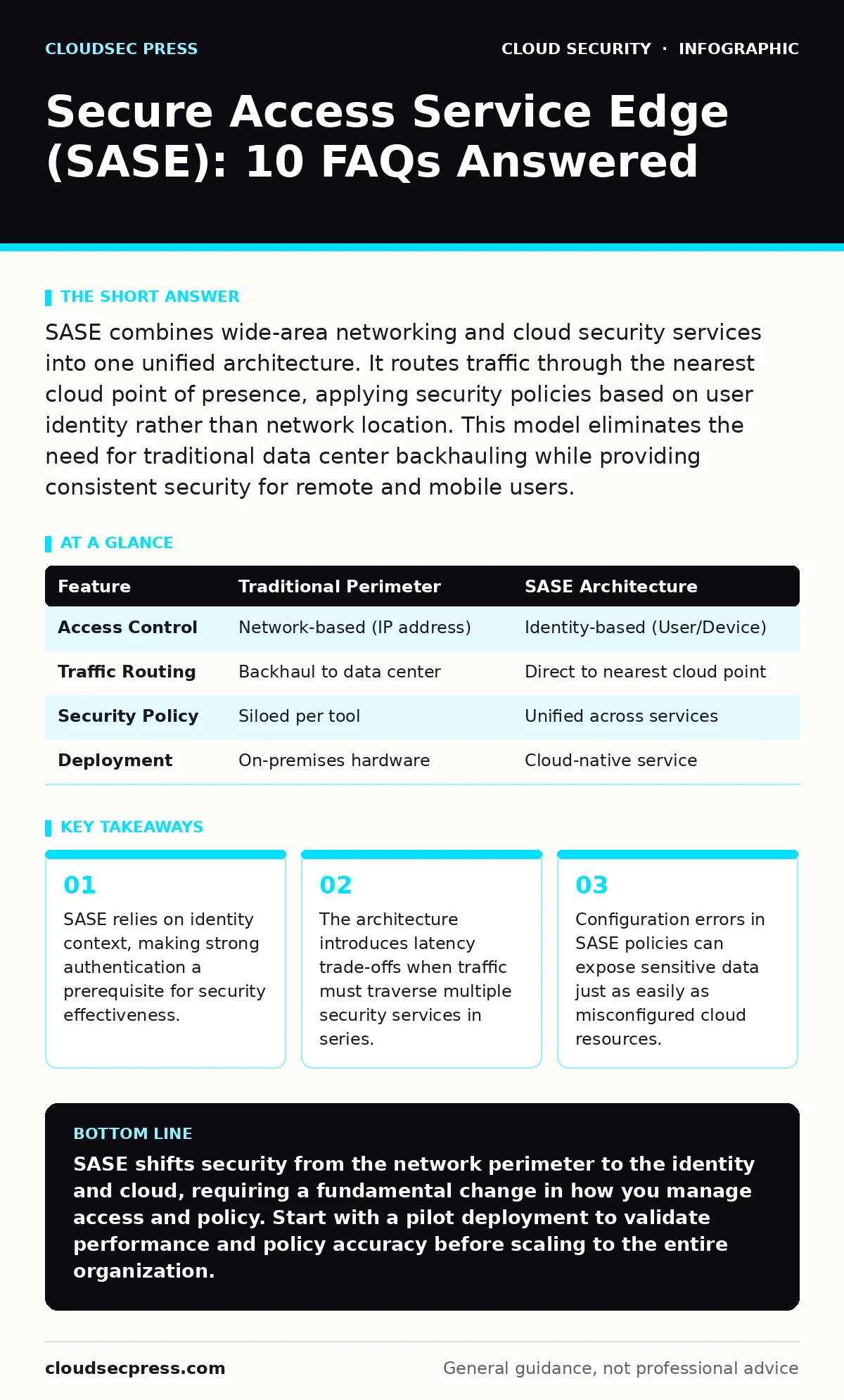
SASE combines wide-area networking and cloud security services into one unified architecture. It routes traffic through the nearest cloud point of presence, applying security policies based on user identity rather than network location. This model eliminates the need for traditional data center backhauling while providing consistent security for remote and mobile users.
What is Secure Access Service Edge?
Secure Access Service Edge is an architectural framework that combines wide-area networking (WAN) capabilities with cloud-native security services. It delivers these services from the cloud to every user location, regardless of whether the user is in an office, at home, or traveling. This model replaces the traditional hub-and-spoke network design where all traffic was routed back to a central data center for inspection. By processing traffic closer to the user, SASE reduces latency and improves the experience for cloud-based applications.
How does SASE differ from SD-WAN?
Software-defined wide area networking (SD-WAN) focuses solely on optimizing network connectivity and traffic steering between locations. SASE includes SD-WAN capabilities but adds a full suite of security functions, such as firewalling, intrusion prevention, and data loss prevention. Think of SD-WAN as the plumbing that moves data efficiently, while SASE is the plumbing plus the water filtration and safety systems. You cannot have SASE without the network optimization, but you can have SD-WAN without the comprehensive security layer.
What security functions are included in SASE?
A true SASE implementation integrates several distinct security services into a single, unified platform. These typically include cloud access security broker (CASB) capabilities to monitor SaaS usage, secure web gateway (SWG) features to filter web traffic, and zero trust network access (ZTNA) to enforce least-privilege access. It also incorporates firewall as a service (FWaaS) and data loss prevention (DLP) mechanisms. The key distinction is that these functions share a common policy engine, allowing administrators to manage access rules in one place rather than across multiple disparate tools.
Why does identity matter more in SASE?
In traditional perimeter security, the network boundary defined who was trusted. SASE removes the network perimeter, making identity the new boundary for access decisions. Every request is evaluated based on who the user is, what device they are using, and the context of the request. This shift means that credential theft becomes a more critical risk vector than network intrusion. You must implement strong multi-factor authentication and continuous verification to ensure that the identity presented is legitimate and uncompromised.
How does SASE handle data privacy and compliance?
SASE architectures often route traffic through multiple cloud points of presence to optimize performance. This routing can cause data to traverse different geographical jurisdictions, potentially conflicting with data residency laws. You must configure geo-routing rules to ensure that sensitive data remains within specific legal boundaries. Additionally, the unified logging provided by SASE can simplify compliance auditing, but only if you maintain strict access controls over the security logs themselves. Mismanagement of these logs can create a new compliance liability.
| Feature | Traditional Perimeter | SASE Architecture |
|---|---|---|
| Access Control | Network-based (IP address) | Identity-based (User/Device) |
| Traffic Routing | Backhaul to data center | Direct to nearest cloud point |
| Security Policy | Siloed per tool | Unified across services |
| Deployment | On-premises hardware | Cloud-native service |
See also: Cloud Security Architecture Diagram: Map Controls to Reduce Risk · 7 Payment Card Theft Mistakes That Leave Your Business Open
What are the performance trade-offs?
Routing traffic through security services can introduce latency, especially if the traffic must pass through multiple inspection engines in series. This is known as the "security stack" problem, where each additional service adds processing time. SASE providers mitigate this by placing security functions close to the user, but complex deep packet inspection can still slow down connections. You must balance security depth with performance requirements, potentially exempting low-risk traffic from heavy inspection to maintain speed.
How does SASE integrate with existing cloud security?
SASE does not replace all cloud security needs; it complements them by securing the access path. You still need to secure the workloads and data within the cloud environment itself. For instance, SASE protects the connection to a cloud database, but it does not fix an unsecured cloud database configuration. Similarly, it secures the access to a SaaS application, but it cannot prevent a SaaS account takeover if credentials are stolen. It is vital to understand that SASE is a transport and access security layer, not a workload protection platform.
What is the hidden cost of SASE complexity?
The primary hidden cost of SASE is the operational complexity of managing unified policies. Administrators must translate security requirements into rules that apply across network, identity, and application contexts. A single misconfigured rule can block legitimate business traffic or expose sensitive data. This complexity often requires specialized skills that differ from traditional network administration. Organizations frequently underestimate the time needed to tune policies and troubleshoot issues that span multiple security domains.
Can SASE protect against insider threats?
SASE provides better visibility into user behavior than traditional perimeter tools, which helps detect insider threats. By monitoring access patterns and data movements in real-time, security teams can identify anomalies such as unusual data downloads or access from unexpected locations. However, SASE cannot prevent an insider who has legitimate credentials from accessing authorized data. It enhances detection and response capabilities, but it relies on proper policy definition and monitoring to be effective against malicious insiders.
How do you avoid common SASE deployment mistakes?
The most common mistake is attempting to migrate all traffic at once without proper testing. This approach often results in widespread connectivity issues and security gaps. Instead, start with a pilot group of users and applications to validate policies and performance. Another frequent error is ignoring the integration with identity providers, which can lead to authentication failures or excessive privilege escalation. Ensure that your identity provider is properly configured and that service accounts are managed with the same rigor as user accounts.
Key takeaways
- SASE relies on identity context, making strong authentication a prerequisite for security effectiveness.
- The architecture introduces latency trade-offs when traffic must traverse multiple security services in series.
- Configuration errors in SASE policies can expose sensitive data just as easily as misconfigured cloud resources.
SASE shifts security from the network perimeter to the identity and cloud, requiring a fundamental change in how you manage access and policy. Start with a pilot deployment to validate performance and policy accuracy before scaling to the entire organization.
Frequently asked questions
Does SASE replace the need for a firewall?
SASE includes firewall capabilities as a service, so you do not need traditional perimeter firewalls for branch or remote access. However, you may still need host-based firewalls on endpoints for additional protection.
Is SASE suitable for small businesses?
SASE can be cost-effective for small businesses because it eliminates the need for expensive on-premises security hardware. However, the complexity of policy management may require more technical expertise than smaller teams possess.
How does SASE handle zero-day threats?
SASE providers often integrate threat intelligence feeds and sandboxing to detect zero-day threats. The unified nature of SASE allows for rapid policy updates across all users, but detection depends on the provider's threat intelligence capabilities.
Can SASE work with hybrid cloud environments?
Yes, SASE is designed to secure access to both public cloud services and on-premises resources. It treats all destinations equally, applying consistent security policies regardless of where the workload resides.
How this guide was produced: written by the CloudSec Press editorial team with AI assistance, checked against the public references listed below, and reviewed when the facts change. See our editorial policy or report an error.