Serverless Security Risks: 8 Questions Answered for Cloud Architects
Serverless shifts the attack surface from infrastructure to code, making dependency management and event source validation your primary defense mechanisms.

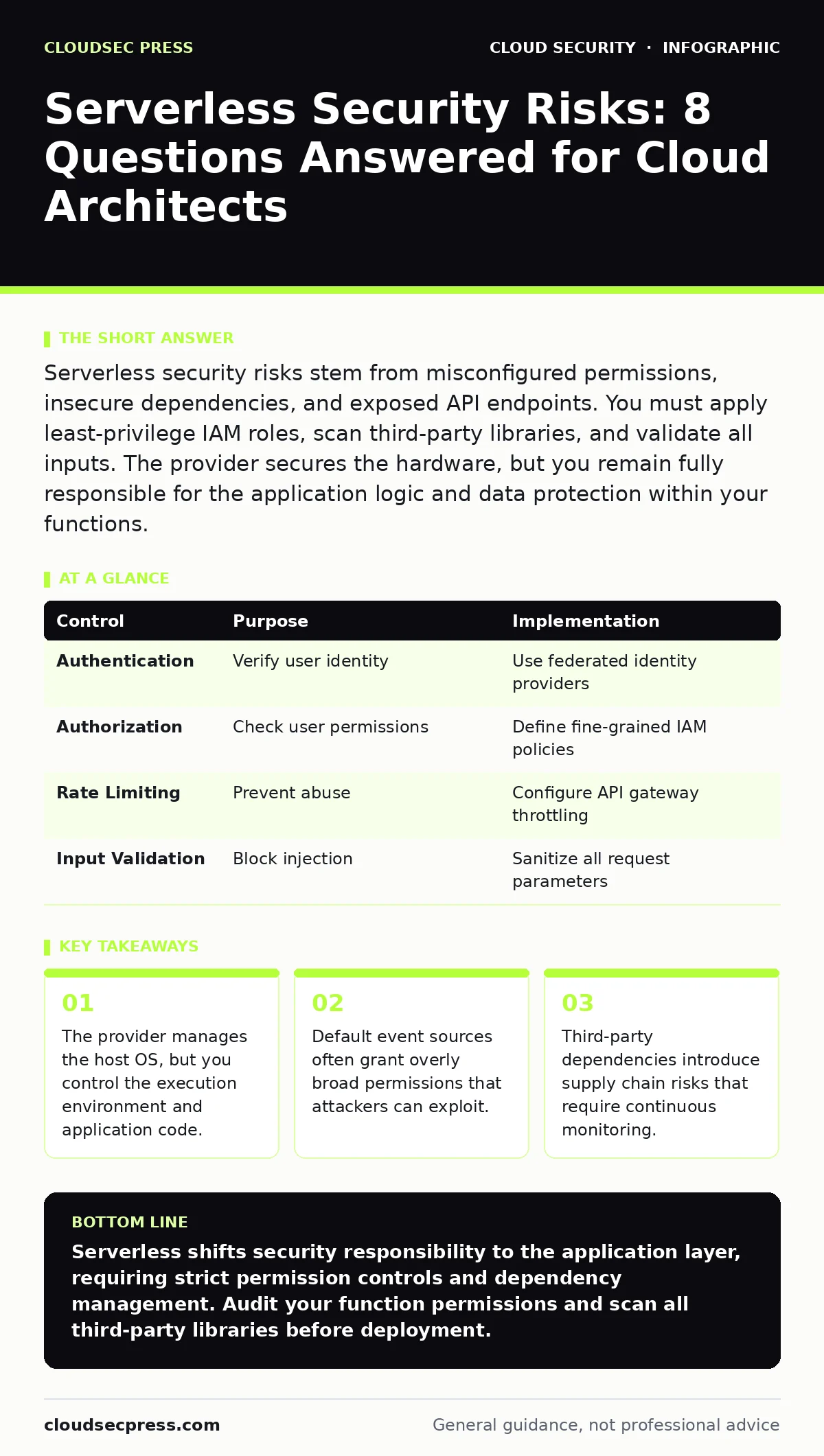
Serverless security risks stem from misconfigured permissions, insecure dependencies, and exposed API endpoints. You must apply least-privilege IAM roles, scan third-party libraries, and validate all inputs. The provider secures the hardware, but you remain fully responsible for the application logic and data protection within your functions.
Who is responsible for security in serverless computing?
The cloud provider secures the underlying infrastructure, while you secure the application code and configuration. This division is known as the shared responsibility model. The provider patches the hypervisor and manages the physical data centers. You are responsible for the logic inside your function, the permissions it holds, and the data it processes.
Do not assume that running on a managed platform eliminates your security duties. The provider cannot inspect your code for logical flaws or business logic errors. They also cannot fix misconfigured IAM roles that grant excessive access to other resources.
Does serverless eliminate infrastructure vulnerabilities?
It removes the need to patch operating systems, but it introduces new risks in the application layer. You no longer manage servers, so you avoid common OS-level exploits. However, your function still runs in an environment that can be compromised through code injection or malicious dependencies.
The attack surface shifts from the network perimeter to the application logic. Attackers target the inputs your function accepts rather than the server it runs on. This makes input validation and secure coding practices more critical than before.
How do I prevent overly permissive IAM roles?
Apply the principle of least privilege to every function execution role. Many developers grant broad permissions to simplify development, creating a path for privilege escalation. If a function is compromised, the attacker inherits those permissions.
Use resource-based policies to restrict access to specific ARNs rather than wildcard permissions. Regularly audit permissions to remove unused grants. A function that only reads from a specific database table should not have write access to the entire database.
Are third-party dependencies a security risk?
Yes, they are a major vector for supply chain attacks. Your function relies on libraries written by others, which may contain vulnerabilities or malicious code. This is similar to the risks found in insecure container images, where a single bad layer can compromise the entire application.
You must scan these dependencies for known vulnerabilities before deployment. Pin specific versions in your code to prevent unexpected updates from introducing new flaws. Do not trust that the package manager automatically resolves security issues.
How do I secure API endpoints for serverless functions?
Enforce strict authentication and authorization on every entry point. Serverless functions are often exposed via API gateways, which can be targeted by automated bots. Without proper checks, anyone on the internet can invoke your function.
Implement rate limiting to prevent abuse and denial-of-service attacks. Validate all inputs to prevent injection attacks. Treat every request as untrusted, regardless of its source.
| Control | Purpose | Implementation |
|---|---|---|
| Authentication | Verify user identity | Use federated identity providers |
| Authorization | Check user permissions | Define fine-grained IAM policies |
| Rate Limiting | Prevent abuse | Configure API gateway throttling |
| Input Validation | Block injection | Sanitize all request parameters |
See also: SaaS Access Reviews: Definition, Purpose, and Execution
Can serverless functions leak sensitive data?
Yes, if you store secrets in environment variables or code. Environment variables are often visible in logs or error messages. Hardcoding secrets like API keys or database passwords is a critical mistake.
Use a dedicated secrets manager to store and retrieve sensitive data. This ensures that secrets are encrypted at rest and in transit. The function retrieves the secret at runtime, reducing the window of exposure.
How do I mitigate event sourcing risks?
Validate the source and content of every event trigger. Serverless functions react to events from queues, databases, or storage buckets. An attacker who can inject a malicious event can trigger your function with harmful data.
Ensure that only authorized services can send events to your function. Use content-based rules to filter events before they reach your code. This prevents injection attacks through event payloads.
What is the impact of cold starts on security?
Cold starts do not directly introduce vulnerabilities, but they can mask performance issues that indicate an attack. A sudden spike in cold starts may signal a denial-of-service attempt. The overhead of initializing the function can be exploited to exhaust resources.
Monitor initialization times and frequency. Set up alerts for unusual patterns in function invocations. This helps you detect abuse early before it impacts availability.
How do I debug serverless functions securely?
Use distributed tracing instead of verbose logging. Logging detailed information can expose sensitive data or internal architecture details. Tracing provides context about the request flow without storing raw data.
Mask sensitive fields in any logs that are necessary for troubleshooting. Ensure that logs are encrypted and access-controlled. Regularly review log retention policies to minimize data exposure.
Is serverless suitable for high-security applications?
It can be, provided you implement rigorous security controls. The ephemeral nature of functions reduces the persistence of attackers. However, the complexity of event-driven architectures can introduce hidden risks.
Evaluate your application’s requirements against the security features of the platform. Ensure that you have visibility into all function interactions. For complex deployments, consider how serverless fits into your broader cloud security architecture.
Key takeaways
- The provider manages the host OS, but you control the execution environment and application code.
- Default event sources often grant overly broad permissions that attackers can exploit.
- Third-party dependencies introduce supply chain risks that require continuous monitoring.
Serverless shifts security responsibility to the application layer, requiring strict permission controls and dependency management. Audit your function permissions and scan all third-party libraries before deployment.
Frequently asked questions
Does serverless protect against DDoS attacks?
It provides some resilience through auto-scaling, but you must implement rate limiting and WAF rules at the API gateway to mitigate large-scale attacks.
Can I use serverless for PCI-DSS compliance?
Yes, but you must ensure that data is encrypted at rest and in transit, and that access controls meet strict compliance requirements.
How do I secure communication between serverless functions?
Use private endpoints or VPCs to restrict traffic, and enforce mutual TLS authentication between services where possible.
What is the biggest mistake in serverless security?
Granting overly broad IAM permissions, which allows attackers to escalate privileges and access other resources if a function is compromised.
How this guide was produced: written by the CloudSec Press editorial team with AI assistance, checked against the public references listed below, and reviewed when the facts change. See our editorial policy or report an error.