Command Injection vs XSS: How to Tell the Difference
Command injection executes code on the server, while XSS runs scripts in the browser, creating two distinct attack paths with different remediation strategies.

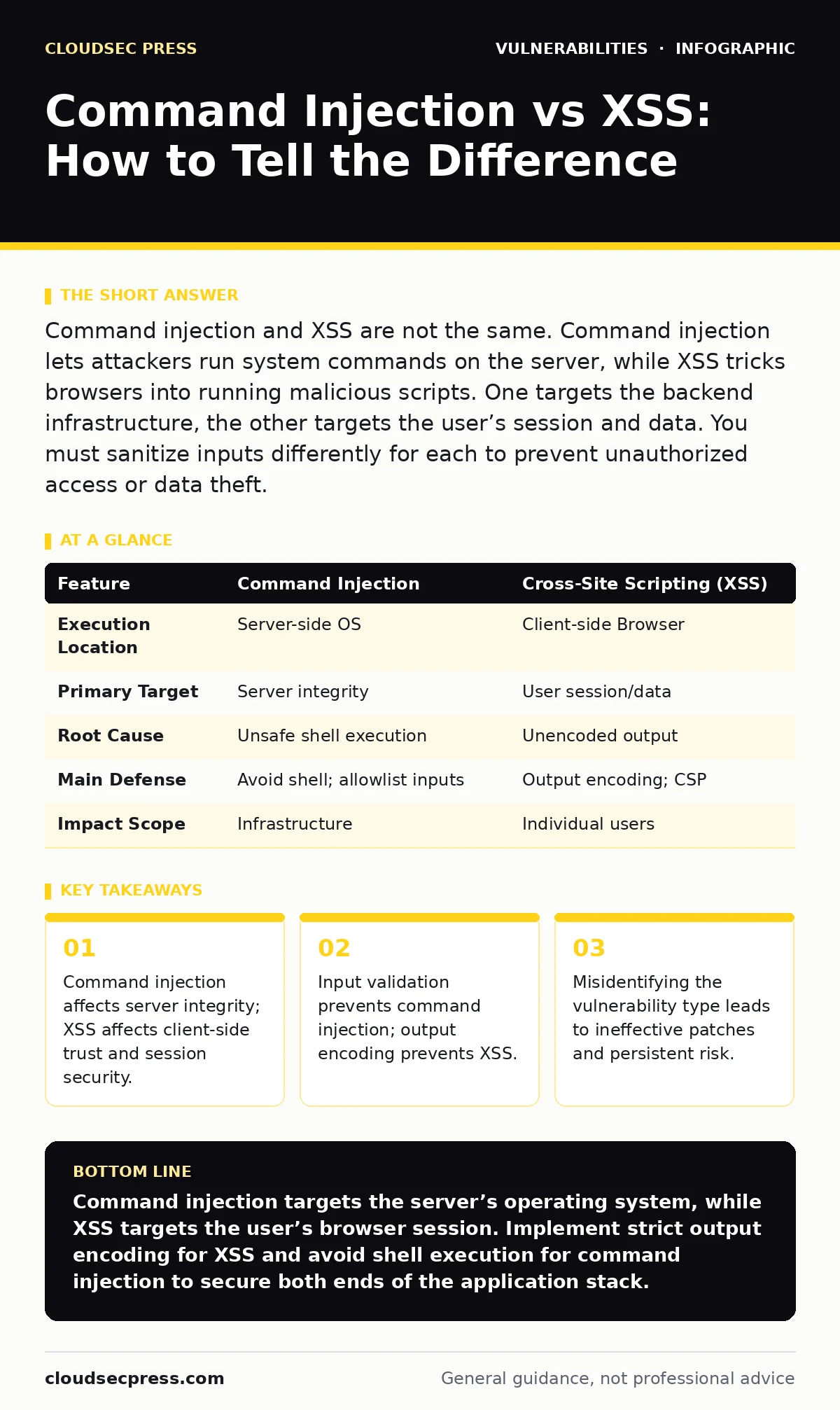
Command injection and XSS are not the same. Command injection lets attackers run system commands on the server, while XSS tricks browsers into running malicious scripts. One targets the backend infrastructure, the other targets the user’s session and data. You must sanitize inputs differently for each to prevent unauthorized access or data theft.
What is the difference between command injection and xss?
Command injection and XSS differ fundamentally in where the code executes and who controls the environment. Command injection allows an attacker to execute arbitrary operating system commands on the server hosting the application. XSS allows an attacker to inject malicious scripts that run in the victim’s web browser. The former compromises the server’s operating system. The latter compromises the user’s session and data within the application. Understanding this distinction dictates your defense strategy.
Where does each vulnerability execute?
Execution location defines the scope of damage. Command injection runs on the server side, using the privileges of the web application process. If that process has root or administrator access, the attacker gains full control of the server. XSS runs on the client side, within the user’s browser context. The attacker cannot directly access the server’s file system through XSS. Instead, they steal cookies, session tokens, or keystrokes from the user. The server remains intact, but the user’s trust in the application is broken.
What are the primary attack vectors?
Attack vectors differ because the entry points are distinct. Command injection occurs when an application passes untrusted user input directly to a system shell or command interpreter. The application might use functions designed to run external programs. XSS occurs when an application includes untrusted data in a web page without proper encoding or escaping. The browser interprets this data as HTML or JavaScript. Both rely on user input, but the mechanism of execution is entirely different. One uses the server’s shell. The other uses the browser’s JavaScript engine.
How do defenses differ for each?
Defenses must target the specific execution context. For command injection, you must avoid passing user input to system shells whenever possible. Use language-specific libraries that invoke programs directly without shell interpretation. If shell execution is unavoidable, use strict allowlists for permitted characters and commands. For XSS, you must encode output data before rendering it in the browser. HTML encoding converts special characters into safe entities. Context-aware encoding handles JavaScript, CSS, and URL contexts correctly. Input validation helps both, but output encoding is the primary defense for XSS.
| Feature | Command Injection | Cross-Site Scripting (XSS) |
|---|---|---|
| Execution Location | Server-side OS | Client-side Browser |
| Primary Target | Server integrity | User session/data |
| Root Cause | Unsafe shell execution | Unencoded output |
| Main Defense | Avoid shell; allowlist inputs | Output encoding; CSP |
| Impact Scope | Infrastructure | Individual users |
When does standard advice fail?
Standard advice often oversimplifies complex edge cases. Many developers assume input validation alone prevents command injection. This fails when the application logic requires dynamic command construction. A strict allowlist is safer, but it can break functionality if not designed carefully. Similarly, relying solely on input filtering for XSS is dangerous. Attackers can encode payloads to bypass filters. Output encoding is more reliable because it neutralizes the payload at the point of execution. Both vulnerabilities require context-aware handling. Generic sanitization libraries often miss edge cases in complex applications.
See also: CSAF Security Advisories Explained: Machine-Readable Vulnerability Data
What is the relationship to other vulnerabilities?
These vulnerabilities often coexist with other flaws in the same application. Command injection frequently pairs with insecure direct object references (IDOR) when file paths are manipulated. If an attacker can inject commands and access arbitrary files, the damage multiplies. XSS often overlaps with prototype pollution in JavaScript-heavy applications. Prototype pollution can allow attackers to modify objects that control output encoding, bypassing XSS protections. Identifying one vulnerability should trigger a review for related issues. Attack surface management helps you map these interconnected risks across your infrastructure.
How do you detect these issues?
Detection methods vary because automated tools struggle with context. Vulnerability scanning tools can find common patterns for both injection types. However, they often produce false positives or miss complex logic flows. Manual code review is more effective for command injection. Look for functions that execute system commands and trace user input to those functions. For XSS, review how user data is rendered in templates. Ensure encoding happens at the output stage, not just the input stage. Patch testing in a staging environment confirms whether your fixes actually block the attack.
What are the long-term risks?
Ignoring these vulnerabilities leads to cumulative risk. Command injection can lead to full server compromise, allowing attackers to install malware or pivot to other systems. This often results in long-term persistence and data exfiltration. XSS leads to account takeover and phishing. Attackers can inject fake login forms or redirect users to malicious sites. The reputational damage from XSS is often immediate and severe. Users lose trust when they see malicious content on your site. Both vulnerabilities require ongoing maintenance. Security bulletins from framework vendors often highlight new bypass techniques. Keeping dependencies updated is a critical part of long-term defense.
Key takeaways
- Command injection affects server integrity; XSS affects client-side trust and session security.
- Input validation prevents command injection; output encoding prevents XSS.
- Misidentifying the vulnerability type leads to ineffective patches and persistent risk.
Command injection targets the server’s operating system, while XSS targets the user’s browser session. Implement strict output encoding for XSS and avoid shell execution for command injection to secure both ends of the application stack.
Frequently asked questions
Can command injection lead to XSS?
No, they are distinct. Command injection executes on the server. XSS executes in the browser. However, a command injection could potentially modify server files to include XSS payloads, creating a secondary attack path.
Is input validation enough to prevent XSS?
No. Input validation can miss encoded or obfuscated payloads. Output encoding is required to neutralize malicious data when it is rendered in the browser. Context-aware encoding is the most reliable defense.
How do I test for command injection?
Review code for functions that execute system commands. Trace user input to those functions. Test with payloads that attempt to break out of the command structure. Use allowlists to restrict permitted inputs and commands.
What is the biggest risk of XSS?
The biggest risk is session hijacking. Attackers can steal
How this guide was produced: written by the CloudSec Press editorial team with AI assistance, checked against the public references listed below, and reviewed when the facts change. See our editorial policy or report an error.