Bot Management: How to Stop Automated Abuse Without Blocking Users
Bot management works by analyzing behavior patterns and device fingerprints to separate helpful automation from malicious scripts in real time.

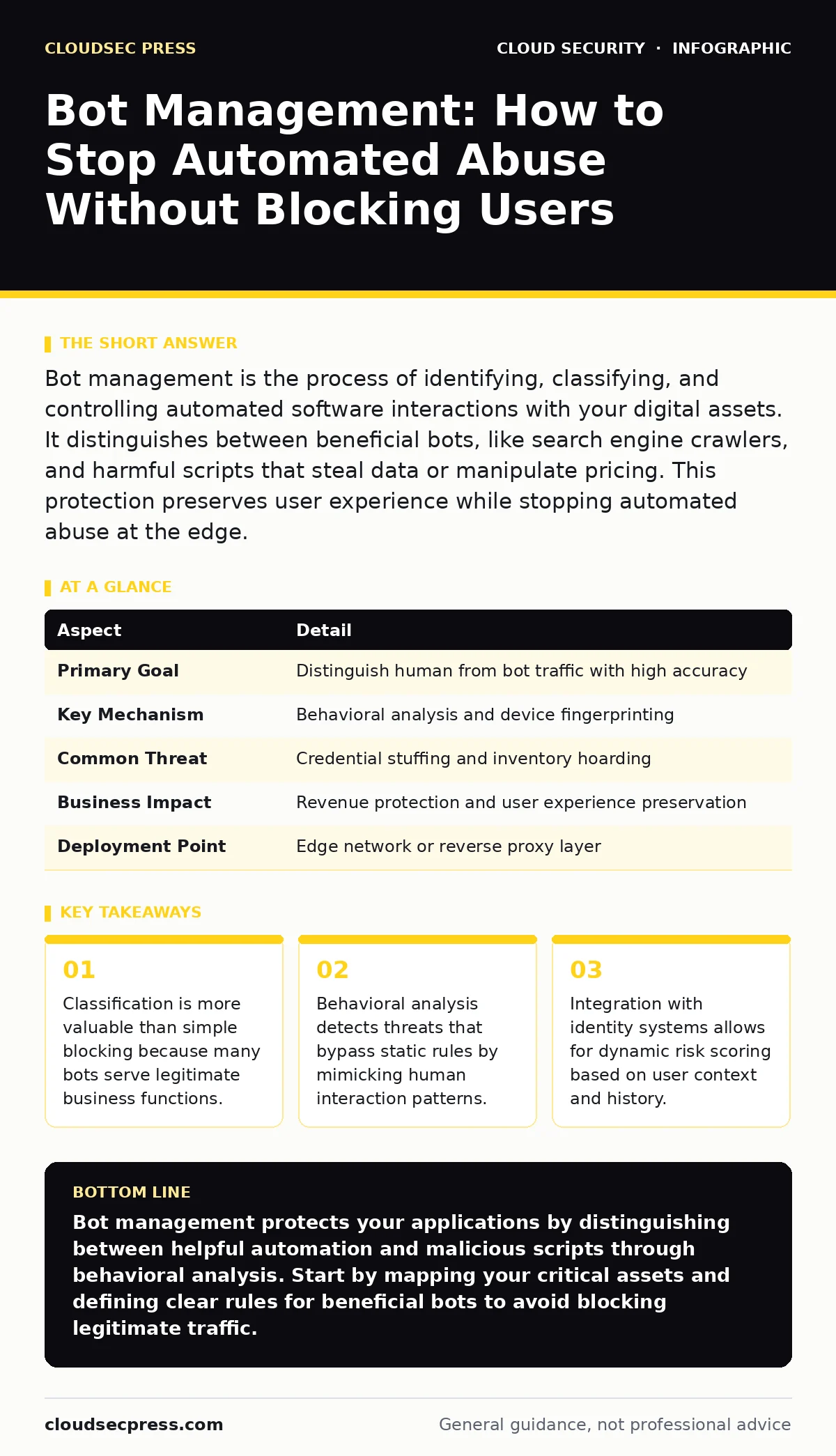
Bot management is the process of identifying, classifying, and controlling automated software interactions with your digital assets. It distinguishes between beneficial bots, like search engine crawlers, and harmful scripts that steal data or manipulate pricing. This protection preserves user experience while stopping automated abuse at the edge.
Understanding the Bot Management Definition
Bot management refers to the continuous process of identifying, classifying, and controlling automated software interactions with your digital infrastructure. Unlike traditional firewalls that inspect network packets, bot management systems examine application-layer behavior. They determine whether an interaction comes from a human user, a beneficial automation tool, or a malicious script. This distinction matters because automated traffic now constitutes the majority of internet requests.
The core purpose is not to eliminate all automation. Many business processes rely on bots for scraping public data, monitoring uptime, or indexing content. The goal is to allow value-generating bots while blocking those that cause financial loss, data theft, or service degradation. You achieve this by establishing a baseline of expected behavior and flagging deviations.
The Problem Bot Management Solves
Modern applications face a constant stream of automated requests that overwhelm servers and distort business logic. Simple rate limiting fails because attackers distribute requests across many IP addresses. Captchas frustrate legitimate users and do not stop sophisticated headless browsers that can solve visual challenges. Bot management addresses the gap between network security and application logic.
Consider a ticketing platform. Attackers use bots to purchase thousands of tickets in seconds, leaving none for real fans. This is not just a nuisance; it is a direct revenue loss. The system must process these requests faster than a human can click. Without specialized controls, the application cannot distinguish between a fan refreshing a page and a script executing a purchase loop.
| Aspect | Detail |
|---|---|
| Primary Goal | Distinguish human from bot traffic with high accuracy |
| Key Mechanism | Behavioral analysis and device fingerprinting |
| Common Threat | Credential stuffing and inventory hoarding |
| Business Impact | Revenue protection and user experience preservation |
| Deployment Point | Edge network or reverse proxy layer |
Main Components of Bot Protection
Effective bot management relies on three interconnected components. First, identification engines analyze traffic signals. These include mouse movements, typing rhythms, and browser consistency. A human user moves a cursor in irregular patterns. A script often moves it in straight lines or at constant speeds.
Second, classification models assign a risk score to each session. This score determines the action taken. Low-risk sessions proceed normally. High-risk sessions trigger additional verification or blocking. The model updates continuously as new attack patterns emerge.
Third, response mechanisms enforce the decisions. Actions range from allowing traffic to presenting a challenge or dropping the connection. You configure these responses based on the sensitivity of the resource. A public blog might tolerate more noise than a checkout page.
Behavioral Analysis and Fingerprinting
Static rules quickly become obsolete. Attackers modify their scripts to mimic known good traffic. Behavioral analysis looks at how a session unfolds over time. It examines the sequence of events and the timing between them. This method catches sophisticated attacks that pass initial checks.
Device fingerprinting creates a unique identifier for the client environment. It collects data about the browser version, installed fonts, screen resolution, and hardware capabilities. This fingerprint persists across sessions. If a device suddenly claims a different configuration, the system flags it as suspicious. This technique helps track bad actors who rotate IP addresses.
Integration with Other Defenses
Bot management does not operate in isolation. It works best when integrated with broader security frameworks. For instance, it complements identity and access management by verifying the legitimacy of the client before authentication occurs. This reduces the load on identity providers and prevents credential stuffing attacks from reaching the database.
It also supports cloud access security brokers (CASB) by filtering traffic before it enters the cloud environment. This reduces the volume of requests that cloud services must process. For organizations using SaaS applications, this layer prevents abuse of API endpoints that might not be fully protected by the vendor.
You should align bot management policies with IaaS, PaaS and SaaS security standards. Consistency across layers ensures that a threat blocked at the edge is not allowed through at the application level. This holistic approach closes gaps that single-point solutions leave open.
See also: SaaS Access Reviews: Definition, Purpose, and Execution
Common Misconceptions About Bot Control
Many teams assume that blocking all bots is the safest strategy. This is a mistake. Search engine crawlers, monitoring tools, and partner integrations are all bots. Blocking them harms visibility, operational awareness, and business partnerships. You must maintain a whitelist of known good bots.
Another misconception is that bot management is a one-time setup. Attackers constantly evolve their techniques. What works today may fail next month. You need continuous tuning and monitoring. Regularly review blocked traffic logs to ensure you are not catching legitimate users.
Some believe that strong authentication alone stops bot abuse. This is false. If a bot has valid credentials, it can authenticate successfully. Bot management protects the account before the login attempt. It prevents the abuse of stolen credentials from ever reaching the authentication system.
Implementing Effective Bot Policies
Start by mapping your critical assets. Identify which endpoints generate the most value and which are most vulnerable to abuse. Apply stricter controls to these areas. A public search page can tolerate more noise than a payment processing endpoint.
Define clear rules for beneficial bots. Work with your marketing and development teams to identify which automation is necessary. Ensure these bots are whitelisted and monitored for changes in behavior. A sudden spike in requests from a known good bot might indicate it has been compromised.
Regularly test your defenses. Use simulated bot traffic to verify that your controls work as expected. Adjust thresholds based on false positive rates. The goal is a balance between security and usability. If users complain about friction, your rules may be too aggressive.
Key takeaways
- Classification is more valuable than simple blocking because many bots serve legitimate business functions.
- Behavioral analysis detects threats that bypass static rules by mimicking human interaction patterns.
- Integration with identity systems allows for dynamic risk scoring based on user context and history.
Bot management protects your applications by distinguishing between helpful automation and malicious scripts through behavioral analysis. Start by mapping your critical assets and defining clear rules for beneficial bots to avoid blocking legitimate traffic.
Frequently asked questions
Does bot management replace a web application firewall?
No. A web application firewall blocks known attack patterns like SQL injection. Bot management identifies and controls automated behavior that may not contain malicious payloads but causes abuse.
How does bot management handle mobile applications?
It analyzes device telemetry and app behavior. Mobile bots often mimic app interactions. The system checks for root detection, emulator usage, and interaction timing to identify fake sessions.
How this guide was produced: written by the CloudSec Press editorial team with AI assistance, checked against the public references listed below, and reviewed when the facts change. See our editorial policy or report an error.