Stop Cloud Cryptojacking: Block Hidden Miners Before They Drain Resources
Most cryptojacking attacks bypass network firewalls entirely because they use legitimate cloud APIs to install mining software on already running instances.

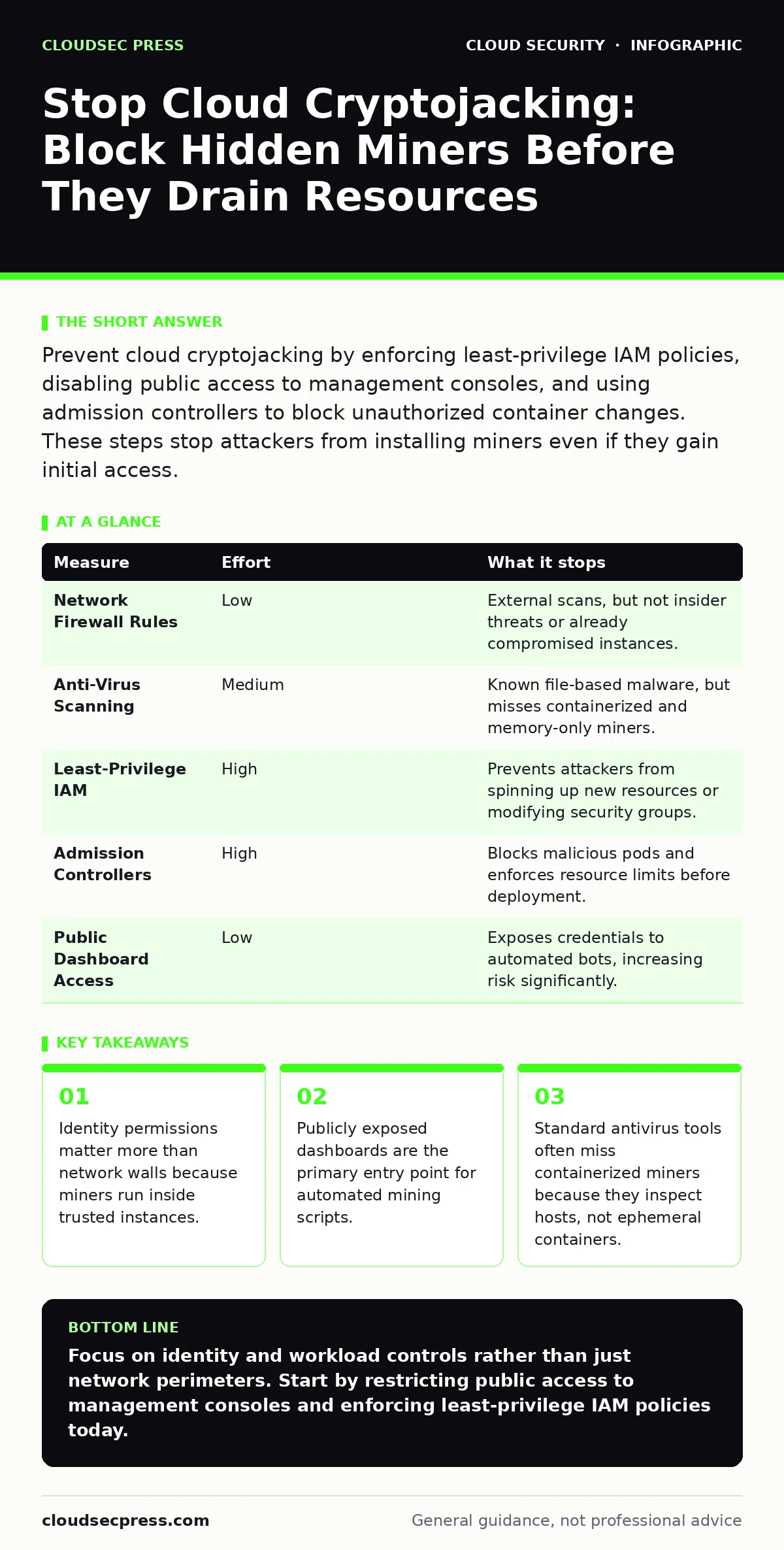
Prevent cloud cryptojacking by enforcing least-privilege IAM policies, disabling public access to management consoles, and using admission controllers to block unauthorized container changes. These steps stop attackers from installing miners even if they gain initial access.
The Silent Cost of Compromised Compute
Cryptojacking in the cloud differs from traditional malware. Attackers do not steal data or encrypt files. Instead, they hijack your computing power to mine cryptocurrency. This activity consumes CPU and GPU cycles, driving up your cloud bills and degrading application performance. The damage is often slow and silent. You might notice a gradual increase in costs or slight latency spikes, but the root cause remains hidden.
The danger lies in the persistence of the threat. A miner installed on a virtual machine runs until you spot it and shut it down. In containerized environments, the problem is worse. Containers are ephemeral. If a miner is baked into an image or injected at runtime, it restarts every time you redeploy. Traditional security tools often fail here because they look for known file signatures on static servers. They miss the dynamic nature of cloud workloads.
Why Identity Is Your First Line of Defense
Network security creates a false sense of safety. Attackers rarely need to breach your perimeter network. They exploit weak identity controls. Imagine an attacker finds a misconfigured storage bucket containing database credentials. They use those credentials to log into your cloud management console. Once inside, they are already trusted. The cloud provider assumes they are you.
This is why least-privilege access is the most effective control. If an attacker gains a user account with broad permissions, they can spin up new instances, modify security groups, and install mining software. If that same account has limited permissions, their options shrink dramatically. They cannot create new resources. They cannot change firewall rules. They are stuck with whatever access they already have, which is often insufficient to launch a large-scale mining operation.
Review your Identity and Access Management (IAM) policies. Remove administrative access from standard users. Ensure that service accounts have only the permissions required for their specific function. This limits the blast radius of any credential theft.
Closing the Dashboard Gap
Exposed management interfaces are a leading cause of compromise. Many organizations leave their cloud dashboards accessible to the public internet. Automated bots scan for these open ports. When they find one, they attempt common default credentials or exploit known vulnerabilities.
You must disable public access to your cloud management console. Force all administrative traffic through a private network or a secure bastion host. Implement multi-factor authentication for all administrative accounts. This adds a layer of friction that automated scripts cannot bypass.
For Kubernetes clusters, this means securing the API server. Many teams leave the API server exposed, allowing anyone to query cluster state. If an attacker can read the cluster state, they can find high-value targets. They can also inject malicious pods if the API server lacks proper authentication.
See our guide on exposed Kubernetes dashboards for detailed steps on hardening your cluster access.
Hardening Container Workloads
Containers introduce unique risks. They share the host kernel. If a container escapes its boundaries, it can compromise the entire host. Cryptojackers love containers because they are lightweight and easy to deploy. They often use sidecar containers to inject miners into running applications.
Admission controllers are your best defense here. These are plugins that intercept requests to the Kubernetes API. They can block pods that do not meet security policies. For example, you can configure an admission controller to reject any pod that requests excessive CPU resources. Miners typically need high CPU allocation. Blocking these requests stops the miner before it starts.
You can also enforce read-only root file systems. This prevents miners from writing binaries to the container disk. If a container tries to write to its root file system, the operation fails. This forces the attacker to use more complex techniques, increasing the chance of detection.
Read more about implementing these controls in our guide on Kubernetes admission controllers.
Monitoring for Anomalous Behavior
Prevention is not enough. You must detect breaches that slip through. Cryptojacking creates distinct behavioral patterns. Miners consume high amounts of CPU and generate significant network traffic to mining pools. Standard monitoring tools often flag this as a performance issue, not a security event.
Configure your monitoring to alert on sustained high CPU usage. Look for spikes that do not correlate with application traffic. Also, monitor outbound network connections. Legitimate applications rarely connect to unknown external IPs on non-standard ports.
Behavioral analytics can help identify these patterns. Machine learning models can learn normal baseline behavior for your workloads. Deviations from this baseline trigger alerts. This approach catches new variants of miners that signature-based tools miss.
See also: Cloud Security Architecture Diagram: Map Controls to Reduce Risk · 7 Payment Card Theft Mistakes That Leave Your Business Open
What Does Not Work
Many teams waste effort on controls that offer little protection against cryptojacking. Here is a breakdown of common measures and their actual effectiveness.
| Measure | Effort | What it stops |
|---|---|---|
| Network Firewall Rules | Low | External scans, but not insider threats or already compromised instances. |
| Anti-Virus Scanning | Medium | Known file-based malware, but misses containerized and memory-only miners. |
| Least-Privilege IAM | High | Prevents attackers from spinning up new resources or modifying security groups. |
| Admission Controllers | High | Blocks malicious pods and enforces resource limits before deployment. |
| Public Dashboard Access | Low | Exposes credentials to automated bots, increasing risk significantly. |
The table shows that identity and workload controls remove more risk than network controls. Network firewalls are necessary but insufficient. They assume the threat is outside. Cryptojacking often starts from inside.
Immediate Actions for Today
You do need a complete overhaul to start reducing risk. Focus on high-impact, low-effort tasks first.
- Audit public IP addresses. Identify any management consoles or databases exposed to the internet. Restrict access to known IP ranges or private networks.
- Review IAM policies. Identify users with administrative privileges. Remove unnecessary permissions. Enable multi-factor authentication for all privileged accounts.
- Check container resource limits. Ensure all pods have CPU and memory limits defined. This prevents a single compromised container from consuming all host resources.
These steps address the most common entry points. They make it harder for attackers to establish a foothold. They also limit the damage if a breach occurs.
The Ongoing Battle
Cloud security is not a one-time fix. Attackers constantly adapt. New vulnerabilities emerge. New attack vectors are discovered. You must maintain a continuous improvement cycle.
Regularly review your security posture. Update your policies as your infrastructure changes. Test your defenses with penetration testing. This helps identify weaknesses before attackers do.
Also, stay informed about emerging threats. The cloud ecosystem evolves rapidly. New services bring new risks. Understanding these risks allows you to adjust your defenses proactively.
For a broader view of your security posture, review our guide on cloud security architecture. It provides a framework for aligning security controls with business goals.
Key takeaways
- Identity permissions matter more than network walls because miners run inside trusted instances.
- Publicly exposed dashboards are the primary entry point for automated mining scripts.
- Standard antivirus tools often miss containerized miners because they inspect hosts, not ephemeral containers.
Focus on identity and workload controls rather than just network perimeters. Start by restricting public access to management consoles and enforcing least-privilege IAM policies today.
Frequently asked questions
Can a firewall stop cryptojacking?
A firewall blocks external traffic but cannot stop miners running inside already trusted instances. Attackers often use legitimate credentials to bypass network controls.
Is multi-factor authentication enough?
MFA protects account access but does not stop attackers who exploit application vulnerabilities or misconfigured services. It is one layer of defense, not a complete solution.
How do I detect a miner in a container?
Monitor for high CPU usage and unusual outbound network connections. Use admission controllers to block pods with excessive resource requests or unauthorized images.
Do I need a CASB for cryptojacking?
A Cloud Access Security Broker (CASB) helps monitor SaaS usage and enforce policies. While useful for data protection, it does not directly prevent compute hijacking in IaaS or PaaS environments.
How this guide was produced: written by the CloudSec Press editorial team with AI assistance, checked against the public references listed below, and reviewed when the facts change. See our editorial policy or report an error.