7 Mistakes That Compromise Your Dark Web Monitoring Strategy
Most organizations waste resources on dark web monitoring because they track indicators that never lead to actionable threat intelligence or remediation steps.

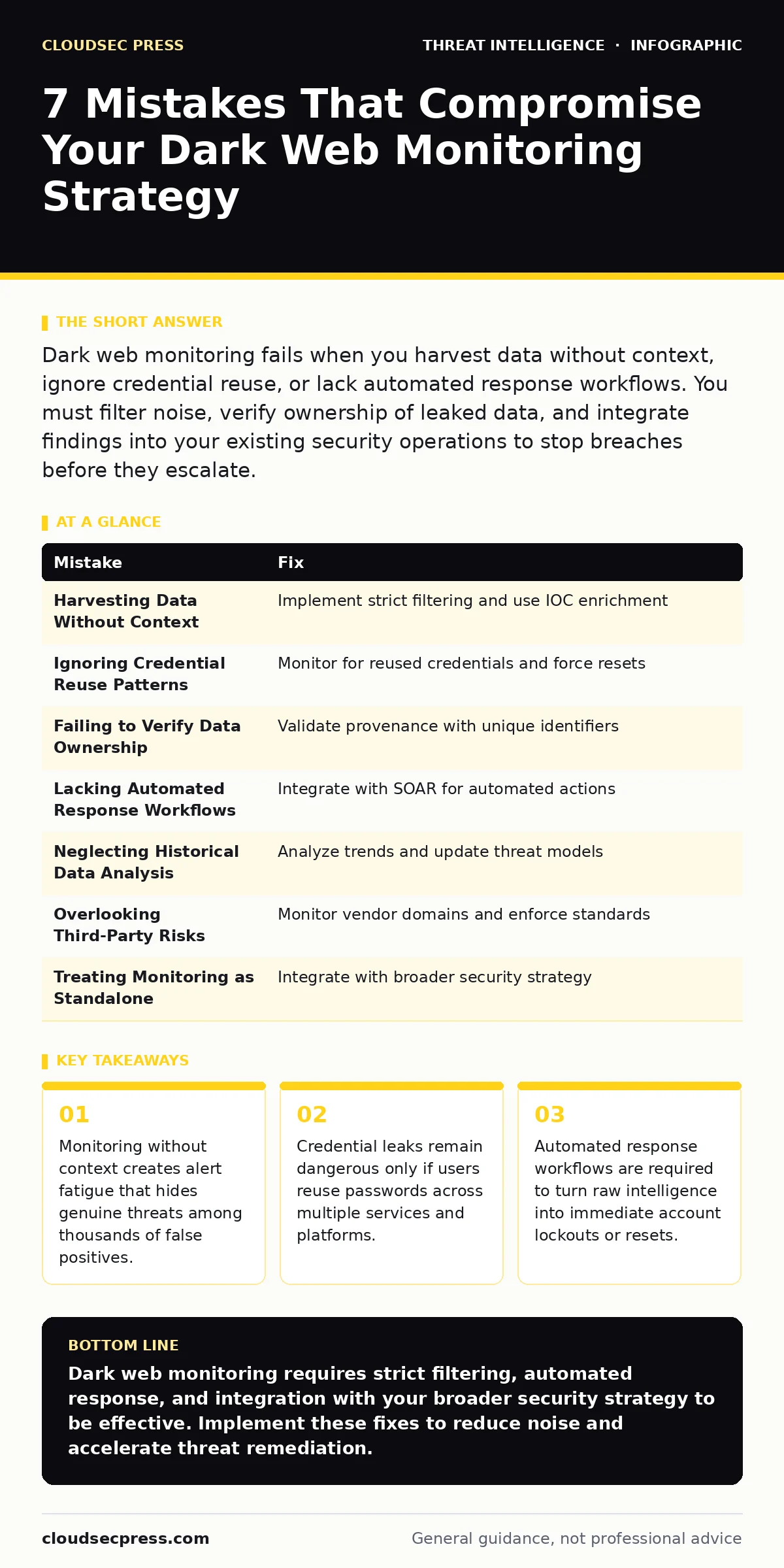
Dark web monitoring fails when you harvest data without context, ignore credential reuse, or lack automated response workflows. You must filter noise, verify ownership of leaked data, and integrate findings into your existing security operations to stop breaches before they escalate.
Mistake 1: Harvesting Data Without Context
Dark web monitoring services scrape forums, marketplaces, and paste sites for indicators of compromise. Collecting every mention of your brand name or domain creates noise that drowns out genuine threats. You receive alerts for unrelated discussions, old data dumps, or false claims that require manual verification. This volume overwhelms your security team and delays response to actual incidents. The lack of context means you cannot distinguish between a rumor and a confirmed breach.
Why it hurts: Your analysts spend hours triaging false positives instead of investigating real attacks. Alert fatigue sets in, causing teams to ignore legitimate warnings. You waste budget on storage and processing for data that never leads to remediation. The signal-to-noise ratio drops so low that critical indicators slip through the cracks unnoticed.
The fix: Implement strict filtering rules based on data freshness and relevance. Focus on specific indicators tied to your infrastructure rather than generic brand mentions. Use IOC enrichment to add context to raw data, such as source reliability and historical prevalence. This reduces noise and ensures your team only investigates high-confidence threats that require immediate attention.
Mistake 2: Ignoring Credential Reuse Patterns
Stolen credentials are often sold in bulk on dark web markets. Many organizations assume that a leak on one site does not affect their internal systems. This assumption fails when employees use the same password for personal accounts and corporate resources. Attackers perform credential stuffing attacks using these leaked pairs against your login portals. Without monitoring for reused credentials, you leave your authentication systems vulnerable to automated entry.
Why it hurts: Attackers gain unauthorized access using valid username and password combinations. They bypass multi-factor authentication if users have previously approved devices or if MFA is not enforced. This leads to account takeover and potential lateral movement within your network. The compromise occurs silently until the attacker extracts data or installs malware.
The fix: Monitor dark web sources specifically for credentials matching your employee email domains. Cross-reference these findings with your identity provider to identify active accounts. Force password resets for any matched credentials immediately. Enforce strict password policies that prevent reuse across personal and professional accounts. This breaks the chain of attack before credential stuffing succeeds.
Mistake 3: Failing to Verify Data Ownership
Not all data found on the dark web belongs to your organization. Attackers sometimes publish stolen data from other companies to create confusion or distract security teams. Monitoring services may flag data containing your domain name if it appears in a larger, unrelated dataset. Acting on unverified data wastes resources and creates unnecessary panic. You may initiate incident response procedures for a breach that never happened.
Why it hurts: Your team diverts attention from real threats to investigate phantom breaches. False alarms erode trust in your monitoring program and lead to decision fatigue. Resources spent on verifying non-existent leaks delay response to actual compromises. The organization suffers from repeated false alarms without improving its security posture.
The fix: Validate the provenance of any leaked data before taking action. Check for unique identifiers, such as internal file names, specific database structures, or proprietary code snippets. Confirm that the data matches your current infrastructure and user base. Only initiate remediation when you have high confidence that the data is genuinely yours.
Mistake 4: Lacking Automated Response Workflows
Identifying a threat on the dark web is useless if you cannot act on it quickly. Manual review and response introduce delays that allow attackers to exploit stolen data. By the time an analyst verifies a leak and initiates a reset, the attacker may have already accessed your systems. Speed is critical in mitigating credential-based attacks. Without automation, your response time exceeds the window of opportunity to prevent damage.
Why it hurts: Attackers capitalize on the delay between detection and response. They may use stolen credentials to access sensitive data, install ransomware, or pivot to other systems. The longer the response time, the greater the potential impact on your organization. Manual processes are slow, error-prone, and cannot scale to handle high-volume alerts.
The fix: Integrate your dark web monitoring service with your security orchestration and automation tools. Use SOAR platforms to create automated playbooks that trigger immediate actions. For example, automatically disable compromised accounts or force password resets when a high-confidence leak is detected. This ensures rapid response without requiring constant human intervention.
Mistake 5: Neglecting Historical Data Analysis
Dark web monitoring should not focus only on recent leaks. Historical data often contains valuable insights into long-term threats and persistent adversaries. Attackers may hoard stolen data and sell it months or years later. Ignoring historical trends prevents you from understanding the full scope of your exposure. You miss opportunities to identify patterns that indicate targeted campaigns against your organization.
Why it hurts: You remain blind to threats that have been dormant for extended periods. Attackers may have been collecting data for a long time before launching an attack. Without historical context, you cannot assess the severity of a new leak or predict future actions. Your defense strategy remains reactive rather than proactive.
The fix: Analyze historical data to identify trends and recurring threats. Look for patterns in the types of data leaked, the sources of the leaks, and the timing of sales. Use this information to update your threat models and improve your defenses. Regularly review historical data to ensure your monitoring rules remain effective against evolving tactics.
See also: Pyramid of Pain: How Indicator Difficulty Shapes Your Defense
Mistake 6: Overlooking Third-Party Risks
Your organization’s security posture is only as strong as its weakest partner. Vendors, suppliers, and contractors often have access to your systems or data. If a third party suffers a breach, your data may be exposed. Monitoring only your own domain leaves you blind to risks introduced by your supply chain. Attackers frequently target smaller vendors to gain access to larger organizations.
Why it hurts: A breach at a vendor can lead to unauthorized access to your internal networks. Attackers may use stolen credentials from a partner to pivot into your environment. This indirect exposure is difficult to detect and mitigate without specific monitoring. Your security efforts are undermined by the actions of external entities.
The fix: Expand your monitoring to include third-party domains and email addresses. Collaborate with vendors to share threat intelligence and best practices. Require partners to adhere to strict security standards and undergo regular assessments. Monitor for leaks involving your partners to identify potential entry points for attackers.
Mistake 7: Treating Monitoring as a Standalone Tool
Dark web monitoring is not a silver bullet. It must be integrated into your broader security strategy. Treating it as an isolated tool limits its effectiveness. You need to combine monitoring with other security measures to create a layered defense. Isolated monitoring provides data but lacks the context and integration needed for effective response.
Why it hurts: You miss connections between dark web activity and internal security events. Without integration, you cannot correlate external threats with internal anomalies. This siloed approach leaves gaps in your defense that attackers can exploit. Your security program becomes fragmented and less effective.
The fix: Integrate dark web monitoring with your existing security tools and processes. Use operational threat intelligence to inform your detection rules and response procedures. Combine monitoring data with endpoint detection and network traffic analysis. This holistic approach ensures that you can detect, respond to, and recover from threats effectively.
| Mistake | Fix |
|---|---|
| Harvesting Data Without Context | Implement strict filtering and use IOC enrichment |
| Ignoring Credential Reuse Patterns | Monitor for reused credentials and force resets |
| Failing to Verify Data Ownership | Validate provenance with unique identifiers |
| Lacking Automated Response Workflows | Integrate with SOAR for automated actions |
| Neglecting Historical Data Analysis | Analyze trends and update threat models |
| Overlooking Third-Party Risks | Monitor vendor domains and enforce standards |
| Treating Monitoring as Standalone | Integrate with broader security strategy |
Key takeaways
- Monitoring without context creates alert fatigue that hides genuine threats among thousands of false positives.
- Credential leaks remain dangerous only if users reuse passwords across multiple services and platforms.
- Automated response workflows are required to turn raw intelligence into immediate account lockouts or resets.
Dark web monitoring requires strict filtering, automated response, and integration with your broader security strategy to be effective. Implement these fixes to reduce noise and accelerate threat remediation.
Frequently asked questions
How do I know if my data is on the dark web?
Use a reputable dark web monitoring service that scans forums and marketplaces for your specific indicators. Verify any findings through manual analysis before taking action.
Can dark web monitoring prevent a breach?
It can help prevent breaches by identifying stolen credentials before they are used. It does not prevent all types of attacks, such as zero-day exploits or insider threats.
What is the difference between dark web and deep web?
The deep web includes all non-indexed content, such as private databases. The dark web is a small part of the deep web that requires specific software to access and is often used for illicit activities.
How often should I check for dark web leaks?
Continuous monitoring is recommended to detect leaks as soon as they appear. Periodic checks may miss time-sensitive threats that require immediate response.
How this guide was produced: written by the CloudSec Press editorial team with AI assistance, checked against the public references listed below, and reviewed when the facts change. See our editorial policy or report an error.