IDS vs IPS: The Operational Difference Between Watching and Blocking
An intrusion detection system alerts you to threats while an intrusion prevention system actively blocks them, creating distinct trade-offs in network latency and false positives.

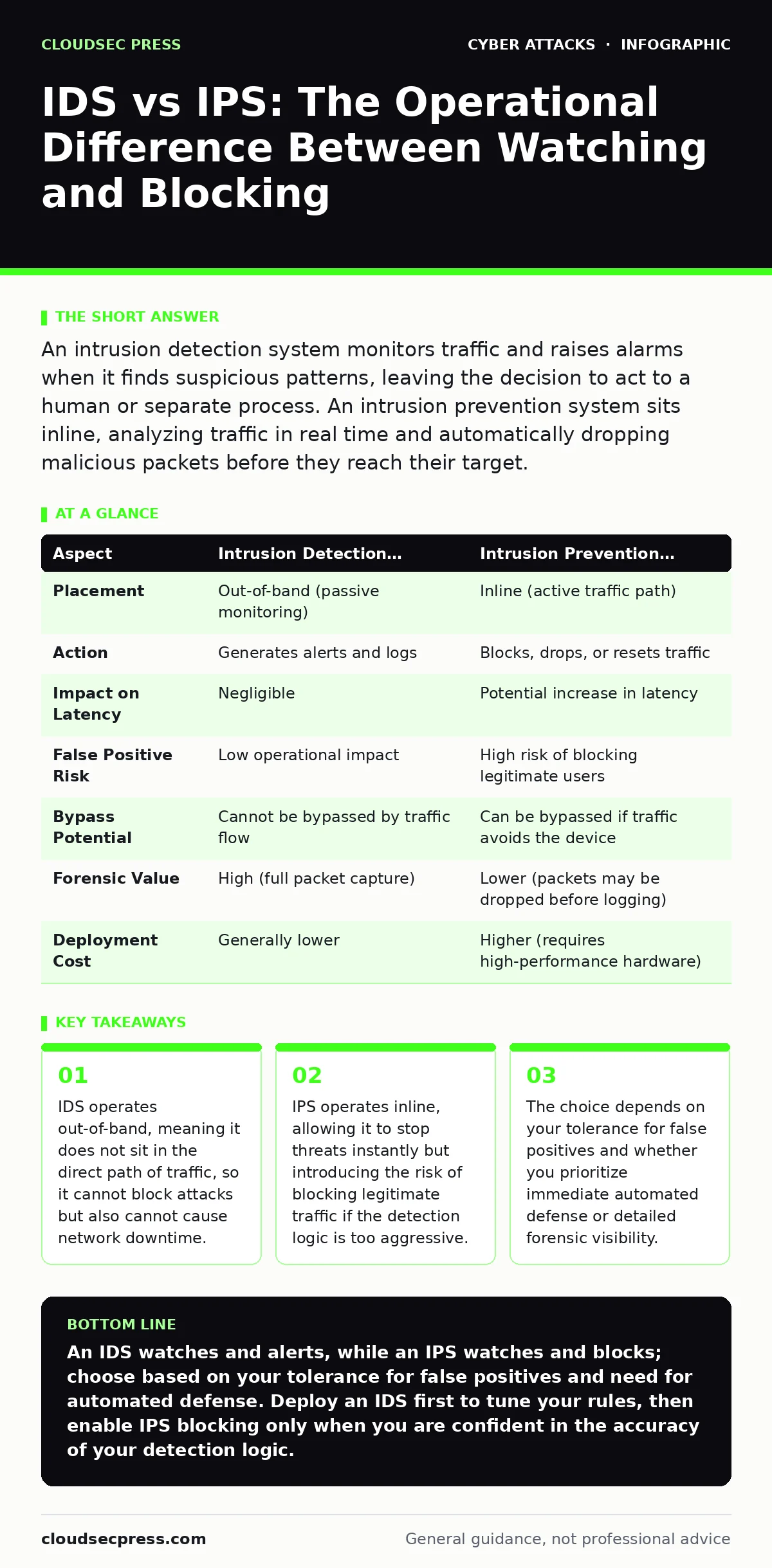
An intrusion detection system monitors traffic and raises alarms when it finds suspicious patterns, leaving the decision to act to a human or separate process. An intrusion prevention system sits inline, analyzing traffic in real time and automatically dropping malicious packets before they reach their target.
The Core Distinction
The fundamental difference lies in the position of the device within your network architecture. An intrusion detection system (IDS) sits passively, observing copies of network traffic without interfering with the flow. It acts as a sensor, generating alerts when it recognizes patterns associated with known attacks or anomalous behavior. An intrusion prevention system (IPS) sits actively in the path of the traffic. It inspects every packet passing through and has the authority to drop, reject, or reset connections that match malicious signatures.
This structural difference dictates their operational impact. Because the IDS is passive, it cannot stop an attack in progress. It provides visibility, allowing security teams to investigate and respond after the fact. The IPS, however, intervenes immediately. This capability offers stronger protection but introduces complexity, as the device must make decisions faster than the traffic flows, often with less context than a human analyst could provide.
How Detection Mechanisms Work
Both systems rely on similar engines to identify threats, but they apply them differently. Signature-based detection compares traffic against a database of known attack patterns. This method is accurate for known threats but fails against new, zero-day exploits. Behavior-based detection looks for deviations from normal network activity, such as a sudden spike in data transfer or unusual login times. This catches unknown threats but generates more noise.
The IDS uses these mechanisms to flag events for review. It can afford to be slower and more thorough in its analysis because it is not delaying live traffic. The IPS must balance accuracy with speed. If it takes too long to analyze a packet, it creates latency. If it analyzes too quickly, it may miss complex, multi-stage attacks. This tension defines the configuration of any inline security device.
Point-by-Point Comparison
| Aspect | Intrusion Detection System (IDS) | Intrusion Prevention System (IPS) |
|---|---|---|
| Placement | Out-of-band (passive monitoring) | Inline (active traffic path) |
| Action | Generates alerts and logs | Blocks, drops, or resets traffic |
| Impact on Latency | Negligible | Potential increase in latency |
| False Positive Risk | Low operational impact | High risk of blocking legitimate users |
| Bypass Potential | Cannot be bypassed by traffic flow | Can be bypassed if traffic avoids the device |
| Forensic Value | High (full packet capture) | Lower (packets may be dropped before logging) |
| Deployment Cost | Generally lower | Higher (requires high-performance hardware) |
Choosing the Right Tool
Selecting between these systems depends on your specific security posture and operational constraints. You must weigh the need for immediate automated defense against the risk of disrupting business operations.
Choose the IDS when:
- You need deep visibility into network traffic without risking service interruption.
- Your security team has the capacity to investigate alerts manually in near real-time.
- You are monitoring a segment of the network where latency is critical, such as high-frequency trading or real-time gaming servers.
- You want to audit traffic for compliance purposes without altering the data stream.
Choose the IPS when:
- You require automated blocking of known threats to reduce the burden on your security team.
- You are protecting perimeter networks where the cost of a breach outweighs the risk of false positives.
- You have a well-tuned security policy that minimizes the chance of blocking legitimate traffic.
- You need to enforce strict access controls that go beyond simple firewall rules.
Where They Overlap
Modern security appliances often combine both functions into a single hardware unit, known as an Intrusion Prevention System with detection capabilities, or a Next-Generation Firewall. These devices can switch between monitoring mode and blocking mode. This flexibility allows you to start in detection mode to tune the rules and observe false positives before enabling blocking.
The overlap extends to the underlying technology. Both use the same signature databases and behavioral analysis engines. The difference is not in what they see, but in what they do with that information. Understanding this overlap is key to configuring your security stack effectively. You can use the detection capabilities to refine the prevention rules, ensuring that when you do block traffic, you are confident in the decision.
Consider how this relates to other security measures. For example, rate limiting can mitigate the impact of certain attacks that an IPS might struggle to block efficiently due to the sheer volume of traffic. Similarly, session hijacking attacks often bypass signature-based detection because they use valid credentials and established connections. In these cases, the visibility provided by an IDS is more valuable than the blocking capability of an IPS.
See also: Cyber Espionage Prevention Checklist: Stop Silent Data Theft · Botnet Attack Mistakes That Leave Your Network Exposed
The Hidden Costs of Automation
The primary hidden cost of an IPS is the management of false positives. A false positive occurs when the system incorrectly identifies legitimate traffic as malicious. In an IDS, this results in an unnecessary alert. In an IPS, it results in blocked access for a legitimate user or service. This can lead to "alert fatigue" where teams disable rules, reducing security, or to operational outages that damage user trust.
Tuning an IPS requires continuous effort. You must regularly update signatures, adjust sensitivity thresholds, and whitelist legitimate applications that trigger false alarms. This maintenance burden is often underestimated. Without proper tuning, an IPS can become a liability, blocking critical business transactions while missing sophisticated attacks that mimic normal behavior.
Another cost is the reduction in forensic data. Because an IPS drops malicious packets, you may not capture the full payload of an attack. This makes post-incident analysis more difficult. An IDS, by contrast, captures the entire packet, providing a complete picture of the attack for later review. This trade-off between immediate protection and investigative depth is central to your decision.
Integrating with Security Culture
Technology alone does not secure your network. The effectiveness of both IDS and IPS depends on the security culture within your organization. If staff ignore alerts or bypass security controls for convenience, even the best devices will fail. You must train your team to understand the purpose of these tools and how to respond to their outputs.
For instance, if an IPS blocks a critical application, the team needs a clear process to investigate and resolve the issue without disabling the protection. This requires collaboration between security and IT operations. By fostering a culture of shared responsibility, you ensure that your security tools enhance rather than hinder your business operations.
Key takeaways
- IDS operates out-of-band, meaning it does not sit in the direct path of traffic, so it cannot block attacks but also cannot cause network downtime.
- IPS operates inline, allowing it to stop threats instantly but introducing the risk of blocking legitimate traffic if the detection logic is too aggressive.
- The choice depends on your tolerance for false positives and whether you prioritize immediate automated defense or detailed forensic visibility.
An IDS watches and alerts, while an IPS watches and blocks; choose based on your tolerance for false positives and need for automated defense. Deploy an IDS first to tune your rules, then enable IPS blocking only when you are confident in the accuracy of your detection logic.
Frequently asked questions
Can an IDS block an attack if configured correctly?
No, an IDS is designed to monitor traffic passively. It can only generate alerts. To block traffic, you must use an IPS or a firewall configured based on the IDS alerts.
Is an IPS better than a firewall?
An IPS provides deeper inspection of traffic content, identifying specific attack patterns. A firewall controls traffic based on rules like IP addresses and ports. They serve different purposes and are often used together.
How do I reduce false positives from an IPS?
Start by running the IPS in detection mode to identify legitimate traffic that triggers alerts. Whitelist these patterns and refine your signatures before switching to blocking mode.
Do I need both IDS and IPS?
It depends on your resources and risk tolerance. Many organizations use a combined appliance that offers both capabilities, allowing them to monitor internal networks while blocking external threats.
How this guide was produced: written by the CloudSec Press editorial team with AI assistance, checked against the public references listed below, and reviewed when the facts change. See our editorial policy or report an error.